Showing posts with label Kikuyu. Show all posts

Monday, July 13, 2015

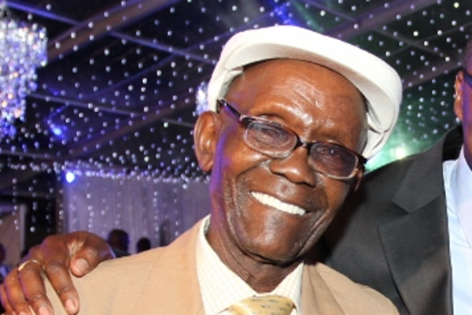
OJWANG: The Passing of Kenya's King of Comedy

  1. He may not have been the father of the Kenyan comedy nation. There were luminaries before him that we remember, in particular: Mzee Pembe and Kipanga. But these were mostly of the radio era. In the Seventies and Eighties, Ojwang became the quintessential king of comedy for most TV-era Kenyans. Comedy, more specifically the Vitimbi series, made him famous -- but far from materially comfortable, let alone prosperous. 

  2. Fame may have been good enough for him, but not for those who know how talent should properly be rewarded, and who now join everyone else who's mourning him.

  3. For the man's died. A Kikuyu (aka Wanjau) with a Luo pseudonym, who -- once you were hooked on his stage character -- it spooked you to even imagine was a Kikuyu. He was so genuinely a Luo in his looks and accent and vocabulary and turn of phrase and mannerism..

  4. He died last night of (we understand) pneumonia, a poor man, all of 78 (or 85 or whatever) years of age. Kenyans of all walks suddenly found themselves 'orphaned'; and in silent, private hand-wringing for someone who had made them (us) laugh all these gone years -- years we now had to pause to fondly remember.

  5. So we rushed to social media to express and share our many-sided sorrows and remembrances. On Twitter, the hashtag #MourningMzeeOjwang became the kraal at which kindred #KOT (Kenyans on Twitter) 'gathered' -- some, I dare say, with intimations or temptations of 'Tero Buru'. It quickly became the country's top trending tag, though not for long.

And so it was that at 10:30 this morning (GMT+3), Twitter's Top 5 'Kenya Trends' featured as: 
1. #MourningMzeeOjwang
2. Morgan Schneiderlin
3. Raheem Sterlin
4.
5. El Chapo.
Here's the tweet that I myself posted this morning:
": various part 2 (Oldies)full movies [Y sez: RIP]"
Click here for another offering of Vitimbi >> Ojwang's opus:
Let me also share with you below a few of the many tweets that appeared today:
  1. RT R.I.P mzee,most of us rem how he made our childhood with his jokes


  1. Will always remember the classic intro of himself as 'Johnstone Sibour Mang'ang'a Hatari Ojwang! ….Brrrrrrrrrrr'


***                                      ***                                    ***                       ***                          ***
In a sort of quick summation of what I consider a key pillar of Ojwang's comedic legacy, I later tweeted as follows:

"#KOT: Advertisers/Marketers who feel safe using #Luo words in their commercials & billboards have #Ojwang 2 thank 4 it. #MourningMzeeOjwang." And as I pointed out in a tweet even before he died, he is the reason (because he had the platform) that many, many Kenyans now say, without batting an eye (and without knowing when or how it all started): "Nilimpea" (I gave him, or her), instead of the old conventional: "Nilimpa" or "Nilimpatia."   .


[PS: I have reworked some parts of the original post, after a simmer].

Tuesday, July 21, 2009

Kenya: The Tug of Cremation and Tradition

"Dust to dust, ash to ash"!

No burial tug-of-war ever gripped the attention and imagination of both men and women in Kenya than that of S.M. Otieno -- a prominent Luo lawyer long married to Wamboi, a Kikuyu -- some twenty three years ago (in December 1986). In some ways, it in fact drew worldwide attention, particularly among feminist and gender advocacy groups.

With the recent passing of Mr. Joshua Okuthe -- a well-known sports personality in Kenya, a former national athlete and a member of the same Umira-Kager clan of Ugenya and Alego that, after a long court battle successfully fought, buried S.M. Otieno according to its wishes and against those of his wife -- the far-less emotive, intra-ethnic controversy was now not about where to bury the dead one, but whether to cremate or bury his remains.

Okuthe's first wife insisted on cremation, arguing that that was his own wish. His second wife, and his clan, sought to bury him in Muhoroni, in the lake region. The first wife pulled a fast one on the rest and had him cremated in Nairobi under the clan's very nose and before a court injunction could have effect. This left the clan with no option but to ritually bury the idea of his body in an empty coffin. It proceeded to do just that, in a low-key and partially televised ceremony at Okuthe's modern-rural home in Muhoroni.

I suspect that an appropriate portion of Yago, the funerary tree of Luo tradition, took the place of the absent, nowhere-to-be-found, body in that bewildering coffin. This is a practice which Luo mourners have typically resorted to when the body is lost and is nowhere to be found despite a decent period of search and waiting and when all sorts of other protocols have been duly observed. So there are really never empty coffins there, and no hollow burials.

Philip Ochieng, the renowned columnist, whose writing I much admire, suggests (I think he thinks that he argues rather than suggests) that cremation was very much a Luo tradition, which they lost (and have forgotten all about) when their paths and those of the Baganda -- who (and whose 'country') bear the names that they gave them, and who have kings because they gave them a kingship though they themselves had nonesuch -- crossed and for a while merged, some centuries ago. For him, the evidence of a cremating past is in the persisting and highly charged practice of "Tero Buru" (Dispatching of the Ashes), which brings to an end, several days after the actual lowering of the departed's body into a defined grave, the series of burial rituals for the community's dead prominents. To Ochieng, "Buru" refers to real (but now only imagined) ashes of the departed. You get "Buru" only whey you burn and burn to the core, and in this case when you cremate. Read more.

I think that Ochieng's conjecture stands on very thin ground, though I have never really tried to unravel the symbolism of "Tero Buru" -- or the genesis of Oburu. In fact, I have never paid it much attention, beyond its momentary theatricality -- which is perhaps monumental on occasion, and which is infrequently shown on local television.

There is just so much historical narrative and folklore -- compounded by a long-running, deeply ingrained and 'living' system of norms and values -- that leaves one with the suspicion and even conviction that the actual burial of ringre (Flesh of the Departed, who is Elsewhere) was the common mode of practice long ago in Sudan*, and long before contact with the Baganda was made -- a practice which only continued, unabated, after that greatly consequential symbiosis was overshadowed by the further, single-minded, movement into present-day Kenya. This view seems to be reinforced by, as I am able to tell, the persisting burial practices of other Luo groups -- who remained and remain in the Sudan, Ethiopia and the DRC, and who did not experience that passionate politico-cultural embrace between the Jok'Owiny and the Baganda.


______________________________________________
*Sudan: That land of countless pyramids, more numerous than in all of Egypt. Pyramids, which symbolize not the practice of cremation but the very idea of creation, and of the everlastingness of the body (and hence of the life hereafter).

Monday, March 23, 2009

The Kisumu Molasses Company

Today's dailies report that Raila Odinga, Kenya's PM, has pledged that members of the public who contributed shares to the molasses plant (close to twenty years ago!), will be allocated shares "once we are listed in the stock exchange." My guess is that listing will not take place any time soon; certainly not before the 2012 General Elections (I don't think Uhuru Kenyatta, who as Finance Minister has a say, will countenance that), and probably not before 2017 (or even 2020, or even 2030). So, if there was any cheering at the Tom Mboya Labour College where the announcement was made, who's kidding whom?

The bigger question, though, is this: What makes Raila Odinga think he's the one to decide when -- or, as has clearly been the case to-date, if -- co-shareholders of the molasses plant are to be allowed into the company, to share in the olemo with the Odinga family?

On page 20 of the busiess section of Daily Nation of March 23, 2009, Raila himself reveals that: "Locals contributed Sh 1.7 billion and a developer (Spectre International) brought $15 million (Sh 1.2 billion). This enabled the moribund plant to get on its feet." Does that not give "locals" a controlling 58.62% of the company? Instead of the Odinga family, shouldn't they, and those who set up the company prior to its becoming moribund, be calling the shots?

A pertinent point here is this: The Luo have no royal family, and never had! Just imagine what Kikuyus would have thought of James Mwangi if he had adopted the same selfish attitude with respect to the founding shareholders of what is now the giant Equity Bank -- in which I myself have a very few shares!

Yes, we can blame past governments for Nyanza's backwardness; but the condenscending attitude displayed by Raila over the weekend is very much part of the reason Nyanza continues to stagnate and whine in despondency. In effect, the buck stops with him. Increasingly, the electorate is restless in the face of this perpetuity -- which is worse in many ways than the impunity everyone is talking about these days. This is impunity squared; and the joke is in the absence of detail and credibility.

The only silver lining I see in the pronouncement is that the intense pressure on the Odinga family by grass-roots Luo is finally having some effect. But promises will not do; nor will passing the buck to the usual "bogeymen".

And then there is the historic injustice personified by the Luo Thrift Union. When will that be addressed? This was no Mbi-I-Kamiti, nor Nyakinyua, nor those many group land-buying companies that Central Province is so well known for.

If you ask me, the share allocation at Kisumu Molasses Company should have been effected at least a decade ago. In fact, subscribers should as a matter of course already know how many shares they have, and should already be co-beneficiaries of any dividend distribution so far authorized and made. They should not be treated like other retail investors who might wish to scramble for "peanut" share allocations during a promissory IPO which may not come in the lifetime of many in the rapidly aging and permanently deprived "cheering crowd" of Nyanza.

The time to allocate the shares is now, long before the 2012 election frenzy; and this does not require NSE listing. This should be the kind of gonywa Nyanza electors should be shouting about. The time to get serious is now. The people want to concentrate on development. It is the politicians who will not put politics aside. The people are not perpetually running for president, it is Raila who is -- clearly not satisfied with being Prime Minister. Perhaps we should bite the bullet and keep the "Premiership" out of the constitution. Out, out, kabisa. It does not seem to be doing anyone any "real good" (power-wise), least of all Raila.

Saturday, February 28, 2009

Prof. E.S. Atieno-Odhiambo, RIP

Some time between 2 p.m. and 3 p.m. on Thursday, February 26th, as I looked out of a window on Gandhi Wing (at the University of Nairobi), I thought I saw Prof. Atieno-Odhiambo stop to talk spiritedly to someone I didn't know. He, Atieno, was headed toward The Fountain of Knowledge, from the direction of Central Administration. My first thought was, "Ah, so Atieno is in town" (in Nairobi visiting us, his former colleagues at UoN, as he occasionally did during his many years at Rice University in Texas). On closer look, however, I saw that it was not the Prof. but someone else entirely. Someone I didn't know either. The person who had momentarily looked like Atieno "became" (morphed into) another before my eyes. Well, it so so happens. And so I dismissed the scene as one of those things, and didn't give it another thought -- concluding that Atieno must surely still be at Rice.

So I was quite taken aback last night at around 9.20 p.m. when my sister-in-law told me, and my wife confirmed, that -- according to the day's Standard newspaper (which I hadn't fully "gone through" yet, as the day had been filled with errands and an early graduate lecture) -- Prof. Atieno-Odhiambo had died (of 'dementia', as reported by his wife) at a hospital in Kisumu City, Kenya, on Wednesday, February 25. That was, incidentally, the same day that George Rarieya (Uncle George) died. I was quite, quite taken aback! I hadn't known that Atieno was back in the country. My thoughts suddenly ran back to that Thursday scene, and I just shook my head in disbelief as I recounted it (my wife, Joan, and her sister giving me a telling look).

When we got back home I checked The Standard and confirmed that it was really true.

Atieno was a leading scholar -- in Kenya, Africa and the world. He ventured boldly beyond the presumed boundaries of his discipline (history), and so extended them. He was much respected, and much liked, by many who knew and remember him (and who are still here) at the University of Nairobi. One of his most memorable works is the one he co-authored with David William Cohen, titled, Burying SM: The Politics of Knowledge and the Sociology of Power in Africa.

S.M. Otieno had been a dignified and very professional city lawyer with a deep sense of what it meant to be a cosmopolitan Kenyan, and what it meant to be charitable. He was a true embodiment of the Kenya (and Kenyans) we want. He had married across ethnic lines, but the cultural-and-legal controversy surrounding his place of burial, following his death in December 1986, sparked off the worst inter-ethnic animosity (since TJ Mboya's assassination in Nairobi 1969) between members of the Kikuyu and Luo communities -- to which his wife and he respectively belonged.

Perhaps even more insightful and intellectually riveting is the book, again co-authored with William David Cohen, titled Risks of Knowledge: Investigations Into the Death of the Hon. Minister John Robert Ouko in 1990. I read an extensive excerpt a few years ago, and was greatly impressed.

Surely, Atieno-Odhiambo has died too soon!

He was one of those few you always looked forward to seeing again, with feeling, upon their return, however brief, to the country. It was not supposed to be like this!

P.S. 1. For an obituary by David Cohen, posted on March 4, click here; 2. Click here for Cabral Pinto's opinion, posted on March 6th.

Friday, September 12, 2008

Language: Wiki Language

The Kikuyu of Kenya are a Bantu-speaking ethnic group. They speak Agikuyu. The Luo, on the other hand, are Nilotic (that is, of the Nile valley). They speak Dholuo (a word which, thanks to the insistence of certain scholars, has become part of the English lexicon now). These two are very dissimilar groups in important ways -- culturally, economically and (in particular?) politically.

Geographically, too, they have traditionally occupied quite different topographies of the land. The Kikuyu have concentrated in the central highlands, generally "around" Mt. Kenya, which is one of the two highest mountains in Africa. The Luo are predominant in the lowlands to the west -- in the basin of Lake Victoria (the largest in Africa); though, unlike the Kikuyu, have kin traditionally scattered "all over" eastern and central Africa. Central is Central and West is West -- but did the twain ever meet before, say, 1890?

There are a few puzzling similarities which make this question pertinent, certainly. For example:

1. In Agikuyu, as I have known for years, though the similarity struck me only a few months ago: When you want to say, "Let's go" you say, "Nitothii" (or simply, "Todhie", which is what I remember from all those years of living in Makongeni and going to school at "Sentii"). In Dholuo, you say, "Wadhi."

2. In Agikuyu, when you want to ask, "Where are you going?" you say, "Wathii ku?" (or "Wathie ku?"). In Dholuo, you say, "Idhi kanye?" (or even "Idhi kure?).

Sasa? Is this symptomatic of one origin deep in the African past (of course it is!), or merely chance similarity. You tell me.

But, if yes, how long ago? Under what circumstances? Where? In the Sudan? Cameroon? The Congo? Uganda? Ethiopia (Karumba's Ethiopia?)? Just here in Kenya?

They do have different physiques, generally, perhaps because of terrain and diet; and because of all the places they have separately been, kalausi-like, all these millennia. Yet there is an occasional hilarious comment in certain circles that the Nyeri Kikuyu are really not Kikuyu, but Luo (whom they are, many of them, as dark as) who now speak Agikuyu.

Of course all Africans, all humans, have one past -- here in Africa.

All humans! Is that why, as Philip Ochieng claims, "Hera" -- that four-letter word -- means the same thing in Greek and Luo? Is that not why we all have spoken language?