I. Introduction:
A recurring, if often contentious, theme in the literature on diffusion of innovations, and more specifically on how best to time (or synchronize) the spread of innovation-linked skills and 'habits', is that three key factors (or variables) -- Knowledge, Attitude and Practice (KAP) -- are implicated in such an exercise, as part of broader HR management and training processes. Johnson (1976: 2.2), for example, points out that one of the purposes of training is to develop "new skills, knowledge, understanding, and attitudes" (see also Clelland, 1973:42-47; Gersovitz et al, 1998: 875-883; Sudsawad, 2007; Webb, Falko, Sniehotta and Michie, 2010; USAID, 2011; WHO, 2012; Chien-Yun et al, 2012; and Strauss, Tetroe, and Graham, Eds, 2013; Legare and Zhang, 2013). The theme recurs, indeed, but in a more assertoric than theory-driven or empirical evidence-adducing fashion in the texts typically published for certain courses in academia. Still, the 'KAP approach' has a powerful intuitive and intriguing appeal.
Armstrong (1999: 488; 2012: 274-308) is an enduring influencer in the KAP conversation; but he singles out practical experience and, more recently, workplace-specific challenges as anchors for the drive toward high-quality learning. He adds, moreover, that "Individuals must be motivated to learn...[and] should be aware that their present level of knowledge, skill or competence, or their existing attitude or behaviour, needs to be improved..." (Armstrong, 1999: 494-495). So practical experience, motivation and the environment in which work actually takes place are key factors in Armstrong's visualization of the KAP process.
Pattanayak and Verma (1997: 94) have briefly weighed in here, too, and define training as a process "designed to improve and bring about measurable change in knowledge, skills, attitude and social behavior..." So 'measurable change' is a useful metric for them. Cole (2002: 380-397; see also 1995: 138-137), on his part, notes that learning implies observable change, which "usually manifests itself through behavior". Measurable and observable change mean the same important thing, of course. As already indicated above, there are even more recent contributors to this discourse. All in all, KAP is a clearly converging meme in the behavior-change management conversation.
II. The KAP Approach:
The 'KAP approach' is a kind of holy grail, and not just for training facilitators. Educators and learners of all strands as well are energized, in one way or another, by the value they see in it. That is to say, the value that it represents for clarifying the causality of practice and spotlighting the reinforcement processes likewise associated with practice. It is worth noting here that, as Cole (1997: 254) has keenly observed, a fundamental characteristic of learning "is that is acquired." It is acquired through training of one or another kind.
Training has a long history, as Miller (1996: 3-18) has suggested. And, Dessler (2000: 253) asserts, "Training is essentially a learning process..." We can say in general that we educate and train people in order to make them more predictably productive in their behavior; and more proactive in whatever ways they apply such 'learning'. Such predictability and proactivity of the 'parts' create in society itself, or 'the whole', the capacity to function more organically, as well as more purposefully. However, the realities of learning, and of how society organizes itself -- or how individuals and groups within it do -- in order to optimally leverage the learning, are more complicated and less straightforward than first appears. Still, leveraging is innovating.
READ: CSO 589 Advanced Training Techniques...
The 'KAP aproach' is a useful formula for interrogating the phenomenological interplay between knowledge, as mediated by attitude -- itself in turn invariably or potentially mediated or 'disrupted' by key contingent factors -- and behavior/practice/action change. It has an interesting scholastic pedigree, to say the least.
Since the +4th century, one understands, the Chinese have debated, reversed and reversed the converse of the saying: "Action is easy but knowledge is difficult", which was Sun Yat Sen's version in the early 20th century. A +17th century Chinese thinker, Wang Chhuan-Shan, used to say: "Knowledge is the beginning of practice, and practice is the completion of knowledge" (see Needham, 1959: 165-6).
KAP KPA
APK AKP
PKA PAK
READ: The Explorer's APK.
READ: The Apprentice's PKA
II.1. Knowledge
According to Talcott Parsons (1970: 304), knowledge (the essential content of the sociology of knowledge) refers to: "cognitively ordered orientations to objects, with reference both to empirical facts and to problems of meaning." According to him, then, the sociology of knowledge has two primary foci, namely:
1. Empirical facts, and -- particularly with reference to "the social system" as the 'empirical' object -- the attendant problem of ideology
Knowledge, as I understand it, refers to: the ability to DO, tell, describe, explain, show, and/or say. Thus, to know is to be able to do, tell, describe, explain, show or say. The extant literature acknowledges that knowledge has three components: Subject (one who knows), Object (that which one knows), and Cognition (the act of knowing). Conversely, Habermas (1972) suggests that there are three categories or types of knowledge:
There are yet other ways of classifying or labelling knowledge, which we will not dwell upon here, such as: Apodictic ('Scientific', 'Certified'), Assertoric (Empirical 'facts'), and Problematic (Critical, Speculative, Predictive-Deductive).
II.2. Attitude and Attitude Theory:
Winston Churchill is said to have remarked, with deep insight, that: "Attitude is a little thing that makes a big difference"
Attitude, incorporating values, refers to “An individual’s characteristic way of responding to an object or situation. It is based on experience [or knowledge] and leads to certain behavior or the expression of certain opinions.” (Graham and Bennett, 1998: 294). That is to say, the concept of attitude stands for:
The basic question in attitude-behavior theory is the extent to which a person's attitude toward a certain behavior (such as drug- taking, drinking illicit-brew or wearing a three-piece suit) can be used to predict how that person will actually behave when confronted with the opportunity, for example, to drink such brew.
The debate is not yet settled as to whether (knowledge of) one's attitude toward 'something' is a reliable predictor of one's behavior vis-a-vis that 'thing,' and vice-versa. There is, in other words, no consensus in the literature concerning the linkage between attitude and behavior. Thus:
II.1. Knowledge
According to Talcott Parsons (1970: 304), knowledge (the essential content of the sociology of knowledge) refers to: "cognitively ordered orientations to objects, with reference both to empirical facts and to problems of meaning." According to him, then, the sociology of knowledge has two primary foci, namely:
1. Empirical facts, and -- particularly with reference to "the social system" as the 'empirical' object -- the attendant problem of ideology
2. Problems of Meaning, and the Weberian preoccupation with religious ideas (Parsons, 1970: 304)
Knowledge, as I understand it, refers to: the ability to DO, tell, describe, explain, show, and/or say. Thus, to know is to be able to do, tell, describe, explain, show or say. The extant literature acknowledges that knowledge has three components: Subject (one who knows), Object (that which one knows), and Cognition (the act of knowing). Conversely, Habermas (1972) suggests that there are three categories or types of knowledge:
1. Scientific, Empirical-Analytic Knowledge
2. Hermeneutic-Historical Knowledge
3. Critical Knowledge
There are yet other ways of classifying or labelling knowledge, which we will not dwell upon here, such as: Apodictic ('Scientific', 'Certified'), Assertoric (Empirical 'facts'), and Problematic (Critical, Speculative, Predictive-Deductive).
Winston Churchill is said to have remarked, with deep insight, that: "Attitude is a little thing that makes a big difference"
Attitude, incorporating values, refers to “An individual’s characteristic way of responding to an object or situation. It is based on experience [or knowledge] and leads to certain behavior or the expression of certain opinions.” (Graham and Bennett, 1998: 294). That is to say, the concept of attitude stands for:
"... a relatively enduring system of affective, evaluative reactions based upon and reflecting the evaluative concepts or beliefs which have been learned about the characteristics of a social object or class of social objects. As an affective reaction, it is a covert or implicit response... [In other words] it is a drive-producing response which elicits motives and thus gives rise to overt behavior" (Shaw and Wright, 1967).
The basic question in attitude-behavior theory is the extent to which a person's attitude toward a certain behavior (such as drug- taking, drinking illicit-brew or wearing a three-piece suit) can be used to predict how that person will actually behave when confronted with the opportunity, for example, to drink such brew.
The debate is not yet settled as to whether (knowledge of) one's attitude toward 'something' is a reliable predictor of one's behavior vis-a-vis that 'thing,' and vice-versa. There is, in other words, no consensus in the literature concerning the linkage between attitude and behavior. Thus:
1. Some writers argue that
a person's attitude toward a given behavior is a consistent predictor of the person's actual
behaviour. Conversely, if a person behaves in a certain way, then it can be inferred that the person has
attitudes which predispose him/her to behave
that way.
But what
about behavior that one is forced by other persons (significant others), or economic circumstances, for example, to adopt?
2. Other writers argue that
"overt behaviour" varies independently with attitudes. In other words, one's attitude toward a
particular behaviour or practise have no bearing on one's actual behaviour,
and vice versa. That is, you may disapprove of three-piece suits, but still wear them for other, such as ceremonial or broadly pragmatic, reasons.
3. Yet
other writers argue that attitudes affect behavior, but that
the impact of attitude on behavior is mediated by contingent or
situational factors (Acock and DeFleur, 1972: 714-726).
the impact of attitude on behavior is mediated by contingent or
situational factors (Acock and DeFleur, 1972: 714-726).
Andrews
and Kandel (1979: 298-310) generally equate
situational factors with "perceived group norms" held by "significant others and
expressed either verbally or in actions." In my view,
situational factors can be represented not only by perceived group norms but also by factors such as:
1. Socio-Economic Status: based inter alia on income, wealth, occupation, age, gender, race, education and religion
2. Level of experienced psychological or physiological stress.
3. Availability of facilitating or enabling means: such as having the money to buy what is needed, assuming the availability of the needed item. Armstrong (1999: 488) might want us to add here the example of, already mentioned above, of "workplace-specific challenges".
4. Level of attachment to the attitudes of relevant out-groups toward the behavior in question.
Theorists who emphasize the importance of contingent factors in the uncertain interplay between attitude and behavior are persuasively on firmer ground. This suggests that, for policy makers, there is not quite yet a precise formula for generating a critical mass of well-informed and proficient practitioners.
II. 3. Practice as Behavior and Behavior as Action
Practice refers to applied skills, techniques, methods or standard operating procedures (SOP). It can indeed be argued that practice or behavior is applied attitude. These are actual patternsof physical behavior, activity or action. In this case, action, activity or behavior deriving more or less directly from a given knowledge-base and mediated by attitudes that are also rooted in that knowledge. Skill refers to know-how -- that is, knowing, or capacity for, "how to".
That is to say, a skill is:
“An organized and coordinated pattern of mental and/or physical activity in relation to an object or other display of information, usually involving both receptor and effector processes [a receptor process provides the sensory input, while an effector process performs the output or response function]. It is built up gradually in the course of repeated training or other experience. It is serial, each part from second to second is dependent on the last and influences the next. Skills may be described as perceptual, motor, manual, intellectual, social, etc. according to the context or the most important aspect of the skill pattern.” Definition from the UK’s Department of Employment’s Glossary of Training Terms, as quoted in Graham and Bennett (1998: 296).
A skill is, additionally, “A practiced, expert way of perceiving a relevant stimulus and then responding to it” (Graham and Bennett, 998: 296)
“An organized and coordinated pattern of mental and/or physical activity in relation to an object or other display of information, usually involving both receptor and effector processes [a receptor process provides the sensory input, while an effector process performs the output or response function]. It is built up gradually in the course of repeated training or other experience. It is serial, each part from second to second is dependent on the last and influences the next. Skills may be described as perceptual, motor, manual, intellectual, social, etc. according to the context or the most important aspect of the skill pattern.” Definition from the UK’s Department of Employment’s Glossary of Training Terms, as quoted in Graham and Bennett (1998: 296).
A skill is, additionally, “A practiced, expert way of perceiving a relevant stimulus and then responding to it” (Graham and Bennett, 998: 296)
II. 4. The Practical Challenges of Changing Action/Behavior Patterns via Knowledge and Attitude Change
It is worth emphasizing that the acquisition of a 'body' of professional knowledge incorporates or 'engenders', or has built into it, a set of certain professional values, attitudes, worldviews and/or orientations which can or do impact practice. So practice means not only applied skills, techniques and or methods -- in a word SOP (Standard Operating Procedures) -- but also, very importantly, applied attitudes. The linkage between attitude and behavior becomes a matter of practical concern, such as when we use the mass media, for example, to fast-track the spread of IT skills, or spearhead a disease prevention or political-party mobilization
campaign.
In principle, all educational programmes explicitly or implicitly acknowledge that attitude and behavior are interlinked. Such a
programmes have as their starting-point the view that desired behavior-change must
be preceded by appropriate attitude change, rooted in new knowledge. Thus, such programmes devote a good deal of resources and effort to the introduction of
new or relevant knowledge, information or ideas. To make headway in all this, certain questions, which press for answers, must be addressed. These include:
1. How much attitude conditioning (for example through media campaigns -- including advertising and propaganda) is necessary and sufficient to bring about the desired behaviour-change?
2. To what extent should attention focus on attitudes as opposed to, say, physical and legal restriction, or facilitation of
availability or access?
3. Under what circumstances
can we mass-target, and for how long?
III. KAP and Training Typologies
But a detailed interrogation of the training function suggests a rather different kind of classification. In other words, we can identify not three but four main types of training for which prospective trainees may apply, or to which they may be admitted. These four main types, it turns out, are various permutations and combinations of K, A and/or P.
Naturally, such application and admission presuppose and reflect the identification of a training need or gap, operationalized into training specifications -- that is, into the broad content of the training required. For each training type listed, then, we show examples, not an exhaustive list, of related training techniques. Many of these techniques naturally feature in more than one type of training, given their plasticity -- that is, their broad applicability:
III. KAP and Training Typologies
The 'KAP approach' suggests that all “training” falls under the following broad categories:
1. Training, or re-training, in Knowledge
2. Training or re-training in Attitude
3. (a) Training or re-training in Skills/Practices/Behaviors, including, (b) Management Training.
1. Training, or re-training, in Knowledge
2. Training or re-training in Attitude
3. (a) Training or re-training in Skills/Practices/Behaviors, including, (b) Management Training.
But a detailed interrogation of the training function suggests a rather different kind of classification. In other words, we can identify not three but four main types of training for which prospective trainees may apply, or to which they may be admitted. These four main types, it turns out, are various permutations and combinations of K, A and/or P.
Naturally, such application and admission presuppose and reflect the identification of a training need or gap, operationalized into training specifications -- that is, into the broad content of the training required. For each training type listed, then, we show examples, not an exhaustive list, of related training techniques. Many of these techniques naturally feature in more than one type of training, given their plasticity -- that is, their broad applicability:
1. Knowledge Training: Appropriate knowledge training techniques include: coaching, induction, internship, case study, mentoring, formal
lectures, seminars, conferences, conventions, symposia, panel-forums, programmed instruction (or CBT or e-learning generally) and study tours (Graham and Bennett, 1998: 301-304; Armstrong, 2012)
2. Attitude
Training: Examples include: "on-the-job experience within a group of employees Whose attitudes are thought to be appropriate" (Graham and Bennett, 1998: 294), on-the-job
training via attachment to a senior employee whose attitudes are assessed to be exemplary, off-the-job training involving group discussion of case studies which highlight proper attitudes, off-the-job role
playing exercises, induction, mentoring, T-groups as an off-the-job approach to training (T = Training), team learning, sensitivity training and group dynamics training generally (Graham and Bennett, 1998: 294-295; Armstrong, 2012)
3. Skill Training: This is realized through, inter alia: apprenticeship, demonstration, on-the-job training and formal vocational/technical (or tertiary) level training, delegation, job rotation, coaching, assignment, drills and other types of exercise, role playing, and projects (see, for example, Graham and Bennett, 1998: 296-299; Armstrong, 2012)
4. Experiential
Training: Examples here include: attachment, games, case work, simulations, behavioral modelling, outward bound programmes and living-abroad programmes (see, for example, Pattanayak and Verma, 1997: 95)
IV. Conclusion
It can be inferred from all the foregoing that, illuminating as it is, the KAP approach rides roughshod over the attitude-behavior debate (or debacle), stating simply that: KAP = Knowledge (changes/modifies) Attitude (which changes/modifies) Practice. That is to say, knowledge changes (predicts) attitudes, which change (predict) the learner's pattern of practice (or action or behavior).
Conversely, of course, one's practice reveals one's attitude, and one's attitude reveal one's stock of knowledge or experiences. This knowledge-base can thus be systematically exposed (subjected) to pre-selected 'influencers', and so changed -- with beneficial ripple effects on attitude clusters and subsequently sets of practices. Key 'influencers' here are teachers, trainers, change-agents and media of all sorts.
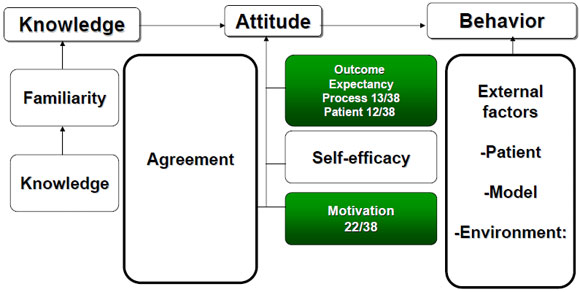
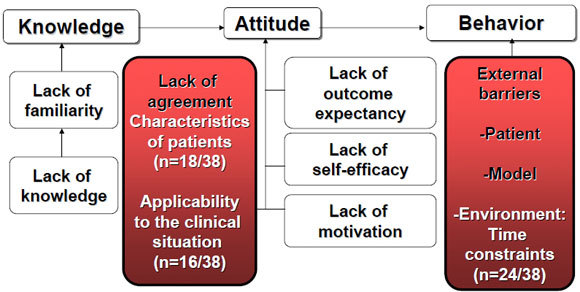
As Legare clearly points out, however, the KAP process is far from straightforward (see also Legare and Zhang, 2013).
[Click Below for Illustrative Images of the KAP Process:
1. France Legare's Graphic Presentation of Facilitators in the KAP Process
2. France Legare's Graphic Presentation of Barriers to the KAP Process. Text Source: France Legare]
Whatever the end-product of training -- preferably delivered by an accredited institution or organization -- some form of certification by an acknowledged authority is of vital importance to the skill 'holder'. Simply put, the certification or credential deflects pressure on the holder to prove, "a zillion times" after training, that he or she actually underwent the training that he/she verbally claims. Certificates or credentials are papers; papers which 'speak' with authority, on behalf of the holder, to such authorities as the holder may want them to speak to.
Not only do credentials validate or authenticate, depending on the credibility or reputation of the issuer, they also universalize the holder's skills. They validate by linking back to the issuers' accounts of the process(es) by which the underlying skill(s) were acquired and by whom, where and when. They universalize in the sense that they are the 'passport' which allows passage into and between labour markets, as well as participation in such markets.
1 See J.M.E.
Moravcsik, Editor (1948) Aristotle: A Collection of Critical Essays. London:
MacMillan
REFERENCES
Acock, Alan and M.L. DeFleur (1972) "A Configurational Approach to Contingent Consistency in the Attitude-Behaviour Relationship." American Sociological Review. Vol. 37, pp. 714-726, 1972.
Akers, Ronald L., Marvin D. Krohn, Lonn Lanza-Kaduce and Marcia Radosevich. 1979. " Social Learning and Deviant Behavior: A Specific Test of a General Theory," pp. 636-655, in American Sociological Review. 1979. Vol. 44.
Andrews, Kenneth and Denise Kandel (1979) "Attitude and Behaviour: A Specification of the Contingent Consistency Hypothesis." American Sociological Review. Vol. 44 (1979), pp. 298-310)
Armstrong, Armstrong, Michael. 1999. A Handbook of Human Resource Management Practice. 7th Edition. London and Philadelphia: Kogan Page.
Armstrong, Armstrong, Michael. 2012. A Handbook of Human Resource Management Practice. 12th Edition. London and Philadelphia: Kogan Page
ASIS. 1994. Emergency Planning Handbook. ASIS (American Society for Industrial Security)
Chien-Yun, Dai et al (2012) “A Study on Modification of Knowledge, Attitude and Practices on Vocational High School Electronics Courses Integrated with
Nanotechnology Concept”
http://www.iasks.org/sites/default/files/ijtee20120401073079.pdf
Clelland, John (1973) “A Critique of KAP Studies and Some Suggestions for Their Improvement,” in Studies in FamilyPlanning. Vol 4, No. 2 (Feb, 1973): 42-47.
Cole, G.A (1995) Organizational Behaviour: Theory and Practice. London: Thomson Learning
Cole,G.A. (1997) PersonnelManagement: Theory and Practice. London: Letts Educational.
Cole, G.A. 2002. Personnel and Human Resource Management. Fifth Edition. London: ELST with Continuum
Dessler, Gary (2000) Human Resource Management. Delhi: Pearson Education Asia
Gersovitz, Mark et al (1998) “The Balance of Self-Reported Heterosexual Activity in KAP Surveys and the Aids Epidemic in Africa” Journal of the American Statistical Association. Vol 93, Issue 443, pp. 875-883
Graham and Bennett Graham, H.T. and Roger Bennet. 1998. Human Resources Management. 9th Edition. London: Financial Times Pitman Publishing. [See pp. 301-304 for knowledge training, pp. 294-295 for attitude training, and pp. 296-299 for skill training]
Habermas, Jurgen (1972 ) Knowledge and Human Interest. Boston: Beacon Press
Johnson (1976) "Organization and Management Training", pp. 2.1-2.17, in Robert L. Craig, Ed. (1976) Training and Development Handbook: A Guide to Human Resource Development. New York: McGraw-Hill
Legare, France and Peng Zhang (2013) "Barriers and Facilitators -- Strategies for Identification and Measurement", section 3.4.a. in Sharon Straus, Jacqueline Tetroe and Ian Graham, Eds. Knowledge Translation in Health Care: Moving From Evidence to Practice. Hoboken, NJ: Wiley Blackwell. [Click here for online access to the slides version of the book]
Miller, Vincent A. 1996. “The History of Training”, pp. 3-18, in Robert L. Craig, Ed-in-Chief. 1996. The ASTD Training and Development Handbook. Fourth Edition. New York: McGraw-Hill. http://www.amazon.com/The-ASTD-Training-Development-Handbook/dp/007013359X
Moravcsik, J.M.E., Editor (1948) Aristotle: A Collection of Critical Essays. London: MacMillan
Needham, Joseph (1959) Science and Civilisation in China. Vol III. Mathematics and the Sciences of the Heavens and the Earth. Cambridge: Cambridge University Press
Parsons, Talcott (1970) "An Approach to the Sociology of Knowledge", pp. 282-306, in James E. Curtis and John W. Petras, Eds. The Sociology of Knowledge: A Reader. New York: Praeger Publishers.
Pattanayak, Biswajeet and Harish C. Verma. 1997. A Textbook on Human Resource Management. New Delhi: Wheeler Publishing.
Shaw, Marvin E. and Jack M. Wright (1967) Scales for the Measurement of attitudes. New York: McGraw-Hill
Straus, Sharon, Jacqueline Tetroe and Ian Graham, Eds. (2013) Knowledge Translation in Health Care: Moving from Evidence to Practice. Hoboken, NJ: Wiley Blackwell [Click here for online access to the slides version of the book]
Sudsawad, P. (2007). "Knowledge Translation: Introduction to Models, Strategies, and Measures." Austin, TX: Southwest Educational Development Laboratory, National Center for the Dissemination of Disability Research.
USAID (2011) “The KAP Survey Model (Knowledge, Attitudes, and Practices)”. Arlington, VA: USAID [Click on View Tool to download a detailed text]
Webb, Thomas L, Falko F. Sniehotta and Susan Michie (2010) “Using Theories of Behaviour Change to Inform Interventions for Addictive Behaviours” http://onlinelibrary.wiley.com
WHO (2012) Health Education, Theoretical Concepts, Effective Strategies and Core Competencies. Cairo: WHO


1 comment:
i would really like to know if there different methods of "carrying out" KAPS model
Post a Comment