Showing posts with label Theory. Show all posts

Tuesday, August 07, 2018

CSO 501 ~ Contemporary Sociological Theory, Course Outline and Reading List, July-September 2018 Semester


INTRODUCTION

This course is designed to deepen graduate (M.A.) students' understanding of basic sociological theories, and of new undercurrents. The course also seeks to increase their awareness of the relevance of theory to their specific fields of interest.  It emphasizes contemporary themes and macro-level dimensions of social reality. Given that students will have been exposed to a greater or lesser degree to the major sociological theories during their undergraduate years, the lecture-seminar format adopted for the course stresses close familiarity with a set of readings around carefully selected topics and themes. Experience suggests that undergraduate courses with a theory content have tended to dwell on the broad outlines of particular theories. In general, students have not been required to demonstrate detailed knowledge of specific texts, or the writings of particular authors. This is a shortcoming which this course will help to overcome.


COURSE DESCRIPTION

Survey of major theorists and schools of thought in recent decades. Course includes functionalism, exchange theory, conflict theory, symbolic interaction, and phenomenology. Analysis of a sample of recent thinkers with a major impact on sociological thinking, from this list: Blumer, Bourdieu, Braverman, Collins, Foucault, Garfinkel, Geertz, Giddens, Goffman, Habermas, Marcuse, Marx, Mead, Merton, Parsons, Ritzer, Simmel and Wallerstein. The major concepts and theories to be sampled include: conflict; exchange theory; systems theory; modernity and post-modernity; G and State Coordinates; double-reflexivity; ethnomethodology; action/practice, agency-structure linkages and structuration; network theory; dependency and underdevelopment; the ecumene, world system and globalization; rational choice theory; dialectics, negations and revolution; and ethnic and cultural identity. 


Tuesday, May 22, 2018

On the Difference Between Method and Methodology


"What is the difference between methods and methodology in research?" This question was very recently asked in LinkedIn's "Research, Methodology, and Statistics in the Social Sciences" Group, which currently has 137,052 members. A number of answers were given, including one from me. I've chosen to share mine below, preferring to start with Methodology: 

Methodology is the study or theory or interrogation of a range of Methods of scientific/scholarly research in terms of their relative/respective appropriateness to solving specified types or sets of research problems. Methods, on the other hand, are the actual techniques (not 'tools', which are a different kettle of fish) of data collection and analysis, respectively, that we use in particular studies. 


In principle, the Method(s) we use in a given study is/are determined to be fit for the (stated) purpose -- the problem statement -- in terms of the Methodology or Methodologies they are couched in and, moreover, broadly accepted by the Gatekeepers (our peers and revered precursors) in our respective disciplines. 

It is common knowledge that, nowadays, Methodologies and Methods cut across various disciplines and sub-disciplines.

Friday, October 21, 2016

CSO 589: Advanced Training Techniques ~ Course Outline and Reading List, September-December 2016 Semester


COURSE OBJECTIVE

To engage current and prospective trainers and training managers in a joint quest for innovative solutions to the training needs and competency aspirations of different levels of an evolving workforce.

COURSE DESCRIPTION/CONTENT


Key concepts. The nature and patterns of learning in human society. The historical evolution of the learning process. Linkages between Knowledge, Attitudes and Practice (KAP), respectively. Applying the KAP model and its derivatives to learning and training situations. Training typologies and training specifications. Selected theories and models of learning, training and skill-acquisition, Un-packaging, repackaging and fine-tuning identified training techniques. Devising innovative solutions for today’s problems. Linking identified training solutions to real-life challenges, and to selected substantive areas (clusters) covered in the Department’s M.A curriculum.

Sunday, June 12, 2016

ARCHIVE: Toward a Theory of the Memetic Sphere

ABSTRACT:

Three basic objectives are pursued in this paper. One, to outline a theory of the memetic sphere. Some have called it the ideosphere, but none has dwelt upon the similitudes by means of which it reflects the celestial sphere, which in turn serves as its 'model'. 

Two, to show that an expanding memetic sphere is in actuality the centrifugal afterglow of a now permanent information explosion, which in turn feeds on it. A theory of the memetic sphere is thus a theory of information explosion. 

Three, to demonstrate that the way for individuals and groups to stay afloat  in an information cauldron, which human society has become, is to establish a computer-based network connectivity to transform 'Planet Earth' (otherwise a 'Wide Area') into a symbolic LAN (Local Area Network). This symbolism is, indeed, already ingrained in a popular catch-phrase in cyberspace, which says: "Think globally, act locally". A theory of information explosion consequently evolves into a theory of network connectivity... 

CLICK HERE TO READ THE WHOLE ABSTRACT AND PAPER


PS: A subsequent, shorter, version of this paper was published in Hekima: Journal of the Humanities and Social Sciences, Volume 2 Number 2 of February 2005.


Thursday, June 02, 2016

Skill Acquisition in the Informal Sector: Target Group Identification and Project Feasibility Survey

1. INTRODUCTION

Background:

In the last few years, there has been growing realization in Kenya that if technical training is a prerequisite for self-employment, then the available formal sector training opportunities are too limited vis-a-vis the number of people who require technical training, and rather unfocused in terms of what is required for effective involvement in the informal sector (Yambo, 1991: 3). This has prompted the view that the time has come  to initiate a concerted effort to enable the informal sector to develop the capability to satisfy its own training needs. This view was reinforced by the rediscovery of the fact that informal sector apprenticeship has indeed been in existence -- albeit a low-key existence -- around the country for a considerable length of time already (King, 1977; Williams, 1980; Chepkonga, 1989).

A policy paper issued in 1990 by the Kenyan government acknowledged, probably for the first time, that the country's informal sector represented not only "a large untapped potential" for apprentice training, but also the prospect for "Superior training to apprentices" (Ministry of Planning and National Development, 1990: 41). This point of view was echoed in a recent evaluation of the Taita-Taveta Youth Polytechnic Programme (DANIDA, 1990: 98). However, the obvious evolution of thinking about the place of informal sector apprenticeship in human resource development has had a less than telling effect on the orientation of projects geared to informal sector training, most of which continue to presuppose a large dose of direct formal or "non-formal" sector intervention (Herschbach, 1989: 9-13; King, 1989: 27-35; Goodale, 1989: 58-66; McLaughlin, 1990: 160-174). In other words, practice is yet to catch up with "theory".

CLICK HERE TO READ THE WHOLE PAPER

Monday, April 04, 2016

The Theoretical and the Empirical: Two Salient Dimensions of the Comparative Argument

The comparative argument cannot be fully closed with empirical evidence alone, but with implicit or explicit reference to theory as well. This is the only way to make sense of whatever it is that the comparative eye draws attention to. It is theory which in one way or another affirms and settles the basis for comparison, in the first place. 

Certainly, the empirical dimension provides the evidence that one can observe, as one must. However, the data it generates cannot have shape or form without help from the explanatory and agenda-setting power of theory. 

Thus, the theoretical dimension contextualizes the process by which the verdict is delivered, as well as the verdict itself. It follows from all this that the two -- the theoretical and the empirical -- are inseparable sides of the same comparative coin.

Tuesday, March 01, 2016

KAP as a Model of Behavior Change and Innovative Practice {CSO 589}


I. Introduction:
A recurring, if often contentious, theme in the literature on diffusion of innovations, and more specifically on how best to time (or synchronize) the spread of innovation-linked skills and 'habits', is that three key factors (or variables) -- Knowledge, Attitude and Practice (KAP) -- are implicated in such an exercise, as part of broader HR management and training processes. Johnson (1976: 2.2), for example, points out that one of the purposes of training is to develop "new skills, knowledge, understanding, and attitudes" (see also Clelland, 1973:42-47; Gersovitz et al, 1998: 875-883; Sudsawad, 2007; Webb, Falko, Sniehotta and Michie, 2010; USAID, 2011; WHO, 2012; Chien-Yun et al, 2012; and Strauss, Tetroe, and Graham, Eds, 2013; Legare and Zhang, 2013). The theme recurs, indeed, but in a more assertoric than theory-driven or empirical evidence-adducing fashion in the texts typically published for certain courses in academia. Still, the 'KAP approach' has a powerful intuitive and intriguing appeal.

Armstrong (1999: 488; 2012: 274-308) is an enduring influencer in the KAP conversation; but he singles out practical experience and, more recently, workplace-specific challenges as anchors for the drive toward high-quality learning. He adds, moreover, that "Individuals must be motivated to learn...[and] should be aware that their present level of knowledge, skill or competence, or their existing attitude or behaviour, needs to be improved..." (Armstrong, 1999: 494-495). So practical experience, motivation and the environment in which work actually takes place are key factors in Armstrong's visualization of the KAP process.

Pattanayak and Verma (1997: 94) have briefly weighed in here, too, and define training as a process "designed to improve and bring about measurable change in knowledge, skills, attitude and social behavior..." So 'measurable change' is a useful metric for them. Cole (2002: 380-397; see also 1995: 138-137), on his part, notes that learning implies observable change, which "usually manifests itself through behavior". Measurable and observable change mean the same important thing, of course. As already indicated above, there are even more recent contributors to this discourse. All in all, KAP is a clearly converging meme in the behavior-change management conversation.

II. The KAP Approach:
The 'KAP approach' is a kind of holy grail, and not just for training facilitators. Educators and learners of all strands as well are energized, in one way or another, by the value they see in it. That is to say, the value that it represents for clarifying the causality of practice and spotlighting the reinforcement processes likewise associated with practice. It is worth noting here that, as Cole (1997: 254) has keenly observed, a fundamental characteristic of learning "is that is acquired." It is acquired through training of one or another kind.

Training has a long history, as Miller (1996: 3-18) has suggested. And, Dessler (2000: 253) asserts, "Training is essentially a learning process..." We can say in general that we educate and train people in order to make them more predictably productive in their behavior; and more proactive in whatever ways they apply such 'learning'. Such predictability and proactivity of the 'parts' create in society itself, or 'the whole', the capacity to function more organically, as well as more purposefully. However, the realities of learning, and of how society organizes itself -- or how individuals and groups within it do -- in order to optimally leverage the learning, are more complicated and less straightforward than first appears. Still, leveraging is innovating. 

READ: CSO 589 Advanced Training Techniques...  


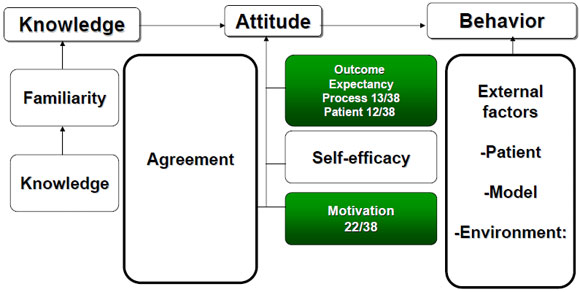
The 'KAP aproach' is a useful formula for interrogating the phenomenological interplay between knowledge, as mediated by attitude -- itself in turn invariably or potentially mediated or 'disrupted' by key contingent factors -- and behavior/practice/action change. It has an interesting scholastic pedigree, to say the least.

Since the +4th century, one understands, the Chinese have debated, reversed and reversed the converse of the saying: "Action is easy but knowledge is difficult", which was Sun Yat Sen's version in the early 20th century. A +17th century Chinese thinker, Wang Chhuan-Shan, used to say: "Knowledge is the beginning of practice, and practice is the completion of knowledge" (see Needham, 1959: 165-6).

The 'KAP approach' is indeed not immune to this ebb and flow of a puzzle. However, its focus of attention is not directly on the easier path to the knowledge-action space. Rather, the focus is on the (taken-for-granted) flow of effects that one should typically see, empirically if not so readily theoretically, from imparted knowledge, as the starting point, to attitude (a concept which subsumes/presumes values) and on to behavior or practice. Clearly, however, K is not always the starting point of the great variety of human ventures that we can bring to mind. The explorer's mind-set, for example, does rearrange the KAP sequence into another: APK. Other permutations can easily be imagined as well. Here's the totality of the nuances:
KAP   KPA
APK   AKP
PKA   PAK

READ: The Explorer's APK.
READ: The Apprentice's PKA

II.1. Knowledge
According to Talcott Parsons (1970: 304), knowledge (the essential content of the sociology of knowledge) refers to: "cognitively ordered orientations to objects, with reference both to empirical facts and to problems of meaning." According to him, then, the sociology of knowledge has two primary foci, namely:

1. Empirical facts, and -- particularly with reference to "the social system" as the 'empirical' object -- the attendant problem of ideology
2. Problems of Meaning, and the Weberian preoccupation with religious ideas (Parsons, 1970: 304)

Knowledge, as I understand it, refers to: the ability to DO, tell, describe, explain, show, and/or say. Thus, to know is to be able to do, tell, describe, explain, show or say. The extant literature acknowledges that knowledge has three components: Subject (one who knows), Object (that which one knows), and Cognition (the act of knowing). Conversely, Habermas (1972) suggests that there are three categories or types of knowledge:
1.         Scientific, Empirical-Analytic Knowledge
2.         Hermeneutic-Historical Knowledge
3.         Critical Knowledge

There are yet other ways of classifying or labelling knowledge, which we will not dwell upon here, such as: Apodictic ('Scientific', 'Certified'), Assertoric (Empirical 'facts'), and Problematic (Critical, Speculative, Predictive-Deductive).


II.2. Attitude and Attitude Theory:

Winston Churchill is said to have remarked, with deep insight, that: "Attitude is a little thing that makes a big difference"

Attitude, incorporating values, refers to “An individual’s characteristic way of responding to an object or situation. It is based on experience [or knowledge] and leads to certain behavior or the expression of certain opinions.” (Graham and Bennett, 1998: 294). That is to say, the concept of attitude stands for:
"... a relatively enduring system of affective, evaluative reactions based upon and reflecting the evaluative concepts or beliefs which have been learned about the characteristics of a social object or class of social objects. As an affective reaction, it is a covert or implicit response... [In other words] it is a drive-producing response which elicits motives and thus gives rise to overt behavior" (Shaw and Wright, 1967).

The basic question in attitude-behavior theory is the extent to which a person's attitude toward a certain behavior (such as drug- taking, drinking illicit-brew or wearing a three-piece suit) can be used to predict how that person will actually behave when confronted with the opportunity, for example, to drink such brew.

The debate is not yet settled as to whether (knowledge of) one's attitude toward 'something' is a reliable predictor of one's behavior vis-a-vis that 'thing,' and vice-versa. There is, in other words, no consensus in the literature concerning the linkage between attitude and behavior. Thus:

1. Some writers argue that a person's attitude toward a given behavior is a consistent predictor of the person's actual behaviour. Conversely, if a person behaves in a certain way, then it can be inferred that the person has attitudes which predispose him/her to     behave that way. 

But what about behavior that one is forced by other persons (significant others), or economic circumstances, for example, to adopt? 

2. Other writers argue that "overt behaviour" varies independently with attitudes. In other words, one's attitude toward a particular behaviour or practise have no bearing on one's actual behaviour, and vice versa. That is, you may disapprove of three-piece suits, but still wear them for other, such as ceremonial or broadly pragmatic, reasons.

3. Yet other writers argue that attitudes affect behavior, but that 
the impact of attitude on behavior is mediated by contingent or 
situational factors (Acock and DeFleur, 1972: 714-726).

Andrews and Kandel (1979: 298-310) generally equate situational factors with "perceived group norms" held by "significant others and expressed either verbally or in actions." In my view, situational factors can be represented not only by perceived group norms but also by factors such as:

1. Socio-Economic Status: based inter alia on income, wealth, occupation, age, gender, race, education and religion

2. Level of experienced psychological or physiological stress.

3. Availability of facilitating or enabling means: such as having the money to buy what is needed, assuming the availability of the needed item. Armstrong (1999: 488) might want us to add here the example of, already mentioned above, of "workplace-specific challenges". 

4. Level of attachment to the attitudes of relevant out-groups toward the behavior in question.

Theorists who emphasize the importance of contingent factors in the uncertain interplay between attitude and behavior are persuasively on firmer ground. This suggests that, for policy makers, there is not quite yet a precise formula for generating a critical mass of well-informed and proficient practitioners.


II. 3. Practice as Behavior and Behavior as Action
Practice refers to applied skills, techniques, methods or standard operating procedures (SOP). It can indeed be argued that practice or behavior is applied attitude. These are actual patternsof physical behavior, activity or action. In this case, action, activity or behavior deriving more or less directly from a given knowledge-base and mediated by attitudes that are also rooted in that knowledge. Skill refers to know-how -- that is, knowing, or capacity for, "how to".

That is to say, a skill is:

“An organized and coordinated pattern of mental and/or physical activity in relation to an object or other display of information, usually involving both receptor and effector processes [a receptor process provides the sensory input, while an effector process performs the output or response function]. It is built up gradually in the course of repeated training or other experience. It is serial, each part from second to second is dependent on the last and influences the next. Skills may be described as perceptual, motor, manual, intellectual, social, etc. according to the context or the most important aspect of the skill pattern.” Definition from the UK’s Department of Employment’s Glossary of Training Terms, as quoted in Graham and Bennett (1998: 296). 

A skill is, additionally, “A practiced, expert way of perceiving a relevant stimulus and then responding to it” (Graham and Bennett, 998: 296)

II. 4. The Practical Challenges of Changing Action/Behavior Patterns via Knowledge and Attitude Change
It is worth emphasizing that the acquisition of a 'body' of professional knowledge incorporates or 'engenders', or has built into it, a set of certain professional values, attitudes, worldviews and/or orientations which can or do impact practice. So practice means not only applied skills, techniques and or methods -- in a word SOP (Standard Operating Procedures) -- but also, very importantly, applied attitudes. The linkage between attitude and behavior becomes a matter of practical concern, such as when we use the mass media, for example, to fast-track the spread of IT skills, or spearhead a disease prevention or political-party mobilization campaign.

In principle, all educational programmes explicitly or implicitly acknowledge that attitude and behavior are interlinked. Such a programmes have as their starting-point the view that desired behavior-change must be preceded by appropriate attitude change, rooted in new knowledge. Thus, such programmes devote a good deal of resources and effort to the introduction of new or relevant knowledge, information or ideas. To make headway in all this, certain questions, which press for answers, must be addressed. These include:

1. How much attitude conditioning (for example through media campaigns -- including advertising and propaganda) is necessary and sufficient to bring about the desired behaviour-change? 
2. To what extent should attention focus on attitudes as opposed to, say, physical and legal restriction, or facilitation of availability or access?

3. Under what circumstances can we mass-target, and for how long? 

III. KAP and Training Typologies

The 'KAP approach' suggests that all “training” falls under the following broad categories: 
1. Training, or re-training, in Knowledge 
2. Training or re-training in Attitude 
3. (a) Training or re-training in Skills/Practices/Behaviors, including, (b) Management Training.

But a detailed interrogation of the training function suggests a rather different kind of classification. In other words, we can identify not three but four main types of training for which prospective trainees may apply, or to which they may be admitted. These four main types, it turns out, are various permutations and combinations of K, A and/or P. 

Naturally, such application and admission presuppose and reflect the identification of a training need or gap, operationalized into training specifications -- that is, into the broad content of the training required. For each training type listed, then, we show examples, not an exhaustive list, of related training techniques. Many of these techniques naturally feature in more than one type of training, given their plasticity -- that is, their broad applicability: 

1.     Knowledge Training: Appropriate knowledge training techniques include: coaching, induction, internship, case study, mentoring, formal lectures, seminars, conferences, conventions, symposia, panel-forums, programmed instruction (or CBT or e-learning generally) and study tours (Graham and Bennett, 1998: 301-304; Armstrong, 2012)

2.     Attitude Training:  Examples include: "on-the-job experience within a group of employees Whose attitudes are thought to be appropriate" (Graham and Bennett, 1998: 294), on-the-job training via attachment to a senior employee whose attitudes are assessed to be exemplary, off-the-job training involving group discussion of case studies which highlight proper attitudes, off-the-job role playing exercises, induction, mentoring, T-groups as an off-the-job approach to training (T = Training), team learning, sensitivity training and group dynamics training generally (Graham and Bennett, 1998: 294-295; Armstrong, 2012)

3.     Skill Training: This is realized through, inter alia: apprenticeship, demonstration, on-the-job training and formal vocational/technical (or tertiary) level training, delegation, job rotation, coaching, assignment, drills and other types of exercise, role playing, and projects (see, for example, Graham and Bennett, 1998: 296-299; Armstrong, 2012)

4.     Experiential Training: Examples here include: attachment, games, case work, simulations, behavioral modelling, outward bound programmes and living-abroad programmes (see, for example, Pattanayak and Verma, 1997: 95)


IV. Conclusion
It can be inferred from all the foregoing that, illuminating as it is, the KAP approach rides roughshod over the attitude-behavior debate (or debacle), stating simply that: KAP = Knowledge (changes/modifies) Attitude (which changes/modifies) Practice. That is to say, knowledge changes (predicts) attitudes, which change (predict) the learner's pattern of practice (or action or behavior). 

Conversely, of course, one's practice reveals one's attitude, and one's attitude reveal one's stock of knowledge or experiences. This knowledge-base can thus be systematically exposed (subjected) to pre-selected 'influencers', and so changed -- with beneficial ripple effects on attitude clusters and subsequently sets of practices. Key 'influencers' here are teachers, trainers, change-agents and media of all sorts. 

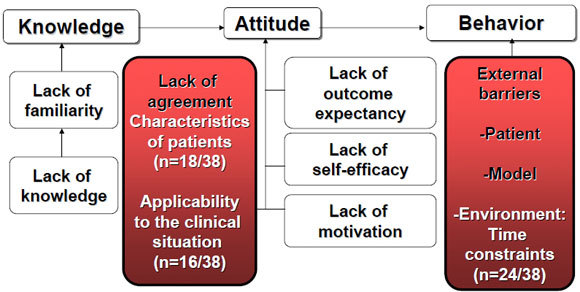
As Legare clearly points out,  however, the KAP process is far from straightforward (see also Legare and Zhang, 2013). 

[Click Below for Illustrative Images of the KAP Process: 
1. France Legare's Graphic Presentation of Facilitators in the KAP Process   
2. France Legare's Graphic Presentation of Barriers to the KAP Process. Text Source: France Legare]

Whatever the end-product of training -- preferably delivered by an accredited institution or organization -- some form of certification by an acknowledged authority is of vital importance to the skill 'holder'. Simply put, the certification or credential deflects pressure on the holder to prove, "a zillion times" after training, that he or she actually underwent the training that he/she verbally claims. Certificates or credentials are papers; papers which 'speak' with authority, on behalf of the holder, to such authorities as the holder may want them to speak to. 

Not only do credentials validate or authenticate, depending on the credibility or reputation of the issuer, they also universalize the holder's skills. They validate by linking back to the issuers' accounts of the process(es) by which the underlying skill(s) were acquired and by whom, where and when. They universalize in the sense that they are the 'passport' which allows passage into and between labour markets, as well as participation in such markets.  


1 See J.M.E. Moravcsik, Editor (1948) Aristotle: A Collection of Critical Essays. London: MacMillan


REFERENCES

Acock, Alan and M.L. DeFleur (1972) "A Configurational Approach to Contingent Consistency in the Attitude-Behaviour  Relationship." American Sociological Review. Vol. 37, pp. 714-726, 1972.

Akers, Ronald L., Marvin D. Krohn, Lonn Lanza-Kaduce and Marcia Radosevich. 1979. " Social Learning and Deviant Behavior: A Specific Test of a General Theory," pp. 636-655, in American Sociological Review. 1979. Vol.  44.           

Andrews, Kenneth and Denise Kandel (1979) "Attitude and Behaviour: A Specification of the Contingent Consistency Hypothesis." American Sociological Review. Vol. 44 (1979),  pp. 298-310)

Armstrong, Armstrong, Michael. 1999. A Handbook of Human Resource Management Practice. 7th Edition. London and Philadelphia: Kogan Page. 

Armstrong, Armstrong, Michael. 2012. A Handbook of Human Resource Management Practice. 12th Edition. London and Philadelphia: Kogan Page

ASIS. 1994. Emergency Planning Handbook. ASIS (American Society for Industrial Security)

Chien-Yun, Dai et al (2012) “A Study on Modification of Knowledge, Attitude and Practices on Vocational High School Electronics Courses Integrated with 
Nanotechnology Concept”
http://www.iasks.org/sites/default/files/ijtee20120401073079.pdf

Clelland, John (1973) “A Critique of KAP Studies and Some Suggestions for Their Improvement,” in Studies in FamilyPlanning. Vol 4, No. 2 (Feb, 1973): 42-47.

Cole, G.A (1995) Organizational Behaviour: Theory and Practice. London: Thomson Learning

Cole,G.A. (1997) PersonnelManagement: Theory and Practice. London: Letts Educational.

Cole, G.A. 2002. Personnel and Human Resource Management. Fifth Edition. London: ELST with Continuum

Dessler, Gary (2000) Human Resource Management. Delhi: Pearson Education Asia

Gersovitz, Mark et al (1998) “The Balance of Self-Reported Heterosexual Activity in KAP Surveys and the Aids Epidemic in Africa” Journal of the American Statistical Association. Vol 93, Issue 443, pp. 875-883   

Graham and Bennett Graham, H.T. and Roger Bennet. 1998. Human Resources Management. 9th Edition. London: Financial Times Pitman Publishing. [See pp. 301-304 for knowledge training, pp. 294-295 for attitude training, and pp. 296-299 for skill training]

Habermas, Jurgen (1972 ) Knowledge and Human Interest. Boston: Beacon Press 

Johnson (1976) "Organization and Management Training", pp. 2.1-2.17, in Robert L. Craig, Ed.  (1976) Training and Development Handbook: A Guide to Human Resource Development. New York: McGraw-Hill

Legare, France and Peng Zhang (2013) "Barriers and Facilitators -- Strategies for Identification and Measurement", section 3.4.a. in Sharon Straus, Jacqueline Tetroe and Ian Graham, Eds. Knowledge Translation in Health Care: Moving From Evidence to Practice. Hoboken, NJ: Wiley Blackwell. [Click here for online access to the slides version of the book]

Miller, Vincent A. 1996. “The History of Training”, pp. 3-18, in Robert L. Craig, Ed-in-Chief. 1996. The ASTD Training and Development Handbook. Fourth Edition. New York: McGraw-Hill.  http://www.amazon.com/The-ASTD-Training-Development-Handbook/dp/007013359X 

Moravcsik, J.M.E., Editor (1948) Aristotle: A Collection of Critical Essays. London: MacMillan

Needham, Joseph (1959) Science and Civilisation in China. Vol III. Mathematics and the Sciences of the Heavens and the Earth. Cambridge: Cambridge University Press

Parsons, Talcott (1970) "An Approach to the Sociology of Knowledge", pp. 282-306, in James E. Curtis and John W. Petras, Eds. The Sociology of Knowledge: A Reader. New York: Praeger Publishers.

Pattanayak, Biswajeet and Harish C. Verma. 1997. A Textbook on Human Resource Management. New Delhi: Wheeler Publishing. 

Shaw, Marvin E. and Jack M. Wright (1967) Scales for the
Measurement of attitudes. New York: McGraw-Hill

Straus, Sharon, Jacqueline Tetroe and Ian Graham, Eds. (2013) Knowledge Translation in Health Care: Moving from Evidence to Practice. Hoboken, NJ: Wiley Blackwell [Click here for online access to the slides version of the book]

Sudsawad, P. (2007). "Knowledge Translation: Introduction to Models, Strategies, and Measures." Austin, TX: Southwest Educational Development Laboratory, National Center for the Dissemination of Disability Research.


           USAID (2011) “The KAP Survey Model (Knowledge, Attitudes, and Practices)”. Arlington, VA: USAID [Click on View Tool to download a detailed text]
    
    Webb, Thomas L, Falko F. Sniehotta and Susan Michie (2010) “Using Theories of Behaviour Change to Inform Interventions for Addictive Behaviours”   http://onlinelibrary.wiley.com


WHO (2012) Health Education, Theoretical Concepts, Effective Strategies and Core Competencies. Cairo: WHO 

Monday, November 16, 2015

Notes on Social Differentiation and Social Change

NOTES ON SOCIAL DIFFERENTIATION AND SOCIAL CHANGE
Prof. Mauri Yambo

1. Introduction: Conceptualizing Social Differentiation:
Leading scholars have sought to understand the process of differentiation in society over time, and have come up with a variety of useful conceptions and explanations. Among these scholars, whom students are called upon to read in order to likewise understand and explain (and thus to carry the baton forward), are Herbert Spencer[1] (1897)[2], Emile Durkheim (2014)[3], Max Weber (1947: 424-429)[4], Ferdinand Toennies (2001)[5], Georg Simmel, Talcott Parsons (1964: 339-357) and Niklas Luhmann (1987, 1995)[6].  All have looked at how societies evolve over time, based on the forms of complexity that arise inside them and the dissimilarities that perforce emerge among their members, driven by the inevitable pressures and contradictions of nature and nurture. I use ‘nurture’ here as an umbrella term for the multiplicity of ways in which “society, polity, economy and culture”, and even nature, affect us all – even as we, in turn, variously affect them...

CLICK Here to Access the Full Text [This text was first uploaded on November 16, 2015, and then rested. It is only today re-posted on this blog, and thus made publicly available again, It is best accessed via a laptop or PC]


[CSO 103, CSO 501, Theory]

Sunday, April 13, 2014

CSO 302 Qualitative Research Methods, Final Examination Papers, 21 December 2004 to 11 January 2014

To skip the text below and go straight to the examination papers, click here 

As is to be expected, the past papers included in the set I am providing in this blog post reflect the subject-matter of qualitative research methods taught under course code CSO 302 -- a third-year course at the University of Nairobi. The course underscores the contribution of qualitative methods to knowledge-generation, and to the deeper understanding of the social forces operating in 21st century society. 

We can trace the origins of qualitative methods back to the deep, millennia-long, past of human existence -- the ontological/ existential/proto-naturalistic past -- which preceded even the first stage in Auguste Comte's Law of Three Stages; that is, the "theological stage." Similarly, of course, we can trace the very roots of the natural (and social) sciences as we have come to know them back to that same past.

There is clearly a determination in the course to distinguish between methods of data collection and methods of data analysis, and to go for detail. And even though (a) similar methods often appear under a variety names; and, (b) similar names are or seem to be used, on occasion, interchangeably for both data collection and data analysis, you are challenged to spot the random disguises (under a), and to both extricate 'analysis' from 'collection' and articulate the paired differences (under b). 

All this puts a high premium on conceptual clarity and empirical example. Designing an efficient taxonomy of methods, which should proceed from such clarity and example(s), remains an ever-present challenge, which you are challenged to overcome any imaginative way you can, without 'brutally' violating Bateson's (1987: 284-287) classification principles embodied in his theory of logical types. 


Read More >>> Past Papers

Reminder: To access the CSO 302 examination papers, click here 

Sunday, August 11, 2013

G and State Coordinates: Francesca Cancian's Theory of Formal Functionalism

[For the full text of Cancian’s paper on this subject, titled "Functional Analysis of Change", click on the link at the bottom of this post. The paper was first published in American Sociological Review, Vol. 25, No. 6 (December 1960), pp. 818-827. I recommend it]

Francesca Cancian proposes a version of functionalism, Formal Functionalism, which, as Abraham (1982: 90) observed, is made up of “rigorously formulated models which describe how units of a system are inter-related so as to maintain each other as well as the entity itself.” But that is not exactly why her rendition of functionalism stands out. That is not why, almost single-handedly, she effectively neutralizes previous or standard, conflict-inspired, critiques of functionalism.

The inspiration for her brand of functionalism is Nagel’s two key variables: G and State Coordinates, whose definitions we will see in a moment. Even when I first read her work in the early 1980s in a book edited by Etzioni and Etzioni-Halevy, Cancian struck me as one of the boldest defenders of functionalism as a tool for explicating not simply social “stability” or continuity but, importantly, long-term flux in society. To her, functionalism did not by definition reject the empirical factuality of social change, but rather its opposite – the presumption that, somehow, social change was in the functionalist worldview improbable. And yet it is precisely that worldview that its critics accused it of, as if by rote.

Cancian based most of her argument on Ernest Nagel’s[1] formal definition of functional systems, itself influenced by Robert Merton’s essay “Manifest and Latent Functions.” Thus, paraphrasing Nagel, Cancian saw a functional system as:

“a deterministic system – with the added restriction that certain properties of the system are maintained despite potentially disruptive changes in the system or the environment or both.”

In turn, a deterministic system was (in Cancian’s paraphrase of Nagel):

“A simple system – with the added restriction that the properties of the system at one time are a function of its properties at a previous time”

Finally, a simple system (in Cancian’s view) could be formally expressed as a mathematical function, for example:

                        x = f (y)

That is: one property is the function of another. However, Cancian cautions that a simple system does “not necessarily lead to predictions of either change or stability.”

Nagel’s definition portrays a functional system as one made up of two types of variables, as we saw a moment or two ago:

G = “the property of the system that is maintained or is stable”

Examples of G would be a social institution, democracy, civilian government, a corporate entity, a University, a marriage relationship, poverty, happiness, the structure of a nuclear family over time. G should thus be seen as the “enduring dependent variable”.

State Coordinates are the variables which “determine the presence or absence of G”

In other words, State Coordinates are independent variables which determine/shape the status or condition of G.

Cancian rounds off her formalized view of functionalism with a flourish of propositions, as follows:
1.         State Coordinates have “the function of maintaining G” (Cancian, p. 89). Thus, though one or some coordinates may threaten the continuation of G, G will survive if/as other coordinates sufficiently compensate for the variation of the threatening coordinates.
2.         Some coordinates may be located beyond the “system boundary” – in the supersystem, of which the system in question is a part.
3.         A social system, a subsystem such as it may be of a larger social system, in effect represents a set/network of Gs, some of which are bona fide State Coordinates for other Gs located within the social system. Thus, change of a subsystem can be seen as change within a more inclusive subsystem. Importantly, “subsystems treated as state coordinates must be regarded, by definition, to be changing” (Cancian)
4.         The values attached to – that is to say, the variations observed in – respective State Coordinates may mix and match in a variety of ways to yield or maintain the same unchanged G. This, incidentally and ironically, is a back-handed affirmation of the Parsonian idea of “functional equivalents”.
5.         Functional analysis does not assume the stability of G;  “on the contrary, it is assumed that the environment or parts of the system or both are changing so much that it is impossible for G to persist unless there are specific mechanisms within the system to compensate for these changes” (Cancian). Functional Analysis is therefore inapplicable if this latter assumption cannot be made – that is, if the system or subsystem and its environment are considered constant, or G is not threatened. Thus, functional analysis adds value to our understanding of a given social system ( a G) by explaining its structures and functionings, in a static or dynamic context, in terms of how its complement of State Coordinates “do or do not compensate for each other’s variation” (Cancian).
6.         All in all, “the maintenance of G” is assured whenever variations in the values of the State Coordinates upon which the G is anchored rule each other out (or sufficiently compensate for each other), so that the tipping point – the dialectical transition from quantity to quality – is not reached.
7.         Conversely, the combined variations in the State Coordinates that break through the tipping point do, by definition, spell a qualitative change in their specific G – though, contrary to Cancian’s assertion, such a change does not necessarily mean that that “G such as we may have in mind, then it can be argued that formal functionalism accommodates the idea of social or societal change more systematically and perhaps more transparently than the conflict-theory-inspired critiques of functionalism which have, as long as I remember, generally won the continuity-change debate.
8.         G can thus stand for a variety of states or, a la Durkheim, social facts. Examples of social facts, such as a marriage relationship, the family or democracy, were given earlier. The variety of states that Cancian had in mind included: a static or stable state of affairs, a steady or accelerating or declining rate of change, a cycle of events, or series of peaks and troughs.


p.s. 1: Here is an interesting additional reading on functional analysis from The International Encyclopedia of Social Science. it includes discussions on \Marion Levy, Merton, Cancian and Nagel. Read>>
p.s. 2: For a contrasting conversation about another kind of functionalism -- functionalism as a 'materialist' theory of "the nature of mental states" -- read Janet Levine's article in  the Stanford Encyclopedia of Philosophy>>


[1] Nagel’s definition [he was a philosopher] appears in his book Logic Without Metaphysics (Glencoe, IL: The Free Press, 1957) – see pp. 247-283 - “A Formalization of Functionalism”. The article also appears in F.E. Emery (ed) Systems Thinking.

Thursday, April 11, 2013

Elements of Proposal Writing ~ CSO 302, CSO 501

I share in the link below some thoughts, in draft form, on elements of proposal writing. They are intended for  a wide readership that's grappling with detail and technical issues in the above theme; but I also have a target audience in students who take the course that I have taught for a while, CSO 302 (Qualitative Research Methods), and those doing their Master's projects in Sociology. I will be updating the post.

Click here to read the text: Elements of Proposal Writing

Saturday, May 09, 2009

Cocacolonization, McDonaldization, Globalization

The purpose of this brief note is to identify certain useful links on the above theme(s), for my Tourism and Sociological Theory classes -- to the extent that this is still necessary, given the significantly narrowing digital divide for increasingly tech savvy and increasingly "wired" students in many parts of the Third World, including Kenya (where we await with somewhat bated breath the launch of fibre-optic Internet connection with the rest of the world later this year).

Regardless of how narrow the divide has become, however, the starting point in any class reading list is always what the professor identifies as the key texts. We all know that. QED.

Globalization has several important dimensions and drivers, among these being Cocacolonization and McDonaldization. Cocacolonization and McDonaldization, as processes (even processes of domination), have always been interrogated in the broader context of America's popular-cultural domination, benign or otherwise, of the world, particularly since WWII -- a domination which they do help to drive -- and of the consequences and future of that domination qua Americanization or globalization.

A great deal has been written about globalization, far less about Cocacolonization and McDonaldization. It is, furthermore, easier to access (online or in hard copy) texts on globalization, than it is to have a good read on Cocacolonization. Not only that, while the concept of McDonaldization is readily associated with American sociologist George Ritzer, the origins of Cocacolonization as a scholar's (or ideologue's) concept remain fuzzy; though it has been claimed that "Ugly" Americans themselves coined the term cocacolonization. If so, the coining represented a double-barreled assault on the sensibilities of the rest of the world -- certainly then.

I will periodically update this note/post as the need arises, and as time allows. In the meantime, here are online links to some interesting readings

Sources:

1. A link focusing on Cocacolonization rather than, as one might expect, globalization; but the two stand as one: http://www.angelfire.com/folk/globalization/

2. Richard F. Kuisel (1991) "Coca-Cola and the Cold War: The French Face Americanization, 1948-1953", pp. 76-106, in French Historical Studies, Vol. 17, No. 1 (Spring 1991) [Here Kuisel chronicles Coca-Cola's invasion of Europe, and what the French did or did not do about it]: http://www.jstor.org/stable/pdfplus/286280.pdf

3. Mark Pendergrast (1993), "A Brief History of Coca-Colonization" : http://www.nytimes.com/1993/08/15/business/viewpoints-a-brief-history-of-coca-colonization.html

4. Allan Brian Ssenyonga, "Americanization or Globalization?" : http://www.globalenvision.org/library/33/1273

5. Keith Porter, "Americanization vs. Globalization": http://www.globalenvision.org/library/8/691/

6. Joseph Nye (2004) "Globalization is not Americanization": http://usforeignpolicy.about.com/gi/dynamic/offsite.htm?zi=1/XJ&sdn=globalization&zu=http%3A%2F%2Fwww.taipeitimes.com%2FNews%2Fedit%2Farchives%2F2004%2F10%2F22%2F2003207970

7. Commentary on George W. Bush's Notion of Globalization: http://www.globalenvision.org/library/8/617/

8. Wikipedia on Globalization [Though the link is already given in the text, it is given here too with the note that it provides many and very useful links and references on globalization and related concepts]: http://en.wikipedia.org/wiki/Globalization

9. Luke Martell (2007), "The Third Wave in Globalization Theory",
pp. 173-196, in International Studies Review, 9, 2, (Summer 2007): http://www.sussex.ac.uk/Users/ssfa2/thirdwaveweb.htm

10: On George Ritzer's McDonaldization [this link already provided in the text]: http://en.wikipedia.org/wiki/McDonaldization

Thursday, January 22, 2009

Kenya: A Tale of Two Prime Ministers, One De Facto and One Ceremonial

Kenya's all-powerful opposition, embodied in ODM, fought spiritedly for the creation of the post of an Executive Prime Minister and a ceremonial President. Alas, what ODM ended up with in the Grand Coalition was the post of, to all intents and purposes, a ceremonial Prime Minister! How did that happen under our very noses, and how is the situation to be rectified within the strict confines of the democratic process?

In an interview with Edmund Sanders of the Los Angeles Times, which appeared on page 8 of Kenya's The Standard on Saturday of 10 January 2009, Raila Odinga made a stunning admission. He stated (indeed "argued") that Mr. Francis Muthaura, the Permanent Secretary in the Office of the President, is (as has always been the case) Kenya's de facto Prime Minister. He made this remark when asked about his relations with Mwai Kibaki, who even in the Grand Coalition government remains, constitutionally, the country's Executive President -- meaning that he is at once the head-of-state, the head of government and commander in chief of the armed forces. Here is the verbatim answer (I have highlighted the main point):
"It's fairly positive and cordial. We have weekly meetings in which we compare notes and agree on agendas. The problem really is with people you call the president's men, the powers behind the throne. They try to undermine. You find they try to frustrate implementation. There is an office in the civil service that used to be very powerful...permanent secretary of the office of the president. That was the [de facto] prime minister, but headed by a civil servant. He's still there."
He was then asked, "So you are competing with that office?" His answer put a spotlight on how Mr. Muthaura exercised his de facto (indeed constitutional) powers of "supervision and coordination". He worked (always in the name of the President) through the Permanent Secretaries, traditionally the accounting officers of their respective ministries. In this way, he technically bypassed ministers (through whom the Prime Minister was supposed to "supervise and coordinate") government ministries. Here's what Raila said (emphasis mine):
"He's still holding regular meetings with the permanent secretaries [of
government ministries] and giving them instructions.
These president's men want to be like the prefect for the permanent secretaries who supervise the workings of the government, but that is now the function of the prime minister. Sometimes there is a conflict."
The question he was not asked is: does that conflict suggest unconstitutional conduct by Muthaure, or an unresolved "overlap" in the constitutional job descriptions of the Permanent Secretary and the Prime minister? To my mind, there is an ironic "overlap" which should have been sorted out constitutionally before the Grand Coalition agreement was signed last year.

Clearly, ODM was aware of the role that the said Permanent Secretary's office has played since Kenya became a republic. It was ODM's responsibility (and it was in its fundamental interest) to raise the red flag on this -- before the agreement was signed and the flawed duties of office assumed! I think the ODM side was naively satisfied with the (Prime Minister's) job title, forgetting that substantive power, in any corporate entity, lies in the job description. That is an elementary management fact. We should never find ourselves in a situation where two job descriptions are identical; but if we inadvertently do, the way to deal with it is to immediately eliminate one, or to rewrite its description.

Can the situation be reversed along the lines that Raila seems to suggest? That is, can the Prime Minister's job description be enlarged and enriched by stealthily "clawing power from the presidency" -- ostensibly through an "erosion" of day-to-day practice reinforced with well-timed voice (and threats of exit), all of which will make it unnecessary to go the more straightforward constitutional amendment way? Not quite; and even if it were possible, it would be unconstitutional -- and it would be dangerous. I think it is important to respect the rule of law. Law, which is surely an ass we must respect, has effectively given us two Prime Ministers for the value of one (and even one Prime Minister for the value of two), neither of whom is about to cede perfectly legitimate power to the other, simply on the other's muscular say so.

In the Sunday Nation of January 11, 2009 (p. 16), James Orengo claims that Mr. Muthaura is acting illegally. I think he is wrong on this one. Mutula Kilonzo, in the same issue, rejects the suggestion that the office of the Head of Public Service be abolished so that its functions may be performed by the PS in the PM's office -- that, certainly, would be a solution (but Kilonzo dismisses it as attempting a coup). Instead, he argues, "If ODM wants powers of the President, then let them bring a motion to amend the Constitution. There are no shortcuts."

It's not going to be easy to give Raila what Raila wants. So we are stuck with a tale of two Prime Ministers, one de facto and one ceremonial. Ceremonial in the sense that he is most publicly visible in the press conferences and "launching" ceremonies which the Ministers he supervises and coordinates are so clearly fond of. Ceremonial, too, in that, as Raila reckons, the real work he is supposed to do is substantively being done by another!

Thursday, February 01, 2007

Toward a Theory of the Memetic Sphere

By Prof. Mauri Yambo
Abstract
This paper proposes a new theory, a theory of the memetic sphere; and outlines its main features, based on library research. In Dawkinsian parlance, memes are ideas, phrases and sentences with a gene-like capacity to replicate. The theory maps the chain-reaction in the form of which this replication becomes what we know as the information explosion, and attempts to show what lies beyond the explosion. No known study has highlighted the similitudes between the memetic sphere and the physical universe. The theory is summarized in an Einsteinian equation, K = nc², to highlight the fact that the memetic sphere is underpinned by certain ‘regularities,’ velocities and ‘laws’. A brief sociological narrative of the evolution of the memetic sphere is included to underscore the wide Space-Time scatter of its origins and milestones. Though the memetic sphere transcends the biosphere, its alphabet mimics the genetic alphabet – with which it shares some regularities. ‘Unlike’ the universe, it is an open system. Like it, it will be increasingly harder to navigate with ‘arithmetical’ innovations; and will have more and more hidden and unreachable ‘places’ – places to reach for.
[This is the abstract of an article published in Hekima Journal, at the University of Nairobi]