Showing posts with label CSO 501. Show all posts

Tuesday, August 07, 2018

CSO 501 ~ Contemporary Sociological Theory, Course Outline and Reading List, July-September 2018 Semester


INTRODUCTION

This course is designed to deepen graduate (M.A.) students' understanding of basic sociological theories, and of new undercurrents. The course also seeks to increase their awareness of the relevance of theory to their specific fields of interest.  It emphasizes contemporary themes and macro-level dimensions of social reality. Given that students will have been exposed to a greater or lesser degree to the major sociological theories during their undergraduate years, the lecture-seminar format adopted for the course stresses close familiarity with a set of readings around carefully selected topics and themes. Experience suggests that undergraduate courses with a theory content have tended to dwell on the broad outlines of particular theories. In general, students have not been required to demonstrate detailed knowledge of specific texts, or the writings of particular authors. This is a shortcoming which this course will help to overcome.


COURSE DESCRIPTION

Survey of major theorists and schools of thought in recent decades. Course includes functionalism, exchange theory, conflict theory, symbolic interaction, and phenomenology. Analysis of a sample of recent thinkers with a major impact on sociological thinking, from this list: Blumer, Bourdieu, Braverman, Collins, Foucault, Garfinkel, Geertz, Giddens, Goffman, Habermas, Marcuse, Marx, Mead, Merton, Parsons, Ritzer, Simmel and Wallerstein. The major concepts and theories to be sampled include: conflict; exchange theory; systems theory; modernity and post-modernity; G and State Coordinates; double-reflexivity; ethnomethodology; action/practice, agency-structure linkages and structuration; network theory; dependency and underdevelopment; the ecumene, world system and globalization; rational choice theory; dialectics, negations and revolution; and ethnic and cultural identity. 


Tuesday, October 10, 2017

CSO 501 ~ Contemporary Sociological Theory, Course Outline and Reading List ~ Sept-Dec 2017


INTRODUCTION

This course is designed to deepen graduate (M.A.) students' understanding of basic sociological theories, and of new undercurrents. The course also seeks to increase their awareness of the relevance of theory to their specific fields of interest.  It emphasizes contemporary themes and macro-level dimensions of social reality. Given that students will have been exposed to a greater or lesser degree to the major sociological theories during their undergraduate years, the lecture-seminar format adopted for the course stresses close familiarity with a set of readings around carefully selected topics and themes. Experience suggests that undergraduate courses with a theory content have tended to dwell on the broad outlines of particular theories. In general, students have not been required to demonstrate detailed knowledge of specific texts, or the writings of particular authors. This is a shortcoming which this course will help to overcome.

A. COURSE DESCRIPTION


Survey of major theorists and schools of thought in recent decades. Course includes functionalism, exchange theory, conflict theory, symbolic interaction, and phenomenology. Analysis of a sample of recent thinkers with a major impact on sociological thinking, from this list: Blumer, Bourdieu, Braverman, Cardoso, Collins, Foucault, Garfinkel, Geertz, Giddens, Goffman, Gunder Frank, Habermas, Marcuse, Mead, Merton, O’Neil, Parsons, Ritzer, and Wallerstein. The major concepts and theories to be sampled include: conflict; exchange theory; systems theory; modernity and post-modernity; structuration;  action, practice; double-reflexivity; ethnomethodology; agency-structure linkages; network theory; dependency and underdevelopment; world system; rational choice theory; negations and revolution; globalization; and ethnic and cultural identity. 


Tuesday, March 01, 2016

KAP as a Model of Behavior Change and Innovative Practice {CSO 589}


I. Introduction:
A recurring, if often contentious, theme in the literature on diffusion of innovations, and more specifically on how best to time (or synchronize) the spread of innovation-linked skills and 'habits', is that three key factors (or variables) -- Knowledge, Attitude and Practice (KAP) -- are implicated in such an exercise, as part of broader HR management and training processes. Johnson (1976: 2.2), for example, points out that one of the purposes of training is to develop "new skills, knowledge, understanding, and attitudes" (see also Clelland, 1973:42-47; Gersovitz et al, 1998: 875-883; Sudsawad, 2007; Webb, Falko, Sniehotta and Michie, 2010; USAID, 2011; WHO, 2012; Chien-Yun et al, 2012; and Strauss, Tetroe, and Graham, Eds, 2013; Legare and Zhang, 2013). The theme recurs, indeed, but in a more assertoric than theory-driven or empirical evidence-adducing fashion in the texts typically published for certain courses in academia. Still, the 'KAP approach' has a powerful intuitive and intriguing appeal.

Armstrong (1999: 488; 2012: 274-308) is an enduring influencer in the KAP conversation; but he singles out practical experience and, more recently, workplace-specific challenges as anchors for the drive toward high-quality learning. He adds, moreover, that "Individuals must be motivated to learn...[and] should be aware that their present level of knowledge, skill or competence, or their existing attitude or behaviour, needs to be improved..." (Armstrong, 1999: 494-495). So practical experience, motivation and the environment in which work actually takes place are key factors in Armstrong's visualization of the KAP process.

Pattanayak and Verma (1997: 94) have briefly weighed in here, too, and define training as a process "designed to improve and bring about measurable change in knowledge, skills, attitude and social behavior..." So 'measurable change' is a useful metric for them. Cole (2002: 380-397; see also 1995: 138-137), on his part, notes that learning implies observable change, which "usually manifests itself through behavior". Measurable and observable change mean the same important thing, of course. As already indicated above, there are even more recent contributors to this discourse. All in all, KAP is a clearly converging meme in the behavior-change management conversation.

II. The KAP Approach:
The 'KAP approach' is a kind of holy grail, and not just for training facilitators. Educators and learners of all strands as well are energized, in one way or another, by the value they see in it. That is to say, the value that it represents for clarifying the causality of practice and spotlighting the reinforcement processes likewise associated with practice. It is worth noting here that, as Cole (1997: 254) has keenly observed, a fundamental characteristic of learning "is that is acquired." It is acquired through training of one or another kind.

Training has a long history, as Miller (1996: 3-18) has suggested. And, Dessler (2000: 253) asserts, "Training is essentially a learning process..." We can say in general that we educate and train people in order to make them more predictably productive in their behavior; and more proactive in whatever ways they apply such 'learning'. Such predictability and proactivity of the 'parts' create in society itself, or 'the whole', the capacity to function more organically, as well as more purposefully. However, the realities of learning, and of how society organizes itself -- or how individuals and groups within it do -- in order to optimally leverage the learning, are more complicated and less straightforward than first appears. Still, leveraging is innovating. 

READ: CSO 589 Advanced Training Techniques...  


The 'KAP aproach' is a useful formula for interrogating the phenomenological interplay between knowledge, as mediated by attitude -- itself in turn invariably or potentially mediated or 'disrupted' by key contingent factors -- and behavior/practice/action change. It has an interesting scholastic pedigree, to say the least.

Since the +4th century, one understands, the Chinese have debated, reversed and reversed the converse of the saying: "Action is easy but knowledge is difficult", which was Sun Yat Sen's version in the early 20th century. A +17th century Chinese thinker, Wang Chhuan-Shan, used to say: "Knowledge is the beginning of practice, and practice is the completion of knowledge" (see Needham, 1959: 165-6).

The 'KAP approach' is indeed not immune to this ebb and flow of a puzzle. However, its focus of attention is not directly on the easier path to the knowledge-action space. Rather, the focus is on the (taken-for-granted) flow of effects that one should typically see, empirically if not so readily theoretically, from imparted knowledge, as the starting point, to attitude (a concept which subsumes/presumes values) and on to behavior or practice. Clearly, however, K is not always the starting point of the great variety of human ventures that we can bring to mind. The explorer's mind-set, for example, does rearrange the KAP sequence into another: APK. Other permutations can easily be imagined as well. Here's the totality of the nuances:
KAP   KPA
APK   AKP
PKA   PAK

READ: The Explorer's APK.
READ: The Apprentice's PKA

II.1. Knowledge
According to Talcott Parsons (1970: 304), knowledge (the essential content of the sociology of knowledge) refers to: "cognitively ordered orientations to objects, with reference both to empirical facts and to problems of meaning." According to him, then, the sociology of knowledge has two primary foci, namely:

1. Empirical facts, and -- particularly with reference to "the social system" as the 'empirical' object -- the attendant problem of ideology
2. Problems of Meaning, and the Weberian preoccupation with religious ideas (Parsons, 1970: 304)

Knowledge, as I understand it, refers to: the ability to DO, tell, describe, explain, show, and/or say. Thus, to know is to be able to do, tell, describe, explain, show or say. The extant literature acknowledges that knowledge has three components: Subject (one who knows), Object (that which one knows), and Cognition (the act of knowing). Conversely, Habermas (1972) suggests that there are three categories or types of knowledge:
1.         Scientific, Empirical-Analytic Knowledge
2.         Hermeneutic-Historical Knowledge
3.         Critical Knowledge

There are yet other ways of classifying or labelling knowledge, which we will not dwell upon here, such as: Apodictic ('Scientific', 'Certified'), Assertoric (Empirical 'facts'), and Problematic (Critical, Speculative, Predictive-Deductive).


II.2. Attitude and Attitude Theory:

Winston Churchill is said to have remarked, with deep insight, that: "Attitude is a little thing that makes a big difference"

Attitude, incorporating values, refers to “An individual’s characteristic way of responding to an object or situation. It is based on experience [or knowledge] and leads to certain behavior or the expression of certain opinions.” (Graham and Bennett, 1998: 294). That is to say, the concept of attitude stands for:
"... a relatively enduring system of affective, evaluative reactions based upon and reflecting the evaluative concepts or beliefs which have been learned about the characteristics of a social object or class of social objects. As an affective reaction, it is a covert or implicit response... [In other words] it is a drive-producing response which elicits motives and thus gives rise to overt behavior" (Shaw and Wright, 1967).

The basic question in attitude-behavior theory is the extent to which a person's attitude toward a certain behavior (such as drug- taking, drinking illicit-brew or wearing a three-piece suit) can be used to predict how that person will actually behave when confronted with the opportunity, for example, to drink such brew.

The debate is not yet settled as to whether (knowledge of) one's attitude toward 'something' is a reliable predictor of one's behavior vis-a-vis that 'thing,' and vice-versa. There is, in other words, no consensus in the literature concerning the linkage between attitude and behavior. Thus:

1. Some writers argue that a person's attitude toward a given behavior is a consistent predictor of the person's actual behaviour. Conversely, if a person behaves in a certain way, then it can be inferred that the person has attitudes which predispose him/her to     behave that way. 

But what about behavior that one is forced by other persons (significant others), or economic circumstances, for example, to adopt? 

2. Other writers argue that "overt behaviour" varies independently with attitudes. In other words, one's attitude toward a particular behaviour or practise have no bearing on one's actual behaviour, and vice versa. That is, you may disapprove of three-piece suits, but still wear them for other, such as ceremonial or broadly pragmatic, reasons.

3. Yet other writers argue that attitudes affect behavior, but that 
the impact of attitude on behavior is mediated by contingent or 
situational factors (Acock and DeFleur, 1972: 714-726).

Andrews and Kandel (1979: 298-310) generally equate situational factors with "perceived group norms" held by "significant others and expressed either verbally or in actions." In my view, situational factors can be represented not only by perceived group norms but also by factors such as:

1. Socio-Economic Status: based inter alia on income, wealth, occupation, age, gender, race, education and religion

2. Level of experienced psychological or physiological stress.

3. Availability of facilitating or enabling means: such as having the money to buy what is needed, assuming the availability of the needed item. Armstrong (1999: 488) might want us to add here the example of, already mentioned above, of "workplace-specific challenges". 

4. Level of attachment to the attitudes of relevant out-groups toward the behavior in question.

Theorists who emphasize the importance of contingent factors in the uncertain interplay between attitude and behavior are persuasively on firmer ground. This suggests that, for policy makers, there is not quite yet a precise formula for generating a critical mass of well-informed and proficient practitioners.


II. 3. Practice as Behavior and Behavior as Action
Practice refers to applied skills, techniques, methods or standard operating procedures (SOP). It can indeed be argued that practice or behavior is applied attitude. These are actual patternsof physical behavior, activity or action. In this case, action, activity or behavior deriving more or less directly from a given knowledge-base and mediated by attitudes that are also rooted in that knowledge. Skill refers to know-how -- that is, knowing, or capacity for, "how to".

That is to say, a skill is:

“An organized and coordinated pattern of mental and/or physical activity in relation to an object or other display of information, usually involving both receptor and effector processes [a receptor process provides the sensory input, while an effector process performs the output or response function]. It is built up gradually in the course of repeated training or other experience. It is serial, each part from second to second is dependent on the last and influences the next. Skills may be described as perceptual, motor, manual, intellectual, social, etc. according to the context or the most important aspect of the skill pattern.” Definition from the UK’s Department of Employment’s Glossary of Training Terms, as quoted in Graham and Bennett (1998: 296). 

A skill is, additionally, “A practiced, expert way of perceiving a relevant stimulus and then responding to it” (Graham and Bennett, 998: 296)

II. 4. The Practical Challenges of Changing Action/Behavior Patterns via Knowledge and Attitude Change
It is worth emphasizing that the acquisition of a 'body' of professional knowledge incorporates or 'engenders', or has built into it, a set of certain professional values, attitudes, worldviews and/or orientations which can or do impact practice. So practice means not only applied skills, techniques and or methods -- in a word SOP (Standard Operating Procedures) -- but also, very importantly, applied attitudes. The linkage between attitude and behavior becomes a matter of practical concern, such as when we use the mass media, for example, to fast-track the spread of IT skills, or spearhead a disease prevention or political-party mobilization campaign.

In principle, all educational programmes explicitly or implicitly acknowledge that attitude and behavior are interlinked. Such a programmes have as their starting-point the view that desired behavior-change must be preceded by appropriate attitude change, rooted in new knowledge. Thus, such programmes devote a good deal of resources and effort to the introduction of new or relevant knowledge, information or ideas. To make headway in all this, certain questions, which press for answers, must be addressed. These include:

1. How much attitude conditioning (for example through media campaigns -- including advertising and propaganda) is necessary and sufficient to bring about the desired behaviour-change? 
2. To what extent should attention focus on attitudes as opposed to, say, physical and legal restriction, or facilitation of availability or access?

3. Under what circumstances can we mass-target, and for how long? 

III. KAP and Training Typologies

The 'KAP approach' suggests that all “training” falls under the following broad categories: 
1. Training, or re-training, in Knowledge 
2. Training or re-training in Attitude 
3. (a) Training or re-training in Skills/Practices/Behaviors, including, (b) Management Training.

But a detailed interrogation of the training function suggests a rather different kind of classification. In other words, we can identify not three but four main types of training for which prospective trainees may apply, or to which they may be admitted. These four main types, it turns out, are various permutations and combinations of K, A and/or P. 

Naturally, such application and admission presuppose and reflect the identification of a training need or gap, operationalized into training specifications -- that is, into the broad content of the training required. For each training type listed, then, we show examples, not an exhaustive list, of related training techniques. Many of these techniques naturally feature in more than one type of training, given their plasticity -- that is, their broad applicability: 

1.     Knowledge Training: Appropriate knowledge training techniques include: coaching, induction, internship, case study, mentoring, formal lectures, seminars, conferences, conventions, symposia, panel-forums, programmed instruction (or CBT or e-learning generally) and study tours (Graham and Bennett, 1998: 301-304; Armstrong, 2012)

2.     Attitude Training:  Examples include: "on-the-job experience within a group of employees Whose attitudes are thought to be appropriate" (Graham and Bennett, 1998: 294), on-the-job training via attachment to a senior employee whose attitudes are assessed to be exemplary, off-the-job training involving group discussion of case studies which highlight proper attitudes, off-the-job role playing exercises, induction, mentoring, T-groups as an off-the-job approach to training (T = Training), team learning, sensitivity training and group dynamics training generally (Graham and Bennett, 1998: 294-295; Armstrong, 2012)

3.     Skill Training: This is realized through, inter alia: apprenticeship, demonstration, on-the-job training and formal vocational/technical (or tertiary) level training, delegation, job rotation, coaching, assignment, drills and other types of exercise, role playing, and projects (see, for example, Graham and Bennett, 1998: 296-299; Armstrong, 2012)

4.     Experiential Training: Examples here include: attachment, games, case work, simulations, behavioral modelling, outward bound programmes and living-abroad programmes (see, for example, Pattanayak and Verma, 1997: 95)


IV. Conclusion
It can be inferred from all the foregoing that, illuminating as it is, the KAP approach rides roughshod over the attitude-behavior debate (or debacle), stating simply that: KAP = Knowledge (changes/modifies) Attitude (which changes/modifies) Practice. That is to say, knowledge changes (predicts) attitudes, which change (predict) the learner's pattern of practice (or action or behavior). 

Conversely, of course, one's practice reveals one's attitude, and one's attitude reveal one's stock of knowledge or experiences. This knowledge-base can thus be systematically exposed (subjected) to pre-selected 'influencers', and so changed -- with beneficial ripple effects on attitude clusters and subsequently sets of practices. Key 'influencers' here are teachers, trainers, change-agents and media of all sorts. 

As Legare clearly points out,  however, the KAP process is far from straightforward (see also Legare and Zhang, 2013). 

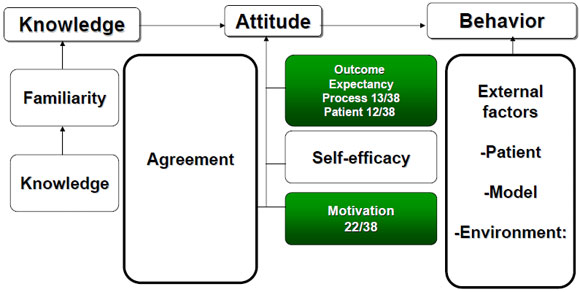
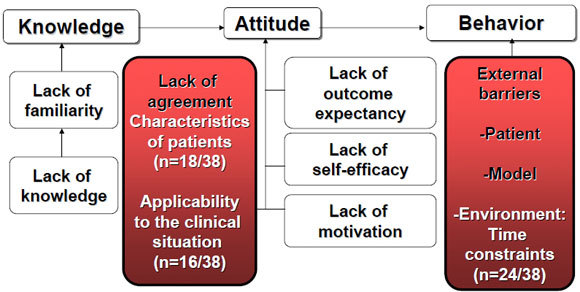
[Click Below for Illustrative Images of the KAP Process: 
1. France Legare's Graphic Presentation of Facilitators in the KAP Process   
2. France Legare's Graphic Presentation of Barriers to the KAP Process. Text Source: France Legare]

Whatever the end-product of training -- preferably delivered by an accredited institution or organization -- some form of certification by an acknowledged authority is of vital importance to the skill 'holder'. Simply put, the certification or credential deflects pressure on the holder to prove, "a zillion times" after training, that he or she actually underwent the training that he/she verbally claims. Certificates or credentials are papers; papers which 'speak' with authority, on behalf of the holder, to such authorities as the holder may want them to speak to. 

Not only do credentials validate or authenticate, depending on the credibility or reputation of the issuer, they also universalize the holder's skills. They validate by linking back to the issuers' accounts of the process(es) by which the underlying skill(s) were acquired and by whom, where and when. They universalize in the sense that they are the 'passport' which allows passage into and between labour markets, as well as participation in such markets.  


1 See J.M.E. Moravcsik, Editor (1948) Aristotle: A Collection of Critical Essays. London: MacMillan


REFERENCES

Acock, Alan and M.L. DeFleur (1972) "A Configurational Approach to Contingent Consistency in the Attitude-Behaviour  Relationship." American Sociological Review. Vol. 37, pp. 714-726, 1972.

Akers, Ronald L., Marvin D. Krohn, Lonn Lanza-Kaduce and Marcia Radosevich. 1979. " Social Learning and Deviant Behavior: A Specific Test of a General Theory," pp. 636-655, in American Sociological Review. 1979. Vol.  44.           

Andrews, Kenneth and Denise Kandel (1979) "Attitude and Behaviour: A Specification of the Contingent Consistency Hypothesis." American Sociological Review. Vol. 44 (1979),  pp. 298-310)

Armstrong, Armstrong, Michael. 1999. A Handbook of Human Resource Management Practice. 7th Edition. London and Philadelphia: Kogan Page. 

Armstrong, Armstrong, Michael. 2012. A Handbook of Human Resource Management Practice. 12th Edition. London and Philadelphia: Kogan Page

ASIS. 1994. Emergency Planning Handbook. ASIS (American Society for Industrial Security)

Chien-Yun, Dai et al (2012) “A Study on Modification of Knowledge, Attitude and Practices on Vocational High School Electronics Courses Integrated with 
Nanotechnology Concept”
http://www.iasks.org/sites/default/files/ijtee20120401073079.pdf

Clelland, John (1973) “A Critique of KAP Studies and Some Suggestions for Their Improvement,” in Studies in FamilyPlanning. Vol 4, No. 2 (Feb, 1973): 42-47.

Cole, G.A (1995) Organizational Behaviour: Theory and Practice. London: Thomson Learning

Cole,G.A. (1997) PersonnelManagement: Theory and Practice. London: Letts Educational.

Cole, G.A. 2002. Personnel and Human Resource Management. Fifth Edition. London: ELST with Continuum

Dessler, Gary (2000) Human Resource Management. Delhi: Pearson Education Asia

Gersovitz, Mark et al (1998) “The Balance of Self-Reported Heterosexual Activity in KAP Surveys and the Aids Epidemic in Africa” Journal of the American Statistical Association. Vol 93, Issue 443, pp. 875-883   

Graham and Bennett Graham, H.T. and Roger Bennet. 1998. Human Resources Management. 9th Edition. London: Financial Times Pitman Publishing. [See pp. 301-304 for knowledge training, pp. 294-295 for attitude training, and pp. 296-299 for skill training]

Habermas, Jurgen (1972 ) Knowledge and Human Interest. Boston: Beacon Press 

Johnson (1976) "Organization and Management Training", pp. 2.1-2.17, in Robert L. Craig, Ed.  (1976) Training and Development Handbook: A Guide to Human Resource Development. New York: McGraw-Hill

Legare, France and Peng Zhang (2013) "Barriers and Facilitators -- Strategies for Identification and Measurement", section 3.4.a. in Sharon Straus, Jacqueline Tetroe and Ian Graham, Eds. Knowledge Translation in Health Care: Moving From Evidence to Practice. Hoboken, NJ: Wiley Blackwell. [Click here for online access to the slides version of the book]

Miller, Vincent A. 1996. “The History of Training”, pp. 3-18, in Robert L. Craig, Ed-in-Chief. 1996. The ASTD Training and Development Handbook. Fourth Edition. New York: McGraw-Hill.  http://www.amazon.com/The-ASTD-Training-Development-Handbook/dp/007013359X 

Moravcsik, J.M.E., Editor (1948) Aristotle: A Collection of Critical Essays. London: MacMillan

Needham, Joseph (1959) Science and Civilisation in China. Vol III. Mathematics and the Sciences of the Heavens and the Earth. Cambridge: Cambridge University Press

Parsons, Talcott (1970) "An Approach to the Sociology of Knowledge", pp. 282-306, in James E. Curtis and John W. Petras, Eds. The Sociology of Knowledge: A Reader. New York: Praeger Publishers.

Pattanayak, Biswajeet and Harish C. Verma. 1997. A Textbook on Human Resource Management. New Delhi: Wheeler Publishing. 

Shaw, Marvin E. and Jack M. Wright (1967) Scales for the
Measurement of attitudes. New York: McGraw-Hill

Straus, Sharon, Jacqueline Tetroe and Ian Graham, Eds. (2013) Knowledge Translation in Health Care: Moving from Evidence to Practice. Hoboken, NJ: Wiley Blackwell [Click here for online access to the slides version of the book]

Sudsawad, P. (2007). "Knowledge Translation: Introduction to Models, Strategies, and Measures." Austin, TX: Southwest Educational Development Laboratory, National Center for the Dissemination of Disability Research.


           USAID (2011) “The KAP Survey Model (Knowledge, Attitudes, and Practices)”. Arlington, VA: USAID [Click on View Tool to download a detailed text]
    
    Webb, Thomas L, Falko F. Sniehotta and Susan Michie (2010) “Using Theories of Behaviour Change to Inform Interventions for Addictive Behaviours”   http://onlinelibrary.wiley.com


WHO (2012) Health Education, Theoretical Concepts, Effective Strategies and Core Competencies. Cairo: WHO 

Friday, February 05, 2016

Ethics ~ The Apex Standard of Scientific Research ~ CSO 320, CSO 501, CSO 589


I. INTRODUCTION TO ETHICS

[Updated: March 26-28, 2016]
[Quick Read: Click Here for a Thematic Summary and Synthesis of the Main Standards of Sociological Research] 


Our attention in this series of conversations now turns to ethics. Ethics, I want to say just now and will later show, is the most encompassing of the nine standards of scientific research that I have listed below, in terms of the number of points in the scientific research process to which it refers. It is, by far, the apex standard. Ethics is, indeed, at once a standard and a set of consequential standards, and a driving force in its own right. It is the standard of standards -- the manyatta of standards, so to speak. As a meme, its roots go back, as we will see, deep into the mists of Time -- back more millennia than any one of us can fathom but with enormous difficulty and little clarity. 

As previously noted, nine key standards, or principles, of scientific research can be gleaned from an ever growing array of texts on research method. As I see it, they are:

3. Control
4. Measurability
5. Validity
6. Reliability
7. Objectivity
8. Ethics (this is the seventh standard so far released)

As a concept, Ethics is derived from the Greek word ethikos (meaning 'arising from habit'). Ethikos in turn arose from an older Greek word ethos (which refers to the custom, character, disposition or core values of a given social entity -- which may range from the individual to the corporate group). Ethics is about conduct. Conduct, Herbert Spencer (1892: 10) pointed out, was the opposite of "purposeless actions"; which was straightforward enough, and yet sufficiently intriguing to catch thoughtful attention. But Spencer (1820-1903), whom we should all read these days, worried that attempts to see good conduct as an ethical ideal might degenerate into a tautology, equating it with a purposefulness and perfection of action. I don't see why perfection should be the 'culminating' ideal, but here is the case he made:
"It is strange that a notion so abstract as that of perfection, or a certain ideal completeness of nature, should ever have been thought one from which a system of guidance can be evolved; as it was in a general way by Plato and more distinctly by Jonathan Edwardes. Perfection is synonymous with goodness in the highest degree; and hence to define good conduct in terms of perfection, is indirectly to define good conduct in terms of itself." (Spencer, 1892: 33)
He suggested that there was only one way out of this logjam -- the means-ends way. Thus: "...the notion of perfection like the notion of goodness can be framed only in relation to ends" (Spencer, 1892: 33). In scientific work, then, the concept of ethics pertains, certainly from the Spencerian perspective, to any or all dimensions of professional conduct in terms of its conformity with, threats to, or violations of, the highest value propositions of a given field of practice.

For present purposes, ethics -- or more specifically, professional ethics (or code of practice) -- refers to proper/professional research conduct guided by the highest normative principles or best traditions, or collective 'hopes', of a discipline. Thus, Weber (1964: 129-130) points out, inter alia, that:
"From a sociological point of view an 'ethical' standard is one to which [people] attribute a certain type of value and which, by virtue of this belief, they treat as a valid norm governing their action. In this sense it can be spoken of as defining what is ethically good in the same way that action which is called beautiful is measured by aesthetic standards. It is possible for ethically normative beliefs of this kind to have a profound influence on action in the absence of any sort of external guarantee. This is often the case when the interests of others would be little affected by their violation."
He continues to say that 'ethical beliefs' can also be 'guaranteed' by religion, or firmly adhered to on account of the "disapproval of violations and the consequent boycott"; or by the probability of, or actual, legal action (Weber, 1964: 130).  

For the discipline of sociology, three associations -- American Sociological Association, British Sociological Association and International Sociological Association -- have, not too long ago, codified what the ethical principles must be, even if often confounded by dilemmas. The first of these associations to formally do so was the American Sociological Association, and only in 1999. 


II. A HISTORY OF ETHICS

However, codification by associations is not where intellectual conversations about ethics began. The associations are, indeed, late comers to the game, important as they may be, and become. Ethical issues and standards have been a matter of concern from the very beginning of sociology. But more than a millennium and a half before sociology came by -- that is, before the times of Ibn Khaldun (AD 1332-1406), Comte (AD 1798-1857) and Durkheim (AD 1858-1917) -- ethical (moral) issues were the subject of philosophical introspection, conversation and debate in China -- particularly via Lao Tzu (c.601-531 BCE), Confucius (551-479 BCE) and Sun Tzu (c.544-496 BCE) -- and Greece. 

In Greece, ethics is traced back to the very dawn of Greek philosophy (see, for example, Khan, 2003: 1-8; Cooper, 2003: 9-18). In all this, Aristotle, who lived from 384 to 322 BCE, has historically been put on the highest pedestal by many later scholars in view of his three seminal treatises (Magna moralia, Eudemian Ethics and, above all, Nicomachean Ethics). However, Aristotle and other Greek philosophers themselves tended to defer to their precursor and fellow Greek, Socrates (c.496-399 BCE). This age-old practice of acknowledging precursors, which nowadays appears to many novice researchers as a nuisance of a requirement -- or even a sinister delaying tactic by supervisors -- is in itself a profound ethical statement. The third of the Greek triumvirate, Plato (428-347 BCE), also had important insights into the problematic of ethics, and did some synthesis of the ideas earlier expressed by Socrates, who was his teacher. 

Cooper (2003: 9-10) implies, however, that this fixation on Socrates was only a convenience, arguing that classical Greek ethics traces farther back to Greek poets such as Homer, who lived even earlier (c.850-800 BCE). Moreover, Socrates was only one of "a sizable group of people", including Democritus and "a number of the itinerant teachers (especially Protagoras) who later became known pejoratively as sophists and were aligned with the tradition of rhetoric rather than philosophy" (Cooper, 2003: 9). Despite these roots that go back to Homer, however, Cooper (2003: 9) concedes that Socrates "and his contemporaries" -- this "sizable group of people" --  
"...were the first to undertake by reasoned analysis and argument to investigate how one ought to lead one's life and, on that basis, to reject uncritical reliance on the traditional authorities in these matters."
So the anxiety of ethics goes back a long way. Lost in the foregoing conversation, however, is the much-touted role of skepticism, which is at the base of the self(critical) stance we are all called upon to adopt as a necessary component of ethical scholarly work, and a counterpoint to dogmatism, and subjectivism. The Skeptical School, founded by Pyrrho of Elis (c.365-275BCE), rejected the notion that Truth (and therefore happiness) could be arrived at by sense perception or reason or both. They argued instead that the condition for happiness was the suspension of judgment on the truthfulness or otherwise of things, since such judgment was always slanted by one theory or another, whose effect was to subjugate our minds to the specific theory -- or theory in general. The ability to "critically discuss" is, even today, the mantra for (and the expected ethical stance in) all scholarly conversation, but this is not intended to paralyze the progression of thought. Doubt must itself be challenged, in a dialectical way, in order to avoid doubting everything in perpetuity.

There is more than a hint above, already, that when ethics is looked at globally, its historical roots point not just to the west (Greece) but also to the east -- that is, to the China of Lao Tzu, Confucius and Sun Tzu. These three orientals lived before or were older than Socrates, Plato and Aristotle. Their cogitations on ethical and related matters, whose coverage turns out to have been both extensive and intensive, clearly predated those of the three Greeks -- but not those attributed to Homer's poetics. Socrates was born the year Sun Tzu died, when Confucius was already 17 years old, and 35 years after the death of Lao Tzu. 

However, even farther back in antiquity than Homer's time, up to the invention of writing itself, religious texts loom large either as distinct artifacts or as embedded elements of larger/longer narratives revolving around the human condition and more specifically the contrast between the good and the bad -- salvation and doom. Beyond the written texts is the vast chain of orality and its related forms of orature -- that is, oral (spoken, recited, sung) literature (or texts) -- and art. Proto-roots of the ethical turn of mind surely lie here. Farther back still, you get closer and closer to the African roots of humanity's mutation-spiced/spiked, grand totality. It goes without saying that oral conversations about the human condition, and about the Good and the Bad, went on in Africa, and only Africa, for tens of thousands of years before homo-sapiens sapiens took the very first steps out of Africa to occupy and populate the rest of the world.

Two religious texts from antiquity stand out, as very early sources of certain ethical strictures which our professional practices are guided by even today: The Egyptian Book of the Dead and the Sumerian cuneiform tablets. The Egyptian book has been variously cited for over a century now as a significant influence on the bible's narratives and proclaimed values, including the Ten Commandments (see, for example, Spencer, 1892: 315-316). The Book of the Dead has been dated farther back than 1600 BCE (that's more than 3600 years ago), around which period, archaeologists suggest, it began to feature in Egyptian burial rituals and sites. The oldest Sumerian tablets, written in cuneiform, are about twice as old, as they have been dated to around 3,200 BCE. But more recent discoveries, decipherings and interpretations also date the earliest Egyptian hieroglyphs to 4,800-5,200 years ago. 

However, the oldest Egyptian (rock) art (called Qurta Art) has been dated to 13,000 BCE (or 15,000 years ago). Of additional interest here is that a Dutch Egyptologist, Ben Haring, succeeded in 2015 to decipher the oldest known abecedary -- that is, an alphabet-like, rather than a hieroglyphic, writing code -- which had been found two decades earlier at Luxor in Upper Egypt, and which dates back to around 2500 BCE. Thus, human thought clearly preceded, and most likely inspired, the invention of the technology we know simply as writing. 

There is indeed a long history of thought without writing -- a tradition of orature -- which goes back 250 thousand to, perhaps, 500 thousand years to the dawn (or occurrence) of a human genetic mutation, Foxp2, which has come to be known as "the language gene." Chowdhuri has, with noteworthy insight, pointed out that even the great holy books have a measure of oral origins, and that this complicates attempts to separate the oldest from the most recent. Partly related to this, Durkheim (1982: 62) has argued that: "Men did not wait [for] the coming of social science to have ideas about law, morality, the family, the state or society itself, for such ideas were indispensable to [i.e. inseparable from] their lives".

READ: Mauri Yambo "On the Foundations And Evolutin of Research Method and Knowledge-Creation"

Thought presupposes language. So does religion, and even more so theology. However, neither thought nor religion necessarily presupposes writing, though writing has since its inception been a massive aid to thinking -- and remembering, and praying. Ultimately, the search for the historical origins of the ethical standards we have today must dig deeper and go farther -- beyond the era of the written text. We write what we think. And we write down what we come upon or know or think we know -- and wish to remember and share across time and appropriated space.


Going back to Comte, and then Durkheim, we find that at the core of Comte's ethics are altruism and positivism. It is not usually realized by those who use the terms altruism and positivism that both were coined by Comte. Altruism is summarized in the phrase "living for others". The opposite of altruism is egoism (or self-centredness, or even selfishness). In its raw form, 'living for others' has elicited very strong but perhaps excessive criticism, from Nietzsche and Ayn Rand, for example. The false impression given by these two is that living for others means living the life of a slave or a moron; or engaging in total self-denial.

Another kind of retort, such as we see argued in the Encyclopedia Britannica, is: why should one feel obliged to 'live for others', who will not live for one? But this is a syllogistic fetish. If the phrase is not taken too literally, then 'living for others' (better still, 'living with others') is a norm ultimately consistent with the value of reciprocity, and related practices of social exchange. After all, even the presumed egoist, who cannot live in splendid isolation or cease to be at all levels a 'social animal', engages with others in multiple if perhaps detached exchanges, in which others unavoidably but inconsistently benefit. 

Parents do live for their children, too, in many symbolic and practical ways; but they "have a life". Far from being suicidal, soldiers have throughout history risked their own lives for fellow soldiers and fellow citizens (see Sun Tzu). Exemplary individuals live their professional lives in ways consistent with the collective ideals (that is, the ethics) of their professions -- and, hopefully, most if not all of their fellow professionals. 'Doing it for the good of the profession' is clearly a high ideal. In the final analysis, then, "living for others" was but a phrase which Comte used to define and highlight the "sociability" inherent in human interactions.

Concerning positivism, Comte's conception of it can be stated, as it generally has, simply as 'Rule of the Senses'. By means of it he sought to banish speculativism -- which he argued that both philosophy and psychology were guilty of -- from all search for knowledge, and from the doing of a discipline he presented as the 'natural science' of society -- that is, sociology.

The main conceptual and methodological pillars of Comte's positivism include the following seven, out of which key ethical tenets of scientific research, already implicit therein, can be distilled:

1. "In short, ...it is only by the thorough observation of [the 'logical facts' of scientific theories] that we can arrive at the knowledge of the logical laws" that drive society (Comte, 1853: 11). Here, Comte clearly uses the term "observation of..." to mean "adherence to...".
2. Positivism calls for sticking to "rational methods of procedure" (Comte, 1853: 11).
3. Rational methods incorporate the "observation of facts", and such observation must be "pure and rational" -- that is, unbiased (Comte, 1853: 11). Thus, "there can be nothing like scientific observation of the passions, except from without, as the stir of emotions disturbs the observing faculties more or less" (Comte, 1853: 11).
4. Moreover, "In order to observe, your intellect must pause from activity" -- something he claims psychologists are only capable of when they cease "for the moment, to be psychologists" (Comte, 1853: 12).
5. "The Positive Method can be judged only in action. It cannot be looked at by itself, apart from the work on which it is employed" (Comte, 1853: 12). It is strictly an applied, as opposed to theoretical, method.
6. Positivism lays emphasis on "positive knowledge" -- that is, empirical knowledge -- as opposed to "vague and mystical conceptions" such as one finds in philosophy, religion and psychology (Comte, 1853: 15-16).
7. Positivism is the culmination of method, representing as it does "The only necessary unity ...of Method" (Comte, 1853: 17).


Durkheim Rules of Sociological Method: 
Concerning Durkheim, we can distill from his Rules the following guides to Truth-finding in the context of social life, the violation of which poses distinct ethical challenges to the sociologist. Adhering to the guides is consistent with his (Durkheim, 1982: 66) argument that "just as the subject matter of physics consists of actual physical bodies and not to the idea that ordinary people have of it" [i.e. physics], so it is that:
"...our representation of morality springs from ['systematically'] observing the rules that function before our very eyes... Consequently it is these rules...which constitute the subject matter of science" -- "not the cursory view we have of them" (Durkheim, 1982: 66)

The guides to Truth-finding are anchored on eight cardinal concepts: social facts (or things), objectivity, observation, comparison (with emphasis on concomitant variation), function, cause, effect and explanation. We find these guides in twelve specific propositions in Durkheim's Rules, as follows (emphasis mine):

1. "Since it is through the senses that the external nature of things is revealed to us, we may ... sum up as follows: in order to be objective science must start from sense-perceptions and not from concepts that have been formed independently from it. It is from observable data that [science] should derive directly the elements for its initial definition" (Durkheim, 1982: 81). Thus, "Observations" are "the essential basic material for all concepts" (Durkheim, 1982: 81)

2. "To demonstrate the utility of a [social] fact does not explain its origins, nor how it is what it is. The uses which it serves presume the specific properties characteristic of it, but do not create it" (Durkheim, 1982: 119-120)

3. "...when one undertakes to explain a social phenomenon the efficient cause which produces it and the function it fulfills must be investigated separately" (Durkheim, 1982: 123).

4, "...every time a social phenomenon is directly explained by a psychological phenomenon, we may rest assured that the explanation is false" (Durkheim, 1982: 129)

5. "The determining cause of a social fact must be sought among antecedent social facts and not among the states of individual consciousness" (Durkheim, 1982: 134). Thus "the function of a social fact must always be sought in the relationship that it bears to some social end" (Durkheim, 1982: 134)

6. "The primary origin of social processes of any importance must be sought in the constitution of the inner social environment." ["In fact, the elements which make up this environment are of two kinds: things and persons"] (Durkheim, 1982: 135-136). Indeed, "social things are...the product of human activity" (Durkheim, 1982: 62).

7. There is "...Only one way of demonstrating that one phenomenon is the cause of another"; this is the comparative method, which is, in effect, "indirect experimentation" -- the "sole one suitable for sociology" (Durkheim, 1982: 147). Indeed, concomitant variation is "the supreme instrument for sociological research" (Durkheim, 1982: 153) -- which must be "practiced with rigor" if it is to yield "the appropriate results" (Durkheim, 1982: 157). 

8. Thus, "Comparative sociology is not a special branch of sociology; it is sociology itself, in so far as it ceases to be purely descriptive and aspires to account for facts" (Durkheim, 1982: 157).

9. "Sociology [should be] neither individualist, communist nor socialist. On principle it [should] ignore these theories, which it could not acknowledge have any scientific value, since they tend not directly to express social facts but to reform them" (Durkheim, 1982: 160). 

10. Sociology is "independent of all philosophy", though it emerged from philosophy, and should remain "just sociology" (Durkheim, 1982: 160).

11. Sociological method "is objective", being "wholly dominated by the idea that social facts are things and must be treated as such" (Durkheim, 1982: 161). Thus social facts are "social things", and sociological method is "exclusively sociological" (Durkheim, 1982: 162). 

12. A "social fact cannot be explained except by another social 
fact" (Durkheim, 1982: 162).


Durkheim (1982: 147) rejected Comte's evolutionary standpoint which, in his (Durkheim's) view, nurtured the false notion that the historical method could also be used to establish causality. To be fair to Comte, though, the historical method, carefully fused with dialectical principles, could be so used.


2. Herbert Spencer's Principles of Ethics [The Principles of Ethics]
The principles of Ethics Vol 2

There is a surprising and puzzling paucity of material in Spencer's writing -- certainly in the two volumes of his Principles of Ethics -- which, one might have expected to find, speaks directly, indirectly or in detail to the ways in which ethical research conduct can be incorporated into specific, or any, stages of scientific research practice by individuals or corporate entities. For present purposes, his research-related ethical prescriptions are reducible to the following (talking) points:
1. "Most people regard the subject-matter of Ethics as being conduct considered as calling forth approbation or reprobation. But the primary subject-matter of Ethics is conduct considered objectively as producing good or bad results to self or others or both" (Spencer, 1892: 8).
2.Tool Imperfections: A tool is imperfect "if it lacks some part needful for effective action, or if some part is so shaped as not fulfill its purpose in the best manner" (Spencer, 1892: 33).
3. Ethical Dilemmas: "The confusion of Ethical thoughts" (Spencer, 1892: 312-316) or ethical prescriptions. Such dilemmas, it seems obvious, are a kind of ethical anomie.
4. Authorities: "A trait common to all forms of sentiments and ideas to be classed as ethical, is the consciousness of authority. The nature of the authority is inconsistent" (Spencer, 1892: 335). Such authority may vest in a ruler, a god, an ancestor, a military leader, "an aggregate public opinion", a coercive force, or "the represented opinion of other individuals" (Spencer, 1892: 335-336).
5. Veracity: "Complete truthfulness" (Spencer, 1892: 400).
6. Industry: Hard work or its opposite; some "calls for strength, courage and skills" (Spencer, 1892: 422-423)


How can we summarize our conversation this far? This way:

1. Ethics, as a necessary underpin for the only 'class' of conduct we can collectively accept as good, has challenged human thought all the way back to the mists of Time when, as one can imagine, humans acquired the capacity to speak, and thus to verbalize their thoughts and judgment of things as Good and Bad -- more specifically, in reference to conduct. In this line of thinking, then, thinkers and philosophers like Homer, Lao Tzu, Confucius, Sun Tzu, Socrates and Plato were late-comers to the game.

2. Ethics is about conduct, professional ethics about professional conduct, good professional conduct about conformity to the highest value propositions of a given field of practice. In research, this means, more specifically, proper/professional conduct guided by the highest normative principles or best traditions, and/or collective 'hopes', of a discipline. 

3. 'Rule of the senses' -- as the anchor for "rational methods of procedure" -- is a necessary standard for evaluating and judging research claims presented as evidence-based.

4. 'Doing it for the good of the profession', or the community, is a high ideal worth espousing.

5. "Social facts are things and must be treated as such", that is, studied empirically. 

6. Systematic and objective observation of social facts is the basis for Truth-finding.

7.  Antecedent social facts must be the basis for determining the cause of any social fact of interest, and for explaining it.

8. The comparative method -- that is, "indirect experimentation" sensitive to concomitant variation -- is the only way to determine cause and effect in sociology (Durkheim).

9. The "subject matter of Ethics" is conduct or practice "considered objectively as producing good or bad results" (Spencer,1892: 8)
10. In a scholastic discipline, the only authority to which a practitioner must defer is, by inference, "the represented opinion of other individuals" in the discipline. That is how I interpret Spencer.

11. Veracity -- that is, "complete truthfulness" (Spencer) -- is an unavoidable rule of method in science.


In scholarly research or professional practice, then, ethics is ultimately, and very broadly,  all about:
1. Good as opposed to Bad or Evil.
2. Truthfulness (or Honesty), not Dishonesty/Cheating.
3. Judiciousness (or Even-handedness), not Prejudice or Bias.
4. Community Spirit, not Deviance or Self-Centredness.
5. Restraint or Self-Control, not Rashness or Recklessness.
6. Humility, not Pride or Self-adulation.
7. Objectivity, not Subjectivity or Value-judgment.
8. Broad-Mindedness, not Narrow-Mindedness.


To a greater or lesser extent, the ethical concerns of the past, even distant past, that are discussed above have in one form or another found their way into and merged with the ethical standards identified and interrogated below. Lines of influence from one particular brand of the past to the standards below may be hard to establish with finality. After all, the refining or innovating mind of the contemporary era may proceed without clear awareness of, or due attention to, precursors but only of existential experiences; but these precursors nevertheless loom large somewhere in the intellectual background.


III. AN OVERVIEW OF THE ETHICAL STANDARDS OF THREE SOCIOLOGICAL ASSOCIATIONS 

III.i. The American Sociological Association:

The American Sociological Association's ethical standards, first published in 1999, are a detailed set of pronouncements covering 20 specific domains within which any individual members' conduct must remain, and is to be monitored and judged. In my view, the eleven most important of these standards are listed below, with illuminating, actual quotations from a further selection of these most important standards:

1. Professional and Scientific Standards (see Standard 1):
"Sociologists adhere to the highest possible technical standards that are reasonable and responsible in their research, teaching, practice, and service activities. They rely on scientifically and professionally derived knowledge; act with honesty and integrity; and avoid untrue, deceptive, or undocumented statements in undertaking work-related functions or activities."

2. Competence (Standard 2):

In all ways, Sociologists: 
"(a) ...conduct research, teach, practice, and provide service only within the boundaries of their competence, based on their education, training, supervised experience, or appropriate professional experience. (b) [Likewise operate] in new areas or involving new techniques only after they have taken reasonable steps to ensure the competence of their work in these areas. (c) ...who engage in research, teaching, practice, or service maintain awareness of current scientific and professional information in their fields of activity and undertake continuing efforts to maintain competence in the skills they use. (d) ...refrain from undertaking an activity when their personal circumstances may interfere with their professional work or lead to harm for a student, supervisee, human subject, client, colleague, or other person to whom they have a scientific, teaching, consulting, or other professional obligation." 

3. Representation and Misuse of Expertise (see Standard 3):
"(a) In research, teaching, practice, service, or other situations where sociologists render professional judgments or present their expertise, they accurately and fairly represent their areas and degrees of expertise. (b) Sociologists do not accept grants, contracts, consultation, or work assignments from individual or organizational clients or sponsors that appear likely to require violation of the standards in this Code of Ethics. Sociologists dissociate themselves from such activities when they discover a violation and are unable to achieve its correction. (c) Because sociologists’ scientific and professional judgments and actions may affect the lives of others, they are alert to and guard against personal, financial, social, organizational, or political factors that might lead to misuse of their knowledge, expertise, or influence. (d) If sociologists learn of misuse or misrepresentation of their work, they take reasonable steps to correct or minimize the misuse or misrepresentation." 

4. Conflict of Interest (see Standard 9)

5. Confidentiality (Standard 11): 
"...(a) Sociologists take reasonable precautions to protect the confidentiality rights of research participants..., or others. (b) Confidential information...is treated as such by sociologists even if there is no legal protection or privilege to do so... (c) Information provided under an understanding of confidentiality is treated as such even after the death of those providing that information... (f) The obligation to maintain confidentiality extends to members of research or training teams and collaborating organizations who have access to the information...[It] is the responsibility of researchers, administrators, and principal investigators to instruct staff to take the steps necessary to protect confidentiality."

6. Informed Consent (Standard 12): Scope of Informed Consent; Informed Consent Process; Informed Consent of Students and Subordinates; Informed Consent with Children; Use of Deception in Research; Use of Recording Technology 

7. Research Planning, Implementation, and Dissemination (Standard 13): Unanticipated Research Opportunities, Offering Inducements for Research Participants, Reporting on Research, Data Sharing.

8. Plagiarism (Standard 14):
"a) In publications, presentations, teaching, practice, and service, sociologists explicitly identify, credit, and reference the author when they take data or material verbatim from another person’s written work, whether it is published, unpublished, or electronically available. (b) In their publications, presentations, teaching, practice, and service, sociologists provide acknowledgment of and reference to the use of others’ work, even if the work is not quoted verbatim or paraphrased, and they do not present others’ work as their own whether it is published, unpublished, or electronically available." 

9. Authorship Credit (Standard 15)
"(a) Sociologists take responsibility and credit, including authorship credit, only for work they have actually performed or to which they have contributed. (b) Sociologists ensure that principal authorship and other publication credits are based on the relative scientific or professional contributions of the individuals involved, regardless of their status. In claiming or determining the ordering of authorship, sociologists seek to reflect accurately the contributions of main participants in the research and writing process. (c) A student is usually listed as principal author on any multiple-authored publication that substantially derives from the student’s dissertation or thesis." [MY ~ Emphasis mine]
10. Publication Process (see Standard 16)

11. Contractual and Consulting Services (see Standard 19).


III.ii. The British Sociological Association:

The British Sociological Association issued its own Statement of Ethical Practice 
about three years later, in March 2002. This statement was borrowed significantly from the statements and codes of three associations; The Social Research Association domiciled in the U.K., the American Sociological Association and the Association of Social Anthropologists of the U.K. and the Commonwealth.

The statement is not designed as "a set of recipes for resolving ethical choices or dilemmas", but rather as an aid to member's awareness of "the ethical issues that may arise throughout the research process and to take responsibility for their own ethical practice." That is to say, it constitutes a summary of "basic principles for ethical practice by sociologists", and is intended to ensure, via sensitization, that "Departures from the principles should be the result of deliberation and not ignorance."

So ignorance of the principles should not be a part of any member's defence -- or the reason that anyone violates any principle, by default. No one should violate a principle merely on account of not having been aware of it. How any deliberate violation of a principle or principles is to be dealt with remains unstated, and in itself constitutes the dilemma of when and how to sanction (that is, punish), or not.

The principles are clustered around the following eight partially overlapping themes:
1. Professional Integrity.
2. Relations With and Responsibilities Towards Research Participants.
3. Covert Research.
4. Anonymity, Privacy and Confidentiality
5. Relations With and Responsibilities Towards Sponsors and/or Funders.
6. Clarifying Objectives, Roles and Rights.
7. Preempting Outcomes and Negotiations About Research.
8. Obligations to Sponsors and/or Funders During the Research Process.

Let us briefly look at the content of each principle in turn (for further details, the reader is referred to the full document cited here):

1. Professional Integrity: Professional integrity includes the obligation to make one's data available to future researchers; in addition to the following:

1.1.Recognizing and respect for "the proper interests" of all research participants as well as non-participants affected by it; and correctly reporting all research findings. Ethical obligation here thus involves the non-violation of relevant national laws and administrative regulations -- related, for example, to data protection, human rights, copyright and libel, as well as "sponsors and employers."

1.2. Working within "the boundaries of ...professional competence", and only using 'appropriate' techniques. Thus, researchers should not accept research or other responsibilities that "they are not qualified to carry out", or that is not "worthwhile". Furthermore, they should know "the limits of their detachment", or involvement, in the scholarly work that they routinely do.

1.3. Incorporating proper and adequate safety measures in the design and implementation of the entire research project.

1.4. Ensure that interactions with the media do not compromise "the reputations" of their respective disciplines. This includes the avoidance of claims to discovery which are not supported by adequate evidence.

2. Relations with and Responsibilities Toward Research Participants: These relations are multifaceted. Thus, the researcher is called upon not only to ensure the physical, social and psychological well-being those who participate in the conduct of his/her study; but also to protect the broad spectrum of human rights of those studied.

Trust and integrity should be the foundation of all researcher-respondent relations, regardless of the "disparities of power and status" in the field. The abuse of power by the powerful should not be condoned in any aspect of the research project.

Participation in sociological research should be anchored on respondents' "freely given informed consent." A respondent gives informed consent to participate only when he/she knows, "in terms meaningful" to him/her, about: Study purpose or objectives, why the study is necessary, the identity of the researcher(s), funding source(s), and how the findings are to be disseminated and implemented.

Thus, respondents should clearly know that they have the right to withhold consent, or to withdraw at any time from an on-going study. Respondents have the right to reject the use of data-gathering devices such as audio-recorders or video cameras. Likewise, research films or records should not be circulated to audiences without prior consent of the respondents [MY ~ But tell that to Tutankhamun].

Related to the foregoing, respondents should be informed of their rights under relevant copyright or data protection laws. On the other hand, however, they should not be given "unrealistic guarantees of confidentiality." That is to say, they must be alerted very early on to the likelihood of data and findings being shared by significant others. Conversely, it may not be a practical proposition to promise respondents to see transcripts of interviews or field notes.

4. Covert Research:
[MY ~ Though it is happening all the time in 'intelligence circles', and is increasingly aided and abetted by the raging spread of the internet and smart technology] the application of covert, or undercover, data gathering techniques and methods in scholarly research is by definition unethical since such activities "violate the principles of informed consent, and may invade the privacy of those being studied."

5. Anonymity, Privacy and Confidentiality:
In general, respondents' personal information should remain invariably and optimally confidential. This will generally require avoiding the recording of "certain kinds of sensitive information," such as identities. Foresight is important here, and the capacity to anticipate "threats to the confidentiality and anonymity of research data" must be cultivated. Records and data should be securely stored -- obviously in ways that keep pace with emergent threats.

All guarantees of confidentiality and anonymity already given to respondents must be honored. The exception to this principle is the necessity in some instances -- such as the discovery of child abuse -- to release certain confidential information to relevant authorities. Conversely, it may be more difficult "to extend guarantees of privacy or confidentiality to public organizations, governments, officials or agencies." [MY ~ As we all know, however, journalists do this all the time]

6. Relations With and Responsibilities Toward Sponsors and/or Funders:

6.1. Research Work Must Be Free of Interference By Sponsors and Funders: It is contrary to ethical principles for sponsors or funding sources to attempt -- or researchers to allow them -- to guide research work toward "particular conclusions", or research findings toward certain "courses of action". It is ethical practice to focus research activity on filling knowledge gaps or generating explanations supported by the findings, but not so when the goal is to push a particular course of action set prior to the research itself.

6.2. Sponsors'/Funders' Have Rights Too: On the other hand, sponsors or funders have rights too. They must be notified in good time of any changes in the agreed Terms of Reference. Moreover, a researcher violates sponsors'/funders' rights -- and the rules of proper research conduct -- by asking for, receiving and/or initiating a study with obviously inadequate funding.

7. Clarifying Objectives, Roles and Rights:
The relations between the researcher and funding agency should be guided fundamentally by a written contract; but the researcher should be careful to avoid contracts which violate ethical standards, or restrict his/her ethical rights or freedom to publish or share research findings. On the other hand, the researcher must be transparent about his/her academic and professional qualifications, and the competence to carry out and complete the study required by the sponsor.

8. Preempting Outcomes and Negotiations about Research:
It is not ethical practice for researchers to sign contracts which require the use of methods chosen by the funding agency, or the production of predetermined findings or results. Researchers should likewise avoid funding entities which restrict the disclosure of research objectives, funding sources, and/or researchers involved in the study [MY ~ But many cutting-edge or hi-tech projects sponsored by government agencies or multinationals routinely do just that in order to maintain or nurture advantage by avoiding leakage to competitors or adversaries].

Where funding sources are for other reasons a source of controversy, the researcher is called upon to be transparent. Where the funding entity is also the gatekeeper -- that is, the authority which must authorize access to respondents or data sources -- the researcher is still required to protect his/her sources. This may, of course, lead to a stalemate and force the conscientious researcher to abandon the study and return the funds.

9. Obligations to Sponsors and/or Funders During the Research Process:

The researcher is obliged to inform the funding agency of any intended or unintentional departures from the agreed TOR. The researcher should also ensure that all contractual work is completed on time, and reports to 'donors' delivered in keeping with the agreed schedule.


III. iii. International Sociological Association (ISA) 

ISA's Code of Ethics, published in 2001, has in its preamble this powerful statement:
"Each sociologist supplements the Code of Ethics in ways based on her/his own personal values, culture and experience. Each sociologist supplements, but does not violate, the standards outlined in this Code of Ethics. It is the individual responsibility of each sociologist to aspire to the highest standards of conduct. 
The efficacy of a Code of Ethics relies principally upon the self-discipline and self-control of those to whom it applies."
The code is presented in four distinct sections. Besides the introductory section and the preamble, these are:
1. Sociology as a field of scientific study and practice.
2. Research procedures.
3. The publication and communication of data4. Extra scientific use of research results.

In outline, these sections provide as follows:

1. Sociology As a Field of Scientific Study and Practice:
1.1. Sociologists are expected to abide by the principle of openness to local and international cooperation "on the basis of scientific correctness alone, without discrimination..."
1.2. All are expected to uphold and practice the principles of group work, cooperation, mutual exchange, and international sharing of scientific findings and discoveries.
1.3.1. Every sociologist is called upon to nurture (a) a self-critical 'attitude' toward his/her own work, acknowledging the tentativeness of research results; and, (b) the value of openness to others about one's ideological perspectives.
1.3.2. Thus, "No sociological assumptions should be treated as proven facts".
1.4. It is everyone's obligation to nurture the "image and integrity" of sociology as a discipline; while preserving the capacity to critique its "fundamental assumptions", methods and achievements. 
1.5. In "teaching and professional practices", it is important to uphold the values of "openness, criticism and respect for all scientific perspectives."
1.6. Sociologists are expected to recognize their obligation to protect students' and clients' rights.

2. Research Procedures:

In terms of research procedures, a key takeaway from practical experience, is the observation by ISA that sociological research depends "to a certain extent on sponsors" -- private and public. A set of ethical points derive from this fact, and can be identified under the following four subsets:

2.1. Sponsors:
2.1.1. Though sponsors may seek specific research "outcomes", sociologists should turn down, or walk away from, grants or contracts with conditions which compromise their right, or professional mandate, to make independent decisions regarding proper research procedures, or give sponsors the power to delay or veto the academic publication of findings that sponsors disagree with.
2.1.2. Sponsors are entitled to "clear information in advance" regarding research procedures to be followed, including the methods to be adopted. They should also be alerted to the possibility that research results may turn out contrary to their expectations.
2.1.3. While sponsors may fund only such research as promotes their political agenda, sociologists should not allow their scientific principles and work to be controlled by that kind of agenda, even if they subscribe to it. Nor should they participate in any activities with "undemocratic aims or discriminatory goals".
2.1.4. All aspects of a funded research activity should be specified in a written agreement or contract.

2.2. Costs and Rewards:
2.2.1. Research funds should be spent according to signed mutual agreements. 
2.2.2. Sociologists should avoid research activities that do not have "sufficient funds"; and likewise should avoid bidding situations in which "further unfair tactics" are used to identify winners.

2.3. Data Gathering:

2.3.1. Sociologists, like other scientists, are called upon to disclose their data gathering methods and, broadly, their data sources.
2.3.2.1. Both quantitative and qualitative researchers must "rigorously" respect their respondents' and informants' security, anonymity and privacy. This includes respondents'/informants' personal information -- unless they ask or agree to be cited (that is, specifically mentioned). Where informants are easy to trace or identify, they should be alerted to the possible consequences.
2.3.2.2. Though payments to informants are "acceptable in principle", they "should be discouraged as far as possible and subject to explicit conditions" related to the quality (that is, 'reliability') of the information given or to be given.
2.3.3. Sociologists should respect the privacy terms under which the private records which they are given access to were collected or curated. However, the use of historical archives is guided by "the rules of the archive" concerned and the legal conditions set by the relevant jurisdictions. The international scientific community usually recognizes these conditions.
2.3.4.1. Researchers should ensure that they obtain respondents' consent in advance.
2.3.4.2. Covert research should in principle be avoided -- unless it is the only option available, or "when access to the usual sources of information is obstructed by those in power."

3. The Publication and Communication of Data:
3.1. The data and results of sociological research are the researchers' intellectual property. Thus, copyright to such intellectual property also, "in principle", belongs to the researchers. However, should the sponsor or employer retain the contract, then the researchers concerned should receive "fair compensation".
3.2. In principle, researchers retain publication rights to their works, either through publishers or at their own cost.
3.3. Researchers have a right to act against any effort by sponsors to distort their findings or present them out of context.
3.4. All substantial contributors to a research project -- that is, scholars, sponsors, technicians and others -- must be acknowledged in any publication based on it.
3.5. Databases should be allowed into the public domain only after the researchers concerned have specified their sources as well as the methods used to collect or construct them. Such specification should be made "within reasonable time". Interim data sets should be availed to peers for scrutiny with respect to accuracy [This provision was adopted earlier by the ISA Executive Council in November 1996].
3.6. Published data become "part of the common knowledge and background of the scientific community". Furthermore, any comment directed at such data should be availed to the researchers concerned, who should be allowed to respond. 

4. Extra Scientific Use of Research Results:
4.1. The results of sociological research "may be a matter of public interest". Consequently, their dissemination should not be hampered in any way by the researchers or any other entities, as this violates the public's fundamental right to be informed. However, unchecked or unaudited dissemination, via individual or mass channels, may introduce "distortions, simplifications and manipulations" of the true results of particular studies. There should therefore be provision for interventions by the researchers concerned in order to correct or counter any "misrepresentations or misuse".   
4.2. Sociologists should avoid "claiming expertise" where they lack "the necessary depth of research knowledge", in particular "when contributing to public discussion or policy debate". [That is to say, they should have the humility to recognize and acknowledge the limits of their expertise, and to act accordingly]. 


III.iv. Summaries of the Works of Individual Authors and Associations

A. From the Works of Individual Thinkers

1. Ethics, as a necessary underpin for the only 'class' of conduct we can collectively accept as good, has challenged human thought all the way back to the mists of Time when, as one can imagine, humans acquired the capacity to speak, and thus to verbalize their thoughts and judgment of things as Good and Bad -- more specifically, in reference to conduct. In this line of thinking, then, thinkers and philosophers like Homer, Lao Tzu, Confucius, Sun Tzu, Socrates and Plato were late-comers to the game.

2. Ethics is about conduct, professional ethics about professional conduct, good professional conduct about conformity to the highest value propositions of a given field of practice. In research, this means, more specifically, proper/professional conduct guided by the highest normative principles or best traditions, and/or collective 'hopes', of a discipline.


3. 'Rule of the senses' -- as the anchor for "rational methods of procedure" -- is a necessary standard for evaluating and judging research claims presented as evidence-based.

4. 'Doing it for the good of the profession', or the community, is a high ideal worth espousing.

5. "Social facts are things and must be treated as such", that is, studied empirically. 

6. Systematic and objective observation of social facts is the basis for Truth-finding.

7.  Antecedent social facts must be the basis for determining the cause of any social fact of interest, and for explaining it.

8. The comparative method -- that is, "indirect experimentation" sensitive to concomitant variation -- is the only way to determine cause and effect in sociology (Durkheim).

9. The "subject matter of Ethics" is conduct or practice "considered objectively as producing good or bad results" (Spencer,1892: 8)


10. In a scholastic discipline, the only authority to which a practitioner must defer is, by inference, "the represented opinion of other individuals" in the discipline. That is how I interpret Spencer.

11. Veracity -- that is, "complete truthfulness" (Spencer) -- stands out as a rule of method in science.B: A Summary of the Main Ethical Prescriptions of Each of Three Leading Sociological Associations

1. American Sociological Association
1. Professional and Scientific Standards (Standard 1)
2. Competence (Standard 2)
3. Representation and Misuse of Expertise (Standard 3)
4. Confidentiality (Standard 11): Maintaining Confidentiality; Anticipation of Possible Uses of Information; Electronic Transmission of Confidential Information; Anonymity of Sources; Minimizing Intrusions on Privacy; Preservation of Confidential Information.

5. Informed Consent (Standard 12): Scope of Informed Consent; Informed Consent Process; Informed Consent of Students and Subordinates; Informed Consent with Children; Use of Deception in Research; Use of Recording Technology 
6. Research Planning, Implementation, and Dissemination (Standard 13): Unanticipated Research Opportunities, Offering Inducements for Research Participants, Reporting on Research, Data Sharing.
7. Plagiarism (Standard 14).
8. Authorship Credit (Standard 15)


2. British Sociological Association
1. Professional Integrity: This demands respect for the interests of all research participants and non-participants affected by a researcher;s work is a crucial component of professional integrity.


2. Researchers should consistently keep their work within the boundaries of their "professional competence."

3. All should avoid making claims, in the media or elsewhere, to scientific discovery not supported by adequate evidence.

4. Researcher-Researcher/Participant Relations: Researchers have responsibility for the general welfare of their research assistants and other research participants, and must not violate their contractual obligations (implied or not) to them. Such relations should be based on trust and integrity, as well as respect for all human rights.

5. Due Respect to Respondents: This requires doing interviews under conditions of free and informed consent by respondents, based on clear knowledge of: researchers' ..., study objectives, rationale, and funding sources; how research results will be disseminated and implemented; their rights under copyright and data protection law -- including the right to object to, or withdraw consent regarding, any aspect of the research in question. 

6. However, there is no reason to give respondents 'unrealistic' promises of confidentiality.

7. Covert Research: Covert or undercover research is unethical.

8. Anonymity, Privacy, Confidentiality: Respondents' personal information must remain maximally confidential. Records and data must be securely stored against ongoing and emergent threats. All guarantees of confidentiality to individuals must be honored. However, abuses (such as child abuse) and other illegal acts encountered during research should not be ignored; they should be reported to relevant authorities.

9. Contracts and Contract Violations: Sponsors or Funding Agencies: These must desist from all attempts to influence findings or conclusions, or violate ethical rights; and researchers must resist all such attempts. Each funded research must be fully covered by a written (and duly signed) contract. 

10. Contracts: It is unethical, however, to design or sign a contract which prescribes the use particular methods, or require results desired by sponsors or funding agencies.

11. Rights of Sponsors or Funding Agencies: Sponsors have rights too. Contracted work must be undertaken as agreed in the Terms of Reference (TOR), and must be completed according to the agreed schedule.

3. International Sociological Association
1. Sponsors and Funding Sources: They are entitled to "clear information in advance" concerning research procedures and methods to be used in -- as well as likely conclusions from -- research projects that they fund. 


2. Grants or Contracts to Avoid: Sociologists should stay away from grants or contracts involving "bidding wars" which are likely to encumber their rights to independent research, or which give sponsors the leeway to delay or veto the publication of findings which they disagree with or which deviate fom their political agenda.

3. Contract: All details of funded research must be fully specified in a written contract or agreement, which should be arrived at by mutual understanding.

4. Research Methods, Data Collection Tools, Data Sources: Researchers must specify their data gathering methods as well as data sources. 

5. Respondents/Informants' Security and Anonymity: Informants' personal information and security must be "rigorously" respected. This includes their personal documents that they may make available. 

6. Covert Research: Such research should be avoided unless it is the only available option.

7. Respondents' consent must be sought and obtained in advance.

8. Findings and Publications: Researchers have intellectual property rights and copyright over the data and results of their research, though some sponsors may insist on a share of those rights. Researchers also have the right to publish their data, findings -- and related interpretations. 

Researchers may invoke the law or initiate other interventions against sponsors' effort to: distort their findings or present them out of context, or otherwise misuse their data.

9. Participants: All main contributors to a research project must be acknowledged in any publication of its content

10. Researchers should avoid making false, or fuzzy, claims to expertise which they do not in fact have. This requirement is particularly important when participants in public policy discussions are sought or recruited or announced

IV. A Thematic Synthesis of the Main Standards Summarized From the Authors and Associations Reviewed


From the above summaries of standards gleaned from the writings of certain leading sociologists and three leading sociological associations, the following synthesis is attempted. Subtle and not so subtle variations will be noticed. Some will pass as differences in emphasis from one 'jurisdiction' or tradition to another, some as contradictions that need explanation, and yet others as deep-rooted, anomie-inducing dilemmas for the researcher wishing to be more compliant. I will not make judgment, besides what I have already said above. My task here is simply to document the various standards -- and to 'systematize' them in some way. The keen observer will probably detect grave omissions. So be it:

IV. 1. From the Works of Individual Thinkers

1. Ethics is a necessary underpin for the only 'class' of conduct we can collectively accept as good.

2. Ethics is about conduct, professional ethics about professional conduct, good professional conduct about conformity to the highest value propositions of a given field of practice. In research, this means, more specifically, proper/professional conduct guided by the highest normative principles or best traditions, and/or collective 'hopes', of a discipline.


3. 'Rule of the senses' -- as the anchor for "rational methods of procedure" -- is a necessary standard for evaluating and judging research claims presented as evidence-based.

4. 'Doing it for the good of the profession', or the community, is a high ideal worth espousing.

5. "Social facts are things and must be treated as such", that is, studied empirically. 

6. Systematic and objective observation of social facts is the basis for Truth-finding.

7.  Antecedent social facts must be the basis for determining the cause of any social fact of interest, and for explaining it.

8. The comparative method -- that is, "indirect experimentation" sensitive to concomitant variation -- is the only way to determine cause and effect in sociology (Durkheim).

9. The "subject matter of Ethics" is conduct or practice "considered objectively as producing good or bad results" (Spencer,1892: 8)


10. In a scholastic discipline, the only authority to which a practitioner must defer is, by inference, "the represented opinion of other individuals" in the discipline. That is how I interpret Spencer.

11. Veracity -- that is, "complete truthfulness" (Spencer) -- stands out as a rule of method in science.

IV.2. From the Main Ethical Prescriptions of Three Leading Sociological Associations, ASA, BSA, ISA

COVERT RESEARCH
Covert or undercover research is unethical. Such research should be avoided unless it is the only available option.

FALSE CLAIMS
All should avoid making claims, in the media or elsewhere, to scientific discovery not supported by adequate evidence.

FINDINGS AND PUBLICATIONS 
Researchers have intellectual property rights and copyright over the data and results of their research, though some sponsors may insist on a share of those rights. Researchers also have the right to publish their data, findings -- and related interpretations. 


Researchers may invoke the law or initiate other interventions against sponsors' effort to distort their findings or present them out of context, or otherwise misuse their data (See also ASA, Standard 15: Authorship Credit).

INFORMED CONSENT
Respondents' consent must be sought and obtained in advance. The principle of due regard to respondents requires doing interviews under conditions of free and informed consent by respondents, based on clear knowledge of: ..., study objectives, rationale, and funding sources; how research results will be disseminated and implemented; their rights under copyright and data protection law -- including the right to object to, or withdraw consent regarding, any aspect of the research in question.

"Informed consent is a basic ethical tenet of scientific research on human populations. Sociologists do not involve a human being as a subject in research without the informed consent of the subject or the subject’s legally authorized representative, except as otherwise specified in this Code. Sociologists recognize the possibility of undue influence or subtle pressures on subjects that may derive from researchers’ expertise or authority, and they take this into account in designing informed consent procedures"  (ASA, Informed Consent, Standard 12)

PARTICIPANTS
All main contributors to a research project must be acknowledged in any publication of its content

PLAGIARISM
"a) In publications, presentations, teaching, practice, and service, sociologists explicitly identify, credit, and reference the author when they take data or material verbatim from another person’s written work, whether it is published, unpublished, or electronically available. (b) In their publications, presentations, teaching, practice, and service, sociologists provide acknowledgment of and reference to the use of others’ work, even if the work is not quoted verbatim or paraphrased, and they do not present others’ work as their own whether it is published, unpublished, or electronically available" (ASA, Standard 14)
PROFESSIONAL AND SCIENTIFIC STANDARDS
"Sociologists adhere to the highest possible technical standards that are reasonable and responsible in their research, teaching, practice, and service activities. They rely on scientifically and professionally derived knowledge; act with honesty and integrity; and avoid untrue, deceptive, or undocumented statements in undertaking work-related functions or activities" (ASA, Standard 1)
 PROFESSIONAL COMPETENCE, COMPETENCY AND EXPERTISE
Researchers should consistently keep their work within the boundaries of their "professional competence." Researchers should avoid making false, or fuzzy, claims to expertise which they do not in fact have. This requirement is particularly important when participants in public policy discussions are sought or recruited or announced. Sociologists should avoid "claiming expertise" where they lack "the necessary depth of research knowledge", in particular "when contributing to public discussion or policy debate". [That is to say, they should have the humility to recognize and acknowledge the limits of their expertise, and to act accordingly]

RESEARCH METHODS, DATA COLLECTION TOOLS AND DATA SOURCES 
Researchers must specify their data gathering methods as well as data sources. 

RESEARCH PLANNING, IMPLEMENTATION AND DISSEMINATION
A number of obligations do confront the researcher here, as we see below:

"Sociologists have an obligation to promote the integrity of research and to ensure that they comply with the ethical tenets of science in the planning, implementation, and dissemination of research. They do so in order to advance knowledge, to minimize the possibility that results will be misleading, and to protect the rights of research participants " (ASA, Standard 13)
Or, concerning reporting of research: 
"Reporting on Research (a) Sociologists disseminate their research findings except where unanticipated circumstances (e.g., the health of the researcher) or proprietary agreements with employers, contractors, or clients preclude such dissemination. (b) Sociologists do not fabricate data or falsify results in their publications or presentations. (c) ...sociologists report their findings fully and do not omit relevant data.... (d) Sociologists...also disclose underlying assumptions, theories, methods, measures, and research designs that might bear upon findings and interpretations of their work. (e) ...once findings are publicly disseminated, sociologists permit their open assessment and verification... (f) If sociologists discover significant errors in their publication or presentation of data, they take reasonable steps to correct such errors..." (ASA, Standard 13.04)

RESEARCHER-RESEARCHER/PARTICIPANT RELATIONS
Researchers have responsibility for the general welfare of their research assistants and other research participants, and must not violate their contractual obligations (implied or not) to them. Such relations should be based on trust and integrity, as well as respect for all human rights.

The broad principle of professional integrity requires giving respect to the interests of all research participants and non-participants affected by a researcher's work.

RESPONDENTS' CONFIDENTIALITY, PRIVACY, SECURITY AND ANONYMITY
Informants' personal information and security must be "rigorously" respected. This includes their personal documents that they may make available. Records and data must be securely stored against ongoing and emergent threats. All guarantees of confidentiality to individuals must be honored. However, abuses (such as child abuse) and other illegal acts encountered during research should not be ignored; they should be reported to relevant authorities (see also 
"Sociologists have an obligation to ensure that confidential information is protected. They do so to ensure the integrity of research and the open communication with research participants and to protect sensitive information obtained in research, teaching, practice, and service..." (see ASA Confidentiality Standard 11)
SPONSORS, FUNDING SOURCES, GRANTS AND CONTRACTS
All details of funded research must be fully specified in a written contract or agreement, which should be arrived at by mutual understanding. Sociologists should stay away from grants or contracts involving "bidding wars" which are likely to encumber their rights to independent research, or which give sponsors the leeway to delay or veto the publication of findings which they disagree with or which deviate from their political agenda.

Sponsors or Funding Agencies must desist from all attempts to influence findings or conclusions, or violate ethical rights; and researchers must resist all such attempts. Each funded research must be fully covered by a written (and duly signed) contract. It is unethical to design or sign a contract which prescribes the use particular methods, or require results desired by sponsors or funding agencies.

Sponsors and Funding Sources are entitled to "clear information in advance" concerning research procedures and methods to be used in -- as well as likely conclusions from -- research projects that they fund. Sponsors have other rights too. Contracted work must be undertaken as agreed in the Terms of Reference (TOR), and must be completed according to the agreed schedule.


V. A Final Word

The synthesis attempted above may be rather detailed, but it is not the first attempt made to come to grips, both epistemologically and theoretically, with the ethics of doing sociological research today. Reference is made here, specifically, to the earlier work done in this field by Sotirios Sarantakos (1993). I think the present work validates his own, and in its own 'journey' highlights the significant but hitherto 'unrecognized' effort that he made to distill and bring to the surface the ethics of sociological research in the main way that many students of methodology have come to acquaint themselves with it.

Here, then, is a recapitulation of Sarantakos' distillation of the core ethical dimensions of sociological research, which highlights, I think, a certain kindredness of spirit with the present, longer cogitation:

1. Researcher-Respondent relationship – i.e. the rights of people/animals subjected to research (proper researcher identification, welfare of respondent, free and informed consent by respondent, respondent’s right to privacy/anonymity/ confidentiality) (Sarantakos, 1993: 24).

2. Researcher-Researcher relationship (no misleading “ascription of authorship”: i.e. “Researchers should not list authors in their report without their permission, should not attribute work to persons who have not contributed and should attribute adequately work completed by students, trainees or associates”; no misuse of authority given by a colleague; criticism should be guided by “honesty, sincerity, justice and responsibility” – not “polemic, personal bias or collective interests”; and no plagiarism ) (Sarantakos, 1993: 25). 

3. Professional ethics (accuracy in data gathering/processing, use of relevant research methods, accurate [faithful] reporting, and no to data fabrication/falsification). 

References


American Sociological Association, ASA (1999) Code of Ethics and Policies and Procedures of the ASA Committee on Professional Ethics. Washington, DC: ASA

Becker, Lawrence C. and Charlotte B. Becker, Eds (2003) A History of Western Ethics. Second Edition. New York and London: Routledge.

British Sociological Association, BSA (2002) Statement of Ethical Practice for the British Sociological Association. Durham: BSA (consider the PDF version provided)

Comte, Auguste (1853) The Positive Philosophy of Auguste Comte. Volume I. Trans. Harriet Martineau. New York: D. Appleton and Co.

Cooper, John M. (2003) "Classical Greek Ethics", pp. 9-18, in Lawrence C. Becker and Charlotte B. Becker (2003) A History of Western Ethics. Second Edition. New York and London: Routledge.

Durkheim, Emile (1957) Professional Ethics and Civic Morals. Trans. Cornelia Brookfield. London and New York: Routledge.

Durkheim, Emile (1982) The Rules of Sociological Method and Selected Texts on Sociology and Its Method. Edited with an Introduction by Steven Lukes. Trans: W.D. Halls. New York: The Free Press

International Sociological Association (2001) Code of Ethics. Madrid: ISA

Jones, Robert Alun (1986) Emile Durkheim: An Introduction to Four Major Works. Beverly Hills, CA: Sage Publications, Inc. (CLICK HERE: Excerpts from Jones' book focusing on Durkheim's The Rules of Sociological Method)

Kahn, Charles H. (2003) "Presocratic Greek Ethics", pp. 1-8), in Lawrence C. Becker and Charlotte B. Becker (2003) A History of Western Ethics. Second Edition. New York: Routledge.

Sage Publications "Chapter 4: The Ethics of Social Research"  {http://www.sagepub.com/sites/default/files/upm-binaries/34088_Chapter4.pdf}

Sarantakos, Sotirios. 1993. Social Research. London: The Macmillan Press. ALSO: Sarantakos, Sotirios. 2005. Social Research. Third Edition. New York: Palgrave Macmillan Press [Find preview copy here   http://www.amazon.co.uk/Social-Research-Sotirios-Sarantakos/dp/1403943206 ]

Spencer, Herbert (1892) The Principles of Ethics: Vol I. New York: D. Appleton and Co. [Click here for: A LibertyFund Edition of the Book, Available Online]

Tzu, Sun (1910) The Art of War. Translated by Lionel Giles. MIT, classics.mit.edu

Weber, Max (1964) The Theory of Social and Economic Organization. Edited With an Introduction by Talcott Parsons. New York: The Free Press