Showing posts with label Practice. Show all posts

Friday, October 21, 2016

CSO 589: Advanced Training Techniques ~ Course Outline and Reading List, September-December 2016 Semester


COURSE OBJECTIVE

To engage current and prospective trainers and training managers in a joint quest for innovative solutions to the training needs and competency aspirations of different levels of an evolving workforce.

COURSE DESCRIPTION/CONTENT


Key concepts. The nature and patterns of learning in human society. The historical evolution of the learning process. Linkages between Knowledge, Attitudes and Practice (KAP), respectively. Applying the KAP model and its derivatives to learning and training situations. Training typologies and training specifications. Selected theories and models of learning, training and skill-acquisition, Un-packaging, repackaging and fine-tuning identified training techniques. Devising innovative solutions for today’s problems. Linking identified training solutions to real-life challenges, and to selected substantive areas (clusters) covered in the Department’s M.A curriculum.

Thursday, June 09, 2016

Opening Remarks at a Commemorative Symposium on Prof. H. Odera Oruka


["The written word does not forget" ~ MY]

This symposium, dedicated as it is to the Father of Philosophic Sagacity, makes pertinent the question: What is the overriding problem of method in Philosophy today? In his research on Sage Philosophy, Odera Oruka appears to abandon his discipline's patent method (or is it patent tool?): the armchair -- or, if you prefer, introspection/contemplation. He immerses himself, with little time for apologies, in a method which in an earlier time might have been called ethnographic, but which is more trendily labeled, nowadays, qualitative research.

But is this an abandonment or in reality an enriching departure from the very norm which creates false boundaries of intellectual space? And if an enrichment, are field interviews, such as Odera Oruka conducted, to be seen as a form of dialogue -- or as observation? Or are they, from another view, a necessary component of what now passes for scholastic interrogation? And if interrogation, is that, as practice, a throwback to subconsciously remembered/emulated encounters with agents of the police state? [As an aside: the other day I encountered one thinker's sardonic (or was that sadistic) commentary on numbers, which went something like this: "if you torture numbers long enough, they will tell you anything you want".]

CLICK HERE TO READ THE FULL TEXT OF THE OPENING REMARKS


FURTHER READING
Azenabor, Godwin (2009) "Odera Oruka's Philosophic Sagacity: Problems and Challenges of Conversation Method in African Philosophy" Thought and Practice: A Journal of the Philosophic Association of Kenya. Premier Issue, New Series, Vol. 1 No. 1, June 2009, pp. 69-86

Hapanyengwi-Chemhuru, Oswell (2003) "Odera Oruka's Four Trends in African Philosophy and their Implications for Education in Africa" Thought and Practice: A Journal of the Philosophical Association of Kenya. New Series, Vol. 5 No. 2, December 2013, pp. 39-55.


NOTE: I made these opening remarks on December 10, 1999 during my tenure as Dean, Faculty of Arts, UoN

Thursday, March 03, 2016

The Apprentice's PKA


In a recent blog piece, focusing broadly on KAP, I remarked as follows:
"The 'KAP approach' is indeed not immune to this ebb and flow of a puzzle. However, its focus of attention is not directly on the easier path to the knowledge-action space. Rather, the focus is on the (taken-for-granted) flow of effects that one should typically see, empirically if not so readily theoretically, from imparted knowledge, as the starting point, to attitude (a concept which subsumes/ presumes values) and on to behavior or practice. Clearly, however, K is not always the starting point of the great variety of human ventures that we can bring to mind. The explorer's mind-set, for example, does rearrange the KAP sequence into another: APK." 
READ: The Explorer's APK

Here, I want to say something very briefly about PKA, which is qualitatively different from KAP and APK. I make use of the confounding and yet familiar imagery of the apprentice. I want to say that, first and foremost, the apprentice 'apprehends' the responsibilities and expectations of his or her 'chosen' work-role through, and by means of, practice. That is to say, the 'practical' apprehension of a specific form of practice makes the apprentice. A keen look at the phenomenology of apprenticeship supports this eye-view. So, too, the weight of definitions of it.

Apprentice training is a form of output training, as defined by Mullins (1999: 689-90). According to him, output training is typically conducted by small enterprises or organizations, whose driving concern is to optimize output from new employees or newly deployed equipment within the shortest time possible. The goal is to defray the costs of such employment or deployment in the shortest time possible, and/or to justify the investment risk involved (Mullins, 1999: 689-90). 

Mullins (1999: 689) adds that "This type of training is centred around the individual, is performed in-house and is only initiated when new equipment, product or persons are introduced into the organisation." 

Mullins' definition is consistent with several others. For example, The Working Centre defines apprenticeship as "a workplace-based training program for people who want to work in a skilled trade" (see ww.theworkingcenter.org). One online business dictionary likewise defines apprenticeship as a:
"[A method] in which trainees learn a craft or trade by hands-on experience while working with a skilled worker, usually under a written or implied indentureship agreement."
Here is a more extended definition by Fuller and Unwin (2013: 2):
"Apprenticeship should be a model of learning for skill formation which takes the apprentice on a journey to becoming a full member of an occupational community. This assumes that there is a defined occupational community to join; and that apprenticeship is a recognised and formalised route to achieving the relevant occupational expertise required to join the community. What follows from this is that each occupation has a defined knowledge-base and an associated curriculum which has to be completed and examined in order for the apprentice to show that they meet the requirements to practice as a recognised member of the community. As a result, the apprentice has at the outset a clear sense of the occupation they are aiming for, and that if they meet the requirements they will gain the necessary certification for employment in that occupation." 
These definitions suggest that the apprentice's course or trajectory of skill-acquisition does not track the standard 'KAP approach'. Instead, what we witness is a PKA process whereby learning begins emphatically with Practice, which generates Knowledge -- certainly of the 'how-to' variety. Knowledge culminates in Attitude change, or attitude settling. 

One may of course prefer an alternative view, whereby the apprentice's P in due course branches simultaneously and equally (in)to K and A, with the two eventually fusing into a sort of K/A, or even A/K. However, I find PKA to be more logically sustainable.

REFERENCES
Fuller, Alison and Lorna Unwin (2013) "Apprenticeship and the Concept of Occupation: Briefing Paper" London Institute of Education, University of London (www.gatsby.org.uk)

Mullins, Laurie J. (1999) Management and Organisational Behaviour. London: Financial Times Pitman Publishing

Tuesday, March 01, 2016

KAP as a Model of Behavior Change and Innovative Practice {CSO 589}


I. Introduction:
A recurring, if often contentious, theme in the literature on diffusion of innovations, and more specifically on how best to time (or synchronize) the spread of innovation-linked skills and 'habits', is that three key factors (or variables) -- Knowledge, Attitude and Practice (KAP) -- are implicated in such an exercise, as part of broader HR management and training processes. Johnson (1976: 2.2), for example, points out that one of the purposes of training is to develop "new skills, knowledge, understanding, and attitudes" (see also Clelland, 1973:42-47; Gersovitz et al, 1998: 875-883; Sudsawad, 2007; Webb, Falko, Sniehotta and Michie, 2010; USAID, 2011; WHO, 2012; Chien-Yun et al, 2012; and Strauss, Tetroe, and Graham, Eds, 2013; Legare and Zhang, 2013). The theme recurs, indeed, but in a more assertoric than theory-driven or empirical evidence-adducing fashion in the texts typically published for certain courses in academia. Still, the 'KAP approach' has a powerful intuitive and intriguing appeal.

Armstrong (1999: 488; 2012: 274-308) is an enduring influencer in the KAP conversation; but he singles out practical experience and, more recently, workplace-specific challenges as anchors for the drive toward high-quality learning. He adds, moreover, that "Individuals must be motivated to learn...[and] should be aware that their present level of knowledge, skill or competence, or their existing attitude or behaviour, needs to be improved..." (Armstrong, 1999: 494-495). So practical experience, motivation and the environment in which work actually takes place are key factors in Armstrong's visualization of the KAP process.

Pattanayak and Verma (1997: 94) have briefly weighed in here, too, and define training as a process "designed to improve and bring about measurable change in knowledge, skills, attitude and social behavior..." So 'measurable change' is a useful metric for them. Cole (2002: 380-397; see also 1995: 138-137), on his part, notes that learning implies observable change, which "usually manifests itself through behavior". Measurable and observable change mean the same important thing, of course. As already indicated above, there are even more recent contributors to this discourse. All in all, KAP is a clearly converging meme in the behavior-change management conversation.

II. The KAP Approach:
The 'KAP approach' is a kind of holy grail, and not just for training facilitators. Educators and learners of all strands as well are energized, in one way or another, by the value they see in it. That is to say, the value that it represents for clarifying the causality of practice and spotlighting the reinforcement processes likewise associated with practice. It is worth noting here that, as Cole (1997: 254) has keenly observed, a fundamental characteristic of learning "is that is acquired." It is acquired through training of one or another kind.

Training has a long history, as Miller (1996: 3-18) has suggested. And, Dessler (2000: 253) asserts, "Training is essentially a learning process..." We can say in general that we educate and train people in order to make them more predictably productive in their behavior; and more proactive in whatever ways they apply such 'learning'. Such predictability and proactivity of the 'parts' create in society itself, or 'the whole', the capacity to function more organically, as well as more purposefully. However, the realities of learning, and of how society organizes itself -- or how individuals and groups within it do -- in order to optimally leverage the learning, are more complicated and less straightforward than first appears. Still, leveraging is innovating. 

READ: CSO 589 Advanced Training Techniques...  


The 'KAP aproach' is a useful formula for interrogating the phenomenological interplay between knowledge, as mediated by attitude -- itself in turn invariably or potentially mediated or 'disrupted' by key contingent factors -- and behavior/practice/action change. It has an interesting scholastic pedigree, to say the least.

Since the +4th century, one understands, the Chinese have debated, reversed and reversed the converse of the saying: "Action is easy but knowledge is difficult", which was Sun Yat Sen's version in the early 20th century. A +17th century Chinese thinker, Wang Chhuan-Shan, used to say: "Knowledge is the beginning of practice, and practice is the completion of knowledge" (see Needham, 1959: 165-6).

The 'KAP approach' is indeed not immune to this ebb and flow of a puzzle. However, its focus of attention is not directly on the easier path to the knowledge-action space. Rather, the focus is on the (taken-for-granted) flow of effects that one should typically see, empirically if not so readily theoretically, from imparted knowledge, as the starting point, to attitude (a concept which subsumes/presumes values) and on to behavior or practice. Clearly, however, K is not always the starting point of the great variety of human ventures that we can bring to mind. The explorer's mind-set, for example, does rearrange the KAP sequence into another: APK. Other permutations can easily be imagined as well. Here's the totality of the nuances:
KAP   KPA
APK   AKP
PKA   PAK

READ: The Explorer's APK.
READ: The Apprentice's PKA

II.1. Knowledge
According to Talcott Parsons (1970: 304), knowledge (the essential content of the sociology of knowledge) refers to: "cognitively ordered orientations to objects, with reference both to empirical facts and to problems of meaning." According to him, then, the sociology of knowledge has two primary foci, namely:

1. Empirical facts, and -- particularly with reference to "the social system" as the 'empirical' object -- the attendant problem of ideology
2. Problems of Meaning, and the Weberian preoccupation with religious ideas (Parsons, 1970: 304)

Knowledge, as I understand it, refers to: the ability to DO, tell, describe, explain, show, and/or say. Thus, to know is to be able to do, tell, describe, explain, show or say. The extant literature acknowledges that knowledge has three components: Subject (one who knows), Object (that which one knows), and Cognition (the act of knowing). Conversely, Habermas (1972) suggests that there are three categories or types of knowledge:
1.         Scientific, Empirical-Analytic Knowledge
2.         Hermeneutic-Historical Knowledge
3.         Critical Knowledge

There are yet other ways of classifying or labelling knowledge, which we will not dwell upon here, such as: Apodictic ('Scientific', 'Certified'), Assertoric (Empirical 'facts'), and Problematic (Critical, Speculative, Predictive-Deductive).


II.2. Attitude and Attitude Theory:

Winston Churchill is said to have remarked, with deep insight, that: "Attitude is a little thing that makes a big difference"

Attitude, incorporating values, refers to “An individual’s characteristic way of responding to an object or situation. It is based on experience [or knowledge] and leads to certain behavior or the expression of certain opinions.” (Graham and Bennett, 1998: 294). That is to say, the concept of attitude stands for:
"... a relatively enduring system of affective, evaluative reactions based upon and reflecting the evaluative concepts or beliefs which have been learned about the characteristics of a social object or class of social objects. As an affective reaction, it is a covert or implicit response... [In other words] it is a drive-producing response which elicits motives and thus gives rise to overt behavior" (Shaw and Wright, 1967).

The basic question in attitude-behavior theory is the extent to which a person's attitude toward a certain behavior (such as drug- taking, drinking illicit-brew or wearing a three-piece suit) can be used to predict how that person will actually behave when confronted with the opportunity, for example, to drink such brew.

The debate is not yet settled as to whether (knowledge of) one's attitude toward 'something' is a reliable predictor of one's behavior vis-a-vis that 'thing,' and vice-versa. There is, in other words, no consensus in the literature concerning the linkage between attitude and behavior. Thus:

1. Some writers argue that a person's attitude toward a given behavior is a consistent predictor of the person's actual behaviour. Conversely, if a person behaves in a certain way, then it can be inferred that the person has attitudes which predispose him/her to     behave that way. 

But what about behavior that one is forced by other persons (significant others), or economic circumstances, for example, to adopt? 

2. Other writers argue that "overt behaviour" varies independently with attitudes. In other words, one's attitude toward a particular behaviour or practise have no bearing on one's actual behaviour, and vice versa. That is, you may disapprove of three-piece suits, but still wear them for other, such as ceremonial or broadly pragmatic, reasons.

3. Yet other writers argue that attitudes affect behavior, but that 
the impact of attitude on behavior is mediated by contingent or 
situational factors (Acock and DeFleur, 1972: 714-726).

Andrews and Kandel (1979: 298-310) generally equate situational factors with "perceived group norms" held by "significant others and expressed either verbally or in actions." In my view, situational factors can be represented not only by perceived group norms but also by factors such as:

1. Socio-Economic Status: based inter alia on income, wealth, occupation, age, gender, race, education and religion

2. Level of experienced psychological or physiological stress.

3. Availability of facilitating or enabling means: such as having the money to buy what is needed, assuming the availability of the needed item. Armstrong (1999: 488) might want us to add here the example of, already mentioned above, of "workplace-specific challenges". 

4. Level of attachment to the attitudes of relevant out-groups toward the behavior in question.

Theorists who emphasize the importance of contingent factors in the uncertain interplay between attitude and behavior are persuasively on firmer ground. This suggests that, for policy makers, there is not quite yet a precise formula for generating a critical mass of well-informed and proficient practitioners.


II. 3. Practice as Behavior and Behavior as Action
Practice refers to applied skills, techniques, methods or standard operating procedures (SOP). It can indeed be argued that practice or behavior is applied attitude. These are actual patternsof physical behavior, activity or action. In this case, action, activity or behavior deriving more or less directly from a given knowledge-base and mediated by attitudes that are also rooted in that knowledge. Skill refers to know-how -- that is, knowing, or capacity for, "how to".

That is to say, a skill is:

“An organized and coordinated pattern of mental and/or physical activity in relation to an object or other display of information, usually involving both receptor and effector processes [a receptor process provides the sensory input, while an effector process performs the output or response function]. It is built up gradually in the course of repeated training or other experience. It is serial, each part from second to second is dependent on the last and influences the next. Skills may be described as perceptual, motor, manual, intellectual, social, etc. according to the context or the most important aspect of the skill pattern.” Definition from the UK’s Department of Employment’s Glossary of Training Terms, as quoted in Graham and Bennett (1998: 296). 

A skill is, additionally, “A practiced, expert way of perceiving a relevant stimulus and then responding to it” (Graham and Bennett, 998: 296)

II. 4. The Practical Challenges of Changing Action/Behavior Patterns via Knowledge and Attitude Change
It is worth emphasizing that the acquisition of a 'body' of professional knowledge incorporates or 'engenders', or has built into it, a set of certain professional values, attitudes, worldviews and/or orientations which can or do impact practice. So practice means not only applied skills, techniques and or methods -- in a word SOP (Standard Operating Procedures) -- but also, very importantly, applied attitudes. The linkage between attitude and behavior becomes a matter of practical concern, such as when we use the mass media, for example, to fast-track the spread of IT skills, or spearhead a disease prevention or political-party mobilization campaign.

In principle, all educational programmes explicitly or implicitly acknowledge that attitude and behavior are interlinked. Such a programmes have as their starting-point the view that desired behavior-change must be preceded by appropriate attitude change, rooted in new knowledge. Thus, such programmes devote a good deal of resources and effort to the introduction of new or relevant knowledge, information or ideas. To make headway in all this, certain questions, which press for answers, must be addressed. These include:

1. How much attitude conditioning (for example through media campaigns -- including advertising and propaganda) is necessary and sufficient to bring about the desired behaviour-change? 
2. To what extent should attention focus on attitudes as opposed to, say, physical and legal restriction, or facilitation of availability or access?

3. Under what circumstances can we mass-target, and for how long? 

III. KAP and Training Typologies

The 'KAP approach' suggests that all “training” falls under the following broad categories: 
1. Training, or re-training, in Knowledge 
2. Training or re-training in Attitude 
3. (a) Training or re-training in Skills/Practices/Behaviors, including, (b) Management Training.

But a detailed interrogation of the training function suggests a rather different kind of classification. In other words, we can identify not three but four main types of training for which prospective trainees may apply, or to which they may be admitted. These four main types, it turns out, are various permutations and combinations of K, A and/or P. 

Naturally, such application and admission presuppose and reflect the identification of a training need or gap, operationalized into training specifications -- that is, into the broad content of the training required. For each training type listed, then, we show examples, not an exhaustive list, of related training techniques. Many of these techniques naturally feature in more than one type of training, given their plasticity -- that is, their broad applicability: 

1.     Knowledge Training: Appropriate knowledge training techniques include: coaching, induction, internship, case study, mentoring, formal lectures, seminars, conferences, conventions, symposia, panel-forums, programmed instruction (or CBT or e-learning generally) and study tours (Graham and Bennett, 1998: 301-304; Armstrong, 2012)

2.     Attitude Training:  Examples include: "on-the-job experience within a group of employees Whose attitudes are thought to be appropriate" (Graham and Bennett, 1998: 294), on-the-job training via attachment to a senior employee whose attitudes are assessed to be exemplary, off-the-job training involving group discussion of case studies which highlight proper attitudes, off-the-job role playing exercises, induction, mentoring, T-groups as an off-the-job approach to training (T = Training), team learning, sensitivity training and group dynamics training generally (Graham and Bennett, 1998: 294-295; Armstrong, 2012)

3.     Skill Training: This is realized through, inter alia: apprenticeship, demonstration, on-the-job training and formal vocational/technical (or tertiary) level training, delegation, job rotation, coaching, assignment, drills and other types of exercise, role playing, and projects (see, for example, Graham and Bennett, 1998: 296-299; Armstrong, 2012)

4.     Experiential Training: Examples here include: attachment, games, case work, simulations, behavioral modelling, outward bound programmes and living-abroad programmes (see, for example, Pattanayak and Verma, 1997: 95)


IV. Conclusion
It can be inferred from all the foregoing that, illuminating as it is, the KAP approach rides roughshod over the attitude-behavior debate (or debacle), stating simply that: KAP = Knowledge (changes/modifies) Attitude (which changes/modifies) Practice. That is to say, knowledge changes (predicts) attitudes, which change (predict) the learner's pattern of practice (or action or behavior). 

Conversely, of course, one's practice reveals one's attitude, and one's attitude reveal one's stock of knowledge or experiences. This knowledge-base can thus be systematically exposed (subjected) to pre-selected 'influencers', and so changed -- with beneficial ripple effects on attitude clusters and subsequently sets of practices. Key 'influencers' here are teachers, trainers, change-agents and media of all sorts. 

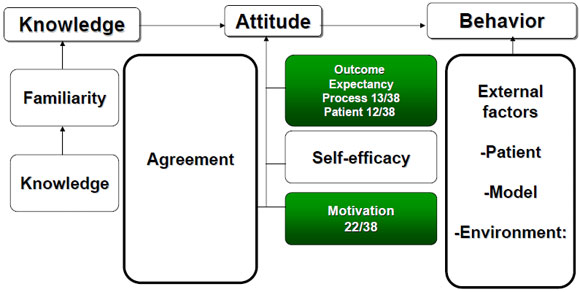
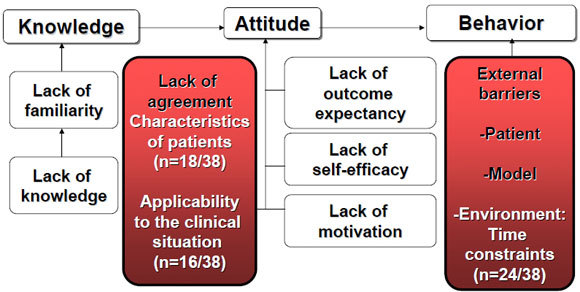
As Legare clearly points out,  however, the KAP process is far from straightforward (see also Legare and Zhang, 2013). 

[Click Below for Illustrative Images of the KAP Process: 
1. France Legare's Graphic Presentation of Facilitators in the KAP Process   
2. France Legare's Graphic Presentation of Barriers to the KAP Process. Text Source: France Legare]

Whatever the end-product of training -- preferably delivered by an accredited institution or organization -- some form of certification by an acknowledged authority is of vital importance to the skill 'holder'. Simply put, the certification or credential deflects pressure on the holder to prove, "a zillion times" after training, that he or she actually underwent the training that he/she verbally claims. Certificates or credentials are papers; papers which 'speak' with authority, on behalf of the holder, to such authorities as the holder may want them to speak to. 

Not only do credentials validate or authenticate, depending on the credibility or reputation of the issuer, they also universalize the holder's skills. They validate by linking back to the issuers' accounts of the process(es) by which the underlying skill(s) were acquired and by whom, where and when. They universalize in the sense that they are the 'passport' which allows passage into and between labour markets, as well as participation in such markets.  


1 See J.M.E. Moravcsik, Editor (1948) Aristotle: A Collection of Critical Essays. London: MacMillan


REFERENCES

Acock, Alan and M.L. DeFleur (1972) "A Configurational Approach to Contingent Consistency in the Attitude-Behaviour  Relationship." American Sociological Review. Vol. 37, pp. 714-726, 1972.

Akers, Ronald L., Marvin D. Krohn, Lonn Lanza-Kaduce and Marcia Radosevich. 1979. " Social Learning and Deviant Behavior: A Specific Test of a General Theory," pp. 636-655, in American Sociological Review. 1979. Vol.  44.           

Andrews, Kenneth and Denise Kandel (1979) "Attitude and Behaviour: A Specification of the Contingent Consistency Hypothesis." American Sociological Review. Vol. 44 (1979),  pp. 298-310)

Armstrong, Armstrong, Michael. 1999. A Handbook of Human Resource Management Practice. 7th Edition. London and Philadelphia: Kogan Page. 

Armstrong, Armstrong, Michael. 2012. A Handbook of Human Resource Management Practice. 12th Edition. London and Philadelphia: Kogan Page

ASIS. 1994. Emergency Planning Handbook. ASIS (American Society for Industrial Security)

Chien-Yun, Dai et al (2012) “A Study on Modification of Knowledge, Attitude and Practices on Vocational High School Electronics Courses Integrated with 
Nanotechnology Concept”
http://www.iasks.org/sites/default/files/ijtee20120401073079.pdf

Clelland, John (1973) “A Critique of KAP Studies and Some Suggestions for Their Improvement,” in Studies in FamilyPlanning. Vol 4, No. 2 (Feb, 1973): 42-47.

Cole, G.A (1995) Organizational Behaviour: Theory and Practice. London: Thomson Learning

Cole,G.A. (1997) PersonnelManagement: Theory and Practice. London: Letts Educational.

Cole, G.A. 2002. Personnel and Human Resource Management. Fifth Edition. London: ELST with Continuum

Dessler, Gary (2000) Human Resource Management. Delhi: Pearson Education Asia

Gersovitz, Mark et al (1998) “The Balance of Self-Reported Heterosexual Activity in KAP Surveys and the Aids Epidemic in Africa” Journal of the American Statistical Association. Vol 93, Issue 443, pp. 875-883   

Graham and Bennett Graham, H.T. and Roger Bennet. 1998. Human Resources Management. 9th Edition. London: Financial Times Pitman Publishing. [See pp. 301-304 for knowledge training, pp. 294-295 for attitude training, and pp. 296-299 for skill training]

Habermas, Jurgen (1972 ) Knowledge and Human Interest. Boston: Beacon Press 

Johnson (1976) "Organization and Management Training", pp. 2.1-2.17, in Robert L. Craig, Ed.  (1976) Training and Development Handbook: A Guide to Human Resource Development. New York: McGraw-Hill

Legare, France and Peng Zhang (2013) "Barriers and Facilitators -- Strategies for Identification and Measurement", section 3.4.a. in Sharon Straus, Jacqueline Tetroe and Ian Graham, Eds. Knowledge Translation in Health Care: Moving From Evidence to Practice. Hoboken, NJ: Wiley Blackwell. [Click here for online access to the slides version of the book]

Miller, Vincent A. 1996. “The History of Training”, pp. 3-18, in Robert L. Craig, Ed-in-Chief. 1996. The ASTD Training and Development Handbook. Fourth Edition. New York: McGraw-Hill.  http://www.amazon.com/The-ASTD-Training-Development-Handbook/dp/007013359X 

Moravcsik, J.M.E., Editor (1948) Aristotle: A Collection of Critical Essays. London: MacMillan

Needham, Joseph (1959) Science and Civilisation in China. Vol III. Mathematics and the Sciences of the Heavens and the Earth. Cambridge: Cambridge University Press

Parsons, Talcott (1970) "An Approach to the Sociology of Knowledge", pp. 282-306, in James E. Curtis and John W. Petras, Eds. The Sociology of Knowledge: A Reader. New York: Praeger Publishers.

Pattanayak, Biswajeet and Harish C. Verma. 1997. A Textbook on Human Resource Management. New Delhi: Wheeler Publishing. 

Shaw, Marvin E. and Jack M. Wright (1967) Scales for the
Measurement of attitudes. New York: McGraw-Hill

Straus, Sharon, Jacqueline Tetroe and Ian Graham, Eds. (2013) Knowledge Translation in Health Care: Moving from Evidence to Practice. Hoboken, NJ: Wiley Blackwell [Click here for online access to the slides version of the book]

Sudsawad, P. (2007). "Knowledge Translation: Introduction to Models, Strategies, and Measures." Austin, TX: Southwest Educational Development Laboratory, National Center for the Dissemination of Disability Research.


           USAID (2011) “The KAP Survey Model (Knowledge, Attitudes, and Practices)”. Arlington, VA: USAID [Click on View Tool to download a detailed text]
    
    Webb, Thomas L, Falko F. Sniehotta and Susan Michie (2010) “Using Theories of Behaviour Change to Inform Interventions for Addictive Behaviours”   http://onlinelibrary.wiley.com


WHO (2012) Health Education, Theoretical Concepts, Effective Strategies and Core Competencies. Cairo: WHO 

Thursday, January 28, 2016

Introduction to Advanced Training Techniques: CSO 589

This is the second 'edition' of the introduction to Advanced Training Techniques to appear on this blog. It too adopts a Question-and-Answer format; in this case one question and three broad answers.

Question: Why the focus on advanced training techniques?

Answer:
 
First of all, training is a key pillar of investment in human resource. Alternatively, it can be viewed as a key function of management, the other functions being: Directing (Leading), Coordinating, Motivating, Planning, Recruiting and Procuring.
A widely acknowledged and oft stated point in management and development circles  -- stated to the point of turning an important notion into a cliche -- is that people are the most valuable resources [or ‘assets’] that an organization, community or society has. Indeed, it is this value to society which people represent that gave currency, in the Sixties, to the term Human Capital. This was later widely replaced by the term HR; and now HRM and HRD are among the most commonly used acronyms around.

If HR are so valuable, it follows that we must invest in them quite deliberately in order to maximize their potential. Certainly, we shouldn’t let HR go to waste or lie idle. We can invest in HR in a number of ways: We can improve on nutrition, or ensure first and foremost that there is enough of basic food requirements to go around. We can invest in health: child, public, occupational and the like. We can provide adequate or improved shelter. We can provide requisite security. We can recruit people into into specific 'jobs' or roles in our various organizations and enterprises. And we can allow or facilitate HR migration to elsewhere: from rural to urban or other rural areas; from one country to neighboring ones, or overseas. Above all, perhaps, we can educate and train people – and employ them.

It can generally be said that we train people in order to make them more productive, but the reality of training is more complicated than that.  There is obviously societal need to operate more seamlessly, more predictably and more optimally. In a word, the need to make society operate as though it were a healthy, robust and clearly purposeful organism. 

Thus, secondly, if we opt to educate and train, we are compelled to decide how best to do so; and to do so we must (a) explore how humans learn -- i.e. the nature of learning, or how Knowledge, Attitudes and Practices (skills, competences and competencies) are learned and acquired; (b) interrogate the various ways in which training is (or should be) effectively conducted and the trainer’s/facilitator’s role is (or should be) construed or constructed; and, (c)  discover ways in which humans can be made to learn or train more effectively. We are compelled, in other words, to examine the various training techniques to decide which ones are most appropriate in/to given situations -- for the learners and for the sponsoring entities.

So discovering and implementing those ways is the broad purpose of this course. It is “Advanced” because we seek to go beyond mere descriptions of form (of categories and types of training techniques) in order to look in some detail at content (the ‘how tos’ of specific techniques) and method; and because we seek to look into the interplay between theory and method in a broad TOT context.

Third: One of the greatest challenges confronting trainers, facilitators and the institutions or organizations which they serve is the actual or perceived gap between the skills supplied and those actually demanded by diverse segments of national or global labour markets. There is, it is argued, a skills gap which hampers employers' capacity to optimize available opportunities. All the blame for this is directed toward universities, in particular, and other educational or training institutions. Potential employers despair and cry foul, faced with what they see as waves, year after year, of graduates armed only with theoretical knowledge and hollow paper qualifications.  And yet institutional training on a mass scale cannot have degree or diploma programmes tailor-made for the very specific skill-needs of every employer (extant or still to come) in every sector of an economy. Employers demand a targeted approach to training, and demand it, as if they didn't know, of institutions hard-wired for the shotgun approach to skill-building (which delivers competence to a far greater degree than it can mould competency); institutions too timid to offer a robust corporate responses to such accusations -- which are largely sanctimonious and self-flattering. "So, what's one to do to make progress?" That's one of the tough questions we will have to wrestle with. 

*                           *                       *                          *

We will, as we move along, encounter many training techniques (or methods) in this course – over 35 (thirty five)[1] in fact. However, there is frequently close interweaving among apparently dissimilar (or disparate) techniques or sets/clusters of them. Indeed, it has been argued that, in practice, training techniques have been “adapted and combined in an almost infinite variety of ways”; and “even the most widely used and well-known” techniques “show wide variation in use depending on factors [external to the techniques themselves] such as instructors and trainees involved and the task being learned” (Arnold, Robertson and Cooper, 1996: 254)[2]. 

Among these best-known techniques are: Lectures, Case Studies, Demonstration and Practice (Arnold, Robertson and Cooper, 1996: 254). Lectures, such as today’s. Case Studies, such as Harvard Business School is famous for. Demonstrations, as in Mke Nyumbani, but not as in the demonstrations that the students of the University of Nairobi “have been known” for. And Practice, as in the learning by doing that is characteristic of apprentice training, on the job training, delegation, assignment, extension workers demonstrations, teaching practice, doctors’ internship or lawyers’ pupilage, high school laboratory work, and so on. 

Other well-known techniques not immediately related to the above are: Classroom Instruction, Coaching (though many observes do not take it as such, for example the football coach – who is only supposed to win matches), Use of Audio-Visual Methods, Games and Meetings of various kinds.

There is a very strong TOT (Training of Trainers) element in this course. How does the TOT approach come in? This question is addressed at various points in the course, if often obliquely. But, very briefly, the answer to that question is as follows: The course will deliver K and, hopefully (directly and indirectly), an enhanced or reconfigured set A – which should lead to (translate into) enhanced P. The same process should cascade to the trainees you will subsequently train. We know we are training experts – even champions. But we also want to have a multiplier effect. This can best be achieved via a TOT format.

END OF ANSWER


[1] (1) Apprenticeship (2) Shadowing (3) On-the-job experience (other than apprenticeship) (4) Attachment/Placement (5) Induction/Orientation (6) Demonstration (7) Coaching (8) Mentoring (9) Job/Position Rotation or Secondment or Externship (10) Delegation (11) Job Enrichment/Enlargement (12) Project Guided/Selective Reading (13) Guided Experience (14) Programmed Instruction/ Learning (15) Computer-Based Training (CBT) or E-Learning (16) Computer-Managed Instruction (CMI) (17) Use of Audio-Visual Methods (18) Use of Interactive Video (19) Use of CCTV (20) Team Learning or T-group Training or Laboratory Training or Group Dynamics Training or Group Methods (21) Leadership/Management Training/Development (22) Lectures (23) Classroom Instruction (24) Seminars (25) Workshops (26) Conferences (27) Meetings (28) Panels (29) Case Studies or Case Method (30) Role Play (31) Games such as Management and Business Games (32) Simulation (33) Drills and Exercises (34) Behaviour Modelling Training (BMT) (35) Correspondence Study or Independent Study or Self-Directed Learning or Training By Objectives (36) Scenario Building or Vision-Building and (37) Sensitivity Training.
[2] Arnold, John, Ivan T. Robertson and Cary L. Cooper. 1996. Work Psychology: Understanding
               Human Behaviour in the Workplace. New Delhi: Macmillan India.

Thursday, April 19, 2012

On Dawkins' Notion of Memes as the Emergent Drivers of Human Evolution


In his book, The Selfish Gene, Richard Dawkins, who was born in Nairobi, Kenya, argues that culture represents a Darwinian struggle among memes. He sees a meme not as a mind-virus but as "a unit of cultural transmission, or a unit of imitation,” just as a gene is a unit of biological transmission. That is to say, memes replicate through imitation, and some are more successful at this than others. So Darwin’s concept of genetic (natural) selection is replicated in, and eventually is to be surpassed by, Dawkins’ idea of memetic selection: “Cultural transmission is analogous to genetic transmission...[and] can give rise to a form of evolution” (but see note 1 below, in which Susan Blackmore makes a case for The Third Replicator).

Genes are domiciled in the gene pool, which, broadly speaking, is the biosphere – itself a crucial component of nature (bio-geosphere) as such. Conversely, memes are domiciled in the “meme pool”, which, broadly speaking, is the ideosphere – or culture. I broadly define culture here to include rules, values, symbols of all kinds, artistic endeavours, scientific and other ideas (including human ingenuity and inventiveness), rituals and practices of all sorts, artefacts (as both the basis and outcome of practices), inventions, technology (as a fusion of knowledge, know-how, software, hardware, orgware and practices of all sorts), memories of the past as well as visions of the future, and a widening range of structures and systems developed in the course of social life. There are several 'classical' definitions of culture, such as Geertz's and Taylor's, which mine has benefited from -- and which mine will hopefully be seen to add value to.

Dawkins suggests that the crucial role that genes, being replicators, play in biological evolution will be increasingly matched by the role played by memes in cultural evolution – based on the principle (or law) that “all life evolves by the differential survival of replicating entities.” Eventually, he implies, memes will be more crucial to human survival and indeed evolution than the genes have hitherto been. In other words, the cultural environment, the meme pool in which memes thrive and indeed evolve, rather than the biosphere as such, may eventually be the primary catalyst even of genetic-biological evolution as we have understood it -- and even if such catalysis comes about via the highly technical, meme-driven, tweaking of the physical environment, or of its actual or likely consequences if unmediated, over extended Time.

That is to say, if the “old gene-selected evolution, by making brains, provided the ‘soup’ in which the first meme arose,” then the meme-selected evolution, by making culture – through the dialectical interface of the brain (human thought and conscious practice) and not just the biosphere but the geosphere as well -- is providing the ‘soup’ (the cultural ‘soup’) in which the meme will replace the gene as the dominant, speedier, force in the biological evolutionary process.

One piece of undeniable evidence of meme-induced genetic evolution -- evidence of which each non-black human is a breathing example -- is natural skin colour? Variation in skin colour, the basis of the lay individual's idea of racial difference, began only as a result of human migration and adaptation to climates, "ages" (such as the series of documented ice ages) and regions far from the origin of humankind in Africa (read more here). Human (ex-African) survival in those other 'climes' was due to adaptation, but the point being made by Dawkins and others (such as Laland, Odlin-Smee and Myles) -- and to which I subscribe -- is that adaptation itself was possible only because of the array of memes (that is, ideas and broader clusters of culture-items) which humans brought along with them or devised along the way and through time (for more on my take on human migration with reference to Dr. Alice Roberts' documentary titled "The Incredible Human Journey", click on this link, or this).

Among the most important, and typically overlapping or mutually reinforcing, memes must surely have been: (a) the long-term development and coordinated use of language (following the mutation associated with the language gene) for survival and unprecedented capacities for collective strategy, conquest and advancement, (b) body cover (animal skins and furs to begin with) consciously crafted to help outlast the long wintry seasons (read more here), (c) the shoe meme, (d) weapons (including projectiles) and body armour of all kinds, (e) built shelters and other safe-haven spaces, (f) utensils and tools for a multiplicity of purposes, (g) an evolving chain of ontological, governance and management ideas, (h) the conquest of fire, (i) transportation modes adapted to terrains come upon over time, and (j) changing ideas about diet.

All forms of cross-breeding (of dogs, horses and cattle, for example), are examples of meme-based evolutionary trending. Except, of course, that such trending is possible only if the problematics of sterility, deformity, pathology, retardation, runaway or cancerous growth, and/or other congenital dead-ends are overcome and healthy intergenerational replication assured. Other potential examples of genetic (re)engineering or preservation driven by memes include the lab-enabled production of GM foods or other substances; the building of normative, legal and physical sanctuaries for species endangered by the consequences of our own intended or unintended decisions, or by long-term ecological change; and artificial insemination (as is becoming increasingly necessary for giant pandas).

In articulating his ideas about memes, and about the connection between memes and genes, Dawkins has of course benefited immensely from the thoughts of Aaron Lynch and Douglas Hofstader. In addition, his conversation relating memes to culture or the ideosphere must be seen in the context of his precursors’ own conceptualizations of the ideosphere and the noosphere, for example; and of how these impact the geosphere. Important among these precursors are: Henri Bergson (1859-1941), Vladimir Vernadsky (1863-1945), Edouard Le Roy (1870-1954), and Teilhard de Chardin (1881-1955). More recent writers are of course picking up from them.


Certain other questions, related or unrelated to the above conversation, obviously need to be asked about meme-driven evolution. Let me ask a few:

  1. Didn’t someone say two or so decades ago that our little toe is doomed to extinction due to the ‘invention’ of shoes; that is, due to the continued dominance of the shoe meme at our feet? If that were doubly true, would it be an example of the sort of culture- or meme-induced biological evolution that is being suggested? And aren’t there similar examples already? [But some people are fighting back against that evolutionary menace, as you will read here]
  2. Would life after the conscious extinction of a pathology such as small pox or, hopefully, sickle cell anaemia be a tell-tale form of evolution – whose evolution? What about the eradication of blindness, or the meme-assisted growth of 3rd to nth generation teeth? [In both cases, Smith (1993) would argue, it is human evolution. The article by Young et al (2005), focusing on differential susceptibility to hypertension, is relevant here -- certainly in a back-handed way]
  3. Will not the long-term, technology-intensive, survival over many millennia of human voyagers through otherwise unrelentingly hostile outer space involve a form of meme-impacted evolution that mirrors what we have seen with human migration on earth? Or will the evolutionary ‘switch’ inside the artificial environments (or constructed 'niches') have to involve something more drastic and more sudden – such as a new, spider-like, human skeleton, as has already been predicted? In which case, might the spiders in our midst be marooned (‘reverse’) aliens? [Laland, Odling-Smee and Myles (2010) have given a very strong and direct answer to the question about the influence of meme-inspired niches on genetic change  (see note 3 at the bottom of this article; Lehman (2007) also interrogates the evolutionary effects of "niche construction" in an interesting way, though not quite with the focus of attention called for by this question]
  4. Will it be correct, and if so proper, to see the genetic modifications and hybridities likely to result from future scientific work as incremental acts of creation, so long as the results of those acts meet the set criteria for high and long-term memetic-genetic survival and evolution, namely: longevity, fecundity (or speed of replication) and copying-fidelity  (Dawkins, 1989: 17, 194), as well as a conquering devotion to the future (what Lynch calls "motivational advantage"), broad acceptance by the general public (Lynch calls this "cognitive advantage"), and the elimination of all threats (in Lynch's words, "sabotaging the competition") that stand in the way of meeting the set criteria?(see Lynch, 1996; read Paul Marsden's review of Lynch's book, Thought Contagion).
Notes: 1. Here is is an account of Susan Blackmore's variation on the above theme, attributing a new form of evolution to digital information. In an article in The New York Times of August 10, 2010, Susan Blackmore herself "conversed" about the existence of a third replicator -- the teme (the technological meme), a concept which, unlike Dawkins' meme, refers to "digital information stored, copied, varied and selected by machines" -- presumably machines made by humans and not machines (although machines making machines can already be imagined and attempted, by humans)
          2. My article, titled "Toward a Theory of the Memetic Sphere", is relevant to the present conversation, and to the notion of the third replicator (which I did not mention).         
          3. Laland, Odling-Smee and Mlyes (2010) point out as follows: "...niche construction can modify selection,...can allow the persistence of organisms in inhospitable environmental conditions that could otherwise lead to their extinction, and be favoured even when costly because of the benefits that will accrue to distant descendants. However, mathematical models reveal that niche construction due to cultural processes can be even more potent than niche construction due to other (gene-based) non-cultural processes, and they show that cultural niche construction can modify selection on human genes, with resulting effects on evolutionary outcomes. Indeed, human niche construction is informed by a uniquely potent and cumulative cultural knowledge base."
          4.  I first came across John Maynard Smith's book titled The Theory of Evolution, which was published in 1993, only this morning (May 12, 2012), as I browsed in the Jomo Kenyatta Memorial Library at the University of Nairobi. Based on my quick reading, especially of the last chapter, I note that Smith, like Dawkins, had already made a number of the key points that I make above. However, some of the important ones that I make do not seem to explicitly feature in Smith's book; for example, the shoe meme, the memetic basis for human 'racial' groups, the 'language gene' (on page 343 of the book he remarks that don't know "how ancient speech is", but they have since come to know).
    In particular, I should reiterate here what I have been meaning to since May 2, I should underscore here the meme that, I think, is of the greatest importance (second only to language as a whole) to human spread, survival and evolution across the planet's colder surfaces and across time -- a meme far greater than the shoe meme or the housing meme, or even the genetic resistance to infectious diseases which Smith (1993: 330), I note belatedly, so strongly emphasizes -- this is the clothing meme. The invention and progressive refinement of clothing -- a concept I use here as an umbrella term for all forms of warm and dry all-body cover against the elements, in particular extremely cold weathers or climates -- I believe, is at the root of human conquest of the earth; just as it will be of our conquest of other earth-like planets.
    Smith (1993: 343?) remarks that "Evolution tends to adapt the nature of animals to their environments. In history, man has adapted his environment to his nature." However, the clothing meme reveals something significantly more subtle. It does not exemplify the conscious adapting of the natural environment to human nature. Instead, it is (let me say it clumsily) a massively consequential 'sleight of hand' -- a 'magical' sort of simulation or mimicry (of animal nature, say mammoth, wolf, reindeer, polar bear or bison), an illusionist's 'going under the skin'  -- which represents, and whose consequences are, nothing less than the adaptation, at once virtual and contrived/artificial and real, of human nature to the natural environment.
         5.  Additional material inserted on April 20, 22, 27, 28, 2012; May 1, 2, 12, 2012.