Showing posts with label Knowledge. Show all posts

Friday, October 21, 2016

CSO 589: Advanced Training Techniques ~ Course Outline and Reading List, September-December 2016 Semester


COURSE OBJECTIVE

To engage current and prospective trainers and training managers in a joint quest for innovative solutions to the training needs and competency aspirations of different levels of an evolving workforce.

COURSE DESCRIPTION/CONTENT


Key concepts. The nature and patterns of learning in human society. The historical evolution of the learning process. Linkages between Knowledge, Attitudes and Practice (KAP), respectively. Applying the KAP model and its derivatives to learning and training situations. Training typologies and training specifications. Selected theories and models of learning, training and skill-acquisition, Un-packaging, repackaging and fine-tuning identified training techniques. Devising innovative solutions for today’s problems. Linking identified training solutions to real-life challenges, and to selected substantive areas (clusters) covered in the Department’s M.A curriculum.

Tuesday, March 08, 2016

CSO 302: Qualitative Research Methods ~ CAT Questions for Jan-Apr 2016 Semester ~ UoN

UNIVERSITY OF NAIROBI
DEPARTMENT OF SOCIOLOGY
CSO 302: QUALITATIVE RESEARCH METHODS
SEMESTER: January-April 2016 [Regular and Module II]


CAT QUESTIONS [Released: 3:15 p.m., March 8th 2016]


You have four questions divided equally into Sections I and II. Answer only one question from each section, for a total of two.
Click Here to Access the CAT Questions

DEADLINES:  
1. Regular + Module II Day Class: Friday, April 1st, 2016, strictly by 11:00 a.m.

2. Module II Evening Class: Saturday, April 2nd, 2016, strictly by 11:00 a.m.

Thursday, March 03, 2016

The Apprentice's PKA


In a recent blog piece, focusing broadly on KAP, I remarked as follows:
"The 'KAP approach' is indeed not immune to this ebb and flow of a puzzle. However, its focus of attention is not directly on the easier path to the knowledge-action space. Rather, the focus is on the (taken-for-granted) flow of effects that one should typically see, empirically if not so readily theoretically, from imparted knowledge, as the starting point, to attitude (a concept which subsumes/ presumes values) and on to behavior or practice. Clearly, however, K is not always the starting point of the great variety of human ventures that we can bring to mind. The explorer's mind-set, for example, does rearrange the KAP sequence into another: APK." 
READ: The Explorer's APK

Here, I want to say something very briefly about PKA, which is qualitatively different from KAP and APK. I make use of the confounding and yet familiar imagery of the apprentice. I want to say that, first and foremost, the apprentice 'apprehends' the responsibilities and expectations of his or her 'chosen' work-role through, and by means of, practice. That is to say, the 'practical' apprehension of a specific form of practice makes the apprentice. A keen look at the phenomenology of apprenticeship supports this eye-view. So, too, the weight of definitions of it.

Apprentice training is a form of output training, as defined by Mullins (1999: 689-90). According to him, output training is typically conducted by small enterprises or organizations, whose driving concern is to optimize output from new employees or newly deployed equipment within the shortest time possible. The goal is to defray the costs of such employment or deployment in the shortest time possible, and/or to justify the investment risk involved (Mullins, 1999: 689-90). 

Mullins (1999: 689) adds that "This type of training is centred around the individual, is performed in-house and is only initiated when new equipment, product or persons are introduced into the organisation." 

Mullins' definition is consistent with several others. For example, The Working Centre defines apprenticeship as "a workplace-based training program for people who want to work in a skilled trade" (see ww.theworkingcenter.org). One online business dictionary likewise defines apprenticeship as a:
"[A method] in which trainees learn a craft or trade by hands-on experience while working with a skilled worker, usually under a written or implied indentureship agreement."
Here is a more extended definition by Fuller and Unwin (2013: 2):
"Apprenticeship should be a model of learning for skill formation which takes the apprentice on a journey to becoming a full member of an occupational community. This assumes that there is a defined occupational community to join; and that apprenticeship is a recognised and formalised route to achieving the relevant occupational expertise required to join the community. What follows from this is that each occupation has a defined knowledge-base and an associated curriculum which has to be completed and examined in order for the apprentice to show that they meet the requirements to practice as a recognised member of the community. As a result, the apprentice has at the outset a clear sense of the occupation they are aiming for, and that if they meet the requirements they will gain the necessary certification for employment in that occupation." 
These definitions suggest that the apprentice's course or trajectory of skill-acquisition does not track the standard 'KAP approach'. Instead, what we witness is a PKA process whereby learning begins emphatically with Practice, which generates Knowledge -- certainly of the 'how-to' variety. Knowledge culminates in Attitude change, or attitude settling. 

One may of course prefer an alternative view, whereby the apprentice's P in due course branches simultaneously and equally (in)to K and A, with the two eventually fusing into a sort of K/A, or even A/K. However, I find PKA to be more logically sustainable.

REFERENCES
Fuller, Alison and Lorna Unwin (2013) "Apprenticeship and the Concept of Occupation: Briefing Paper" London Institute of Education, University of London (www.gatsby.org.uk)

Mullins, Laurie J. (1999) Management and Organisational Behaviour. London: Financial Times Pitman Publishing

Tuesday, March 01, 2016

KAP as a Model of Behavior Change and Innovative Practice {CSO 589}


I. Introduction:
A recurring, if often contentious, theme in the literature on diffusion of innovations, and more specifically on how best to time (or synchronize) the spread of innovation-linked skills and 'habits', is that three key factors (or variables) -- Knowledge, Attitude and Practice (KAP) -- are implicated in such an exercise, as part of broader HR management and training processes. Johnson (1976: 2.2), for example, points out that one of the purposes of training is to develop "new skills, knowledge, understanding, and attitudes" (see also Clelland, 1973:42-47; Gersovitz et al, 1998: 875-883; Sudsawad, 2007; Webb, Falko, Sniehotta and Michie, 2010; USAID, 2011; WHO, 2012; Chien-Yun et al, 2012; and Strauss, Tetroe, and Graham, Eds, 2013; Legare and Zhang, 2013). The theme recurs, indeed, but in a more assertoric than theory-driven or empirical evidence-adducing fashion in the texts typically published for certain courses in academia. Still, the 'KAP approach' has a powerful intuitive and intriguing appeal.

Armstrong (1999: 488; 2012: 274-308) is an enduring influencer in the KAP conversation; but he singles out practical experience and, more recently, workplace-specific challenges as anchors for the drive toward high-quality learning. He adds, moreover, that "Individuals must be motivated to learn...[and] should be aware that their present level of knowledge, skill or competence, or their existing attitude or behaviour, needs to be improved..." (Armstrong, 1999: 494-495). So practical experience, motivation and the environment in which work actually takes place are key factors in Armstrong's visualization of the KAP process.

Pattanayak and Verma (1997: 94) have briefly weighed in here, too, and define training as a process "designed to improve and bring about measurable change in knowledge, skills, attitude and social behavior..." So 'measurable change' is a useful metric for them. Cole (2002: 380-397; see also 1995: 138-137), on his part, notes that learning implies observable change, which "usually manifests itself through behavior". Measurable and observable change mean the same important thing, of course. As already indicated above, there are even more recent contributors to this discourse. All in all, KAP is a clearly converging meme in the behavior-change management conversation.

II. The KAP Approach:
The 'KAP approach' is a kind of holy grail, and not just for training facilitators. Educators and learners of all strands as well are energized, in one way or another, by the value they see in it. That is to say, the value that it represents for clarifying the causality of practice and spotlighting the reinforcement processes likewise associated with practice. It is worth noting here that, as Cole (1997: 254) has keenly observed, a fundamental characteristic of learning "is that is acquired." It is acquired through training of one or another kind.

Training has a long history, as Miller (1996: 3-18) has suggested. And, Dessler (2000: 253) asserts, "Training is essentially a learning process..." We can say in general that we educate and train people in order to make them more predictably productive in their behavior; and more proactive in whatever ways they apply such 'learning'. Such predictability and proactivity of the 'parts' create in society itself, or 'the whole', the capacity to function more organically, as well as more purposefully. However, the realities of learning, and of how society organizes itself -- or how individuals and groups within it do -- in order to optimally leverage the learning, are more complicated and less straightforward than first appears. Still, leveraging is innovating. 

READ: CSO 589 Advanced Training Techniques...  


The 'KAP aproach' is a useful formula for interrogating the phenomenological interplay between knowledge, as mediated by attitude -- itself in turn invariably or potentially mediated or 'disrupted' by key contingent factors -- and behavior/practice/action change. It has an interesting scholastic pedigree, to say the least.

Since the +4th century, one understands, the Chinese have debated, reversed and reversed the converse of the saying: "Action is easy but knowledge is difficult", which was Sun Yat Sen's version in the early 20th century. A +17th century Chinese thinker, Wang Chhuan-Shan, used to say: "Knowledge is the beginning of practice, and practice is the completion of knowledge" (see Needham, 1959: 165-6).

The 'KAP approach' is indeed not immune to this ebb and flow of a puzzle. However, its focus of attention is not directly on the easier path to the knowledge-action space. Rather, the focus is on the (taken-for-granted) flow of effects that one should typically see, empirically if not so readily theoretically, from imparted knowledge, as the starting point, to attitude (a concept which subsumes/presumes values) and on to behavior or practice. Clearly, however, K is not always the starting point of the great variety of human ventures that we can bring to mind. The explorer's mind-set, for example, does rearrange the KAP sequence into another: APK. Other permutations can easily be imagined as well. Here's the totality of the nuances:
KAP   KPA
APK   AKP
PKA   PAK

READ: The Explorer's APK.
READ: The Apprentice's PKA

II.1. Knowledge
According to Talcott Parsons (1970: 304), knowledge (the essential content of the sociology of knowledge) refers to: "cognitively ordered orientations to objects, with reference both to empirical facts and to problems of meaning." According to him, then, the sociology of knowledge has two primary foci, namely:

1. Empirical facts, and -- particularly with reference to "the social system" as the 'empirical' object -- the attendant problem of ideology
2. Problems of Meaning, and the Weberian preoccupation with religious ideas (Parsons, 1970: 304)

Knowledge, as I understand it, refers to: the ability to DO, tell, describe, explain, show, and/or say. Thus, to know is to be able to do, tell, describe, explain, show or say. The extant literature acknowledges that knowledge has three components: Subject (one who knows), Object (that which one knows), and Cognition (the act of knowing). Conversely, Habermas (1972) suggests that there are three categories or types of knowledge:
1.         Scientific, Empirical-Analytic Knowledge
2.         Hermeneutic-Historical Knowledge
3.         Critical Knowledge

There are yet other ways of classifying or labelling knowledge, which we will not dwell upon here, such as: Apodictic ('Scientific', 'Certified'), Assertoric (Empirical 'facts'), and Problematic (Critical, Speculative, Predictive-Deductive).


II.2. Attitude and Attitude Theory:

Winston Churchill is said to have remarked, with deep insight, that: "Attitude is a little thing that makes a big difference"

Attitude, incorporating values, refers to “An individual’s characteristic way of responding to an object or situation. It is based on experience [or knowledge] and leads to certain behavior or the expression of certain opinions.” (Graham and Bennett, 1998: 294). That is to say, the concept of attitude stands for:
"... a relatively enduring system of affective, evaluative reactions based upon and reflecting the evaluative concepts or beliefs which have been learned about the characteristics of a social object or class of social objects. As an affective reaction, it is a covert or implicit response... [In other words] it is a drive-producing response which elicits motives and thus gives rise to overt behavior" (Shaw and Wright, 1967).

The basic question in attitude-behavior theory is the extent to which a person's attitude toward a certain behavior (such as drug- taking, drinking illicit-brew or wearing a three-piece suit) can be used to predict how that person will actually behave when confronted with the opportunity, for example, to drink such brew.

The debate is not yet settled as to whether (knowledge of) one's attitude toward 'something' is a reliable predictor of one's behavior vis-a-vis that 'thing,' and vice-versa. There is, in other words, no consensus in the literature concerning the linkage between attitude and behavior. Thus:

1. Some writers argue that a person's attitude toward a given behavior is a consistent predictor of the person's actual behaviour. Conversely, if a person behaves in a certain way, then it can be inferred that the person has attitudes which predispose him/her to     behave that way. 

But what about behavior that one is forced by other persons (significant others), or economic circumstances, for example, to adopt? 

2. Other writers argue that "overt behaviour" varies independently with attitudes. In other words, one's attitude toward a particular behaviour or practise have no bearing on one's actual behaviour, and vice versa. That is, you may disapprove of three-piece suits, but still wear them for other, such as ceremonial or broadly pragmatic, reasons.

3. Yet other writers argue that attitudes affect behavior, but that 
the impact of attitude on behavior is mediated by contingent or 
situational factors (Acock and DeFleur, 1972: 714-726).

Andrews and Kandel (1979: 298-310) generally equate situational factors with "perceived group norms" held by "significant others and expressed either verbally or in actions." In my view, situational factors can be represented not only by perceived group norms but also by factors such as:

1. Socio-Economic Status: based inter alia on income, wealth, occupation, age, gender, race, education and religion

2. Level of experienced psychological or physiological stress.

3. Availability of facilitating or enabling means: such as having the money to buy what is needed, assuming the availability of the needed item. Armstrong (1999: 488) might want us to add here the example of, already mentioned above, of "workplace-specific challenges". 

4. Level of attachment to the attitudes of relevant out-groups toward the behavior in question.

Theorists who emphasize the importance of contingent factors in the uncertain interplay between attitude and behavior are persuasively on firmer ground. This suggests that, for policy makers, there is not quite yet a precise formula for generating a critical mass of well-informed and proficient practitioners.


II. 3. Practice as Behavior and Behavior as Action
Practice refers to applied skills, techniques, methods or standard operating procedures (SOP). It can indeed be argued that practice or behavior is applied attitude. These are actual patternsof physical behavior, activity or action. In this case, action, activity or behavior deriving more or less directly from a given knowledge-base and mediated by attitudes that are also rooted in that knowledge. Skill refers to know-how -- that is, knowing, or capacity for, "how to".

That is to say, a skill is:

“An organized and coordinated pattern of mental and/or physical activity in relation to an object or other display of information, usually involving both receptor and effector processes [a receptor process provides the sensory input, while an effector process performs the output or response function]. It is built up gradually in the course of repeated training or other experience. It is serial, each part from second to second is dependent on the last and influences the next. Skills may be described as perceptual, motor, manual, intellectual, social, etc. according to the context or the most important aspect of the skill pattern.” Definition from the UK’s Department of Employment’s Glossary of Training Terms, as quoted in Graham and Bennett (1998: 296). 

A skill is, additionally, “A practiced, expert way of perceiving a relevant stimulus and then responding to it” (Graham and Bennett, 998: 296)

II. 4. The Practical Challenges of Changing Action/Behavior Patterns via Knowledge and Attitude Change
It is worth emphasizing that the acquisition of a 'body' of professional knowledge incorporates or 'engenders', or has built into it, a set of certain professional values, attitudes, worldviews and/or orientations which can or do impact practice. So practice means not only applied skills, techniques and or methods -- in a word SOP (Standard Operating Procedures) -- but also, very importantly, applied attitudes. The linkage between attitude and behavior becomes a matter of practical concern, such as when we use the mass media, for example, to fast-track the spread of IT skills, or spearhead a disease prevention or political-party mobilization campaign.

In principle, all educational programmes explicitly or implicitly acknowledge that attitude and behavior are interlinked. Such a programmes have as their starting-point the view that desired behavior-change must be preceded by appropriate attitude change, rooted in new knowledge. Thus, such programmes devote a good deal of resources and effort to the introduction of new or relevant knowledge, information or ideas. To make headway in all this, certain questions, which press for answers, must be addressed. These include:

1. How much attitude conditioning (for example through media campaigns -- including advertising and propaganda) is necessary and sufficient to bring about the desired behaviour-change? 
2. To what extent should attention focus on attitudes as opposed to, say, physical and legal restriction, or facilitation of availability or access?

3. Under what circumstances can we mass-target, and for how long? 

III. KAP and Training Typologies

The 'KAP approach' suggests that all “training” falls under the following broad categories: 
1. Training, or re-training, in Knowledge 
2. Training or re-training in Attitude 
3. (a) Training or re-training in Skills/Practices/Behaviors, including, (b) Management Training.

But a detailed interrogation of the training function suggests a rather different kind of classification. In other words, we can identify not three but four main types of training for which prospective trainees may apply, or to which they may be admitted. These four main types, it turns out, are various permutations and combinations of K, A and/or P. 

Naturally, such application and admission presuppose and reflect the identification of a training need or gap, operationalized into training specifications -- that is, into the broad content of the training required. For each training type listed, then, we show examples, not an exhaustive list, of related training techniques. Many of these techniques naturally feature in more than one type of training, given their plasticity -- that is, their broad applicability: 

1.     Knowledge Training: Appropriate knowledge training techniques include: coaching, induction, internship, case study, mentoring, formal lectures, seminars, conferences, conventions, symposia, panel-forums, programmed instruction (or CBT or e-learning generally) and study tours (Graham and Bennett, 1998: 301-304; Armstrong, 2012)

2.     Attitude Training:  Examples include: "on-the-job experience within a group of employees Whose attitudes are thought to be appropriate" (Graham and Bennett, 1998: 294), on-the-job training via attachment to a senior employee whose attitudes are assessed to be exemplary, off-the-job training involving group discussion of case studies which highlight proper attitudes, off-the-job role playing exercises, induction, mentoring, T-groups as an off-the-job approach to training (T = Training), team learning, sensitivity training and group dynamics training generally (Graham and Bennett, 1998: 294-295; Armstrong, 2012)

3.     Skill Training: This is realized through, inter alia: apprenticeship, demonstration, on-the-job training and formal vocational/technical (or tertiary) level training, delegation, job rotation, coaching, assignment, drills and other types of exercise, role playing, and projects (see, for example, Graham and Bennett, 1998: 296-299; Armstrong, 2012)

4.     Experiential Training: Examples here include: attachment, games, case work, simulations, behavioral modelling, outward bound programmes and living-abroad programmes (see, for example, Pattanayak and Verma, 1997: 95)


IV. Conclusion
It can be inferred from all the foregoing that, illuminating as it is, the KAP approach rides roughshod over the attitude-behavior debate (or debacle), stating simply that: KAP = Knowledge (changes/modifies) Attitude (which changes/modifies) Practice. That is to say, knowledge changes (predicts) attitudes, which change (predict) the learner's pattern of practice (or action or behavior). 

Conversely, of course, one's practice reveals one's attitude, and one's attitude reveal one's stock of knowledge or experiences. This knowledge-base can thus be systematically exposed (subjected) to pre-selected 'influencers', and so changed -- with beneficial ripple effects on attitude clusters and subsequently sets of practices. Key 'influencers' here are teachers, trainers, change-agents and media of all sorts. 

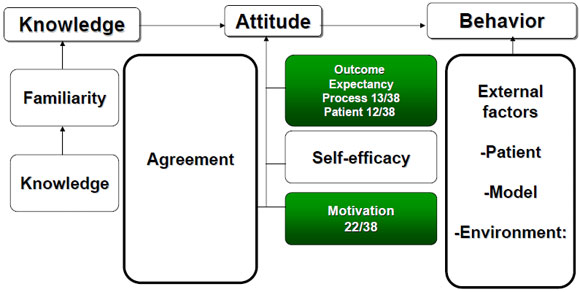
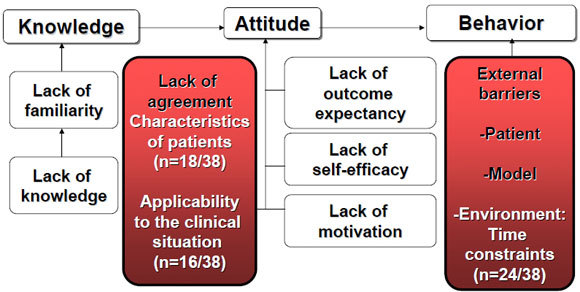
As Legare clearly points out,  however, the KAP process is far from straightforward (see also Legare and Zhang, 2013). 

[Click Below for Illustrative Images of the KAP Process: 
1. France Legare's Graphic Presentation of Facilitators in the KAP Process   
2. France Legare's Graphic Presentation of Barriers to the KAP Process. Text Source: France Legare]

Whatever the end-product of training -- preferably delivered by an accredited institution or organization -- some form of certification by an acknowledged authority is of vital importance to the skill 'holder'. Simply put, the certification or credential deflects pressure on the holder to prove, "a zillion times" after training, that he or she actually underwent the training that he/she verbally claims. Certificates or credentials are papers; papers which 'speak' with authority, on behalf of the holder, to such authorities as the holder may want them to speak to. 

Not only do credentials validate or authenticate, depending on the credibility or reputation of the issuer, they also universalize the holder's skills. They validate by linking back to the issuers' accounts of the process(es) by which the underlying skill(s) were acquired and by whom, where and when. They universalize in the sense that they are the 'passport' which allows passage into and between labour markets, as well as participation in such markets.  


1 See J.M.E. Moravcsik, Editor (1948) Aristotle: A Collection of Critical Essays. London: MacMillan


REFERENCES

Acock, Alan and M.L. DeFleur (1972) "A Configurational Approach to Contingent Consistency in the Attitude-Behaviour  Relationship." American Sociological Review. Vol. 37, pp. 714-726, 1972.

Akers, Ronald L., Marvin D. Krohn, Lonn Lanza-Kaduce and Marcia Radosevich. 1979. " Social Learning and Deviant Behavior: A Specific Test of a General Theory," pp. 636-655, in American Sociological Review. 1979. Vol.  44.           

Andrews, Kenneth and Denise Kandel (1979) "Attitude and Behaviour: A Specification of the Contingent Consistency Hypothesis." American Sociological Review. Vol. 44 (1979),  pp. 298-310)

Armstrong, Armstrong, Michael. 1999. A Handbook of Human Resource Management Practice. 7th Edition. London and Philadelphia: Kogan Page. 

Armstrong, Armstrong, Michael. 2012. A Handbook of Human Resource Management Practice. 12th Edition. London and Philadelphia: Kogan Page

ASIS. 1994. Emergency Planning Handbook. ASIS (American Society for Industrial Security)

Chien-Yun, Dai et al (2012) “A Study on Modification of Knowledge, Attitude and Practices on Vocational High School Electronics Courses Integrated with 
Nanotechnology Concept”
http://www.iasks.org/sites/default/files/ijtee20120401073079.pdf

Clelland, John (1973) “A Critique of KAP Studies and Some Suggestions for Their Improvement,” in Studies in FamilyPlanning. Vol 4, No. 2 (Feb, 1973): 42-47.

Cole, G.A (1995) Organizational Behaviour: Theory and Practice. London: Thomson Learning

Cole,G.A. (1997) PersonnelManagement: Theory and Practice. London: Letts Educational.

Cole, G.A. 2002. Personnel and Human Resource Management. Fifth Edition. London: ELST with Continuum

Dessler, Gary (2000) Human Resource Management. Delhi: Pearson Education Asia

Gersovitz, Mark et al (1998) “The Balance of Self-Reported Heterosexual Activity in KAP Surveys and the Aids Epidemic in Africa” Journal of the American Statistical Association. Vol 93, Issue 443, pp. 875-883   

Graham and Bennett Graham, H.T. and Roger Bennet. 1998. Human Resources Management. 9th Edition. London: Financial Times Pitman Publishing. [See pp. 301-304 for knowledge training, pp. 294-295 for attitude training, and pp. 296-299 for skill training]

Habermas, Jurgen (1972 ) Knowledge and Human Interest. Boston: Beacon Press 

Johnson (1976) "Organization and Management Training", pp. 2.1-2.17, in Robert L. Craig, Ed.  (1976) Training and Development Handbook: A Guide to Human Resource Development. New York: McGraw-Hill

Legare, France and Peng Zhang (2013) "Barriers and Facilitators -- Strategies for Identification and Measurement", section 3.4.a. in Sharon Straus, Jacqueline Tetroe and Ian Graham, Eds. Knowledge Translation in Health Care: Moving From Evidence to Practice. Hoboken, NJ: Wiley Blackwell. [Click here for online access to the slides version of the book]

Miller, Vincent A. 1996. “The History of Training”, pp. 3-18, in Robert L. Craig, Ed-in-Chief. 1996. The ASTD Training and Development Handbook. Fourth Edition. New York: McGraw-Hill.  http://www.amazon.com/The-ASTD-Training-Development-Handbook/dp/007013359X 

Moravcsik, J.M.E., Editor (1948) Aristotle: A Collection of Critical Essays. London: MacMillan

Needham, Joseph (1959) Science and Civilisation in China. Vol III. Mathematics and the Sciences of the Heavens and the Earth. Cambridge: Cambridge University Press

Parsons, Talcott (1970) "An Approach to the Sociology of Knowledge", pp. 282-306, in James E. Curtis and John W. Petras, Eds. The Sociology of Knowledge: A Reader. New York: Praeger Publishers.

Pattanayak, Biswajeet and Harish C. Verma. 1997. A Textbook on Human Resource Management. New Delhi: Wheeler Publishing. 

Shaw, Marvin E. and Jack M. Wright (1967) Scales for the
Measurement of attitudes. New York: McGraw-Hill

Straus, Sharon, Jacqueline Tetroe and Ian Graham, Eds. (2013) Knowledge Translation in Health Care: Moving from Evidence to Practice. Hoboken, NJ: Wiley Blackwell [Click here for online access to the slides version of the book]

Sudsawad, P. (2007). "Knowledge Translation: Introduction to Models, Strategies, and Measures." Austin, TX: Southwest Educational Development Laboratory, National Center for the Dissemination of Disability Research.


           USAID (2011) “The KAP Survey Model (Knowledge, Attitudes, and Practices)”. Arlington, VA: USAID [Click on View Tool to download a detailed text]
    
    Webb, Thomas L, Falko F. Sniehotta and Susan Michie (2010) “Using Theories of Behaviour Change to Inform Interventions for Addictive Behaviours”   http://onlinelibrary.wiley.com


WHO (2012) Health Education, Theoretical Concepts, Effective Strategies and Core Competencies. Cairo: WHO 

Thursday, January 28, 2016

Introduction to Advanced Training Techniques: CSO 589

This is the second 'edition' of the introduction to Advanced Training Techniques to appear on this blog. It too adopts a Question-and-Answer format; in this case one question and three broad answers.

Question: Why the focus on advanced training techniques?

Answer:
 
First of all, training is a key pillar of investment in human resource. Alternatively, it can be viewed as a key function of management, the other functions being: Directing (Leading), Coordinating, Motivating, Planning, Recruiting and Procuring.
A widely acknowledged and oft stated point in management and development circles  -- stated to the point of turning an important notion into a cliche -- is that people are the most valuable resources [or ‘assets’] that an organization, community or society has. Indeed, it is this value to society which people represent that gave currency, in the Sixties, to the term Human Capital. This was later widely replaced by the term HR; and now HRM and HRD are among the most commonly used acronyms around.

If HR are so valuable, it follows that we must invest in them quite deliberately in order to maximize their potential. Certainly, we shouldn’t let HR go to waste or lie idle. We can invest in HR in a number of ways: We can improve on nutrition, or ensure first and foremost that there is enough of basic food requirements to go around. We can invest in health: child, public, occupational and the like. We can provide adequate or improved shelter. We can provide requisite security. We can recruit people into into specific 'jobs' or roles in our various organizations and enterprises. And we can allow or facilitate HR migration to elsewhere: from rural to urban or other rural areas; from one country to neighboring ones, or overseas. Above all, perhaps, we can educate and train people – and employ them.

It can generally be said that we train people in order to make them more productive, but the reality of training is more complicated than that.  There is obviously societal need to operate more seamlessly, more predictably and more optimally. In a word, the need to make society operate as though it were a healthy, robust and clearly purposeful organism. 

Thus, secondly, if we opt to educate and train, we are compelled to decide how best to do so; and to do so we must (a) explore how humans learn -- i.e. the nature of learning, or how Knowledge, Attitudes and Practices (skills, competences and competencies) are learned and acquired; (b) interrogate the various ways in which training is (or should be) effectively conducted and the trainer’s/facilitator’s role is (or should be) construed or constructed; and, (c)  discover ways in which humans can be made to learn or train more effectively. We are compelled, in other words, to examine the various training techniques to decide which ones are most appropriate in/to given situations -- for the learners and for the sponsoring entities.

So discovering and implementing those ways is the broad purpose of this course. It is “Advanced” because we seek to go beyond mere descriptions of form (of categories and types of training techniques) in order to look in some detail at content (the ‘how tos’ of specific techniques) and method; and because we seek to look into the interplay between theory and method in a broad TOT context.

Third: One of the greatest challenges confronting trainers, facilitators and the institutions or organizations which they serve is the actual or perceived gap between the skills supplied and those actually demanded by diverse segments of national or global labour markets. There is, it is argued, a skills gap which hampers employers' capacity to optimize available opportunities. All the blame for this is directed toward universities, in particular, and other educational or training institutions. Potential employers despair and cry foul, faced with what they see as waves, year after year, of graduates armed only with theoretical knowledge and hollow paper qualifications.  And yet institutional training on a mass scale cannot have degree or diploma programmes tailor-made for the very specific skill-needs of every employer (extant or still to come) in every sector of an economy. Employers demand a targeted approach to training, and demand it, as if they didn't know, of institutions hard-wired for the shotgun approach to skill-building (which delivers competence to a far greater degree than it can mould competency); institutions too timid to offer a robust corporate responses to such accusations -- which are largely sanctimonious and self-flattering. "So, what's one to do to make progress?" That's one of the tough questions we will have to wrestle with. 

*                           *                       *                          *

We will, as we move along, encounter many training techniques (or methods) in this course – over 35 (thirty five)[1] in fact. However, there is frequently close interweaving among apparently dissimilar (or disparate) techniques or sets/clusters of them. Indeed, it has been argued that, in practice, training techniques have been “adapted and combined in an almost infinite variety of ways”; and “even the most widely used and well-known” techniques “show wide variation in use depending on factors [external to the techniques themselves] such as instructors and trainees involved and the task being learned” (Arnold, Robertson and Cooper, 1996: 254)[2]. 

Among these best-known techniques are: Lectures, Case Studies, Demonstration and Practice (Arnold, Robertson and Cooper, 1996: 254). Lectures, such as today’s. Case Studies, such as Harvard Business School is famous for. Demonstrations, as in Mke Nyumbani, but not as in the demonstrations that the students of the University of Nairobi “have been known” for. And Practice, as in the learning by doing that is characteristic of apprentice training, on the job training, delegation, assignment, extension workers demonstrations, teaching practice, doctors’ internship or lawyers’ pupilage, high school laboratory work, and so on. 

Other well-known techniques not immediately related to the above are: Classroom Instruction, Coaching (though many observes do not take it as such, for example the football coach – who is only supposed to win matches), Use of Audio-Visual Methods, Games and Meetings of various kinds.

There is a very strong TOT (Training of Trainers) element in this course. How does the TOT approach come in? This question is addressed at various points in the course, if often obliquely. But, very briefly, the answer to that question is as follows: The course will deliver K and, hopefully (directly and indirectly), an enhanced or reconfigured set A – which should lead to (translate into) enhanced P. The same process should cascade to the trainees you will subsequently train. We know we are training experts – even champions. But we also want to have a multiplier effect. This can best be achieved via a TOT format.

END OF ANSWER


[1] (1) Apprenticeship (2) Shadowing (3) On-the-job experience (other than apprenticeship) (4) Attachment/Placement (5) Induction/Orientation (6) Demonstration (7) Coaching (8) Mentoring (9) Job/Position Rotation or Secondment or Externship (10) Delegation (11) Job Enrichment/Enlargement (12) Project Guided/Selective Reading (13) Guided Experience (14) Programmed Instruction/ Learning (15) Computer-Based Training (CBT) or E-Learning (16) Computer-Managed Instruction (CMI) (17) Use of Audio-Visual Methods (18) Use of Interactive Video (19) Use of CCTV (20) Team Learning or T-group Training or Laboratory Training or Group Dynamics Training or Group Methods (21) Leadership/Management Training/Development (22) Lectures (23) Classroom Instruction (24) Seminars (25) Workshops (26) Conferences (27) Meetings (28) Panels (29) Case Studies or Case Method (30) Role Play (31) Games such as Management and Business Games (32) Simulation (33) Drills and Exercises (34) Behaviour Modelling Training (BMT) (35) Correspondence Study or Independent Study or Self-Directed Learning or Training By Objectives (36) Scenario Building or Vision-Building and (37) Sensitivity Training.
[2] Arnold, John, Ivan T. Robertson and Cary L. Cooper. 1996. Work Psychology: Understanding
               Human Behaviour in the Workplace. New Delhi: Macmillan India.

Friday, February 09, 2007

CSO 403: Sociology of Knowledge -- Course Outline

UNIVERSITY OF NAIROBI

DEPARTMENT OF SOCIOLOGY

CSO 403: SOCIOLOGY OF KNOWLEDGE

LECTURER: Prof. Mauri Yambo SEMESTER: October ’06-Jan 2007

COURSE OUTLINE

COURSE OBJECTIVES

To expose students to the social construction of knowledge, and to answer certain fundamental questions: What is knowledge? How do we know? How do we know that we know? [And: What difference does that make?]

COURSE DESCRIPTION/CONTENT

Various forms of knowledge in traditional and contemporary society are discussed, including: symbolic/semiotic, instrumental, scientific/technical, mythological and faith/belief. A distinction is made between subjective and objective bases of knowledge, myth and reality, propaganda and truth. Major conceptual, theoretical and empirical perspectives on knowledge are examined, for example: symbolic interactionism, ethnomethodology, semiology, dialectics and informatics. The main source of knowledge: family, community school/university, laboratory, church, government, the media, "bush telegraph" and thought-and-practice (or learning-by-doing); patterns and instruments of knowledge/information processing, transmission, reception, storage and retrieval in traditional and contemporary society; uses to which knowledge is put: socialization, education, training, social mobilization, conversion, diffusion of innovation and entertainment; linkages between knowledge, attitude and practice (KAP); and concomitants of knowledge and behaviour change: social differentiation and change, technical change, and changes in the quality of life.

[Famous Question: “What did he know, and when did he know it?”]

I. INTRODUCTION: KNOWLEDGE AND EPISTEMOLOGY -- SOME KEY CONCEPTS AND TYPOLOGIES

– Epistemology

– Variations/Meanings of Knowledge

– The Seven Fundamental Questions at the Root of All Knowledge

– A Selection of Key Concepts:

– Concept and Idea, Fact and Fiction, Truth and Belief and Faith

– Reality v. Myth [Check: “Reality Check”, “Reality TV”, Virtual Reality]

– Perception, Fantasy, Illusion and Hallucination

– Norms and Values

– Information v. Knowledge

– Scientific Knowledge Claim.

– Simple Knowledge Structure.

II. BEING, THINKING AND KNOWING

– The Senses and the Environment

– Thought: Its Locus, Subject-Matter and Consequences

– The Role of Culture (and the Special Place of Language)

– Self (including self knowledge), Identity and Otherness

– Knowledge and Human Interests

– Bodies of Knowledge and Knowledge Gaps.

– Uses of Knowledge.

III. LEARNING: EDUCATION, TRAINING AND EXPERIENCE

– The Main Sources of Knowledge:

– Experience – “the best teacher”

– Family, Community, “Church”, Peers, Wazee

– School/College/University, Laboratory, Library, Archive

– The Work-Place

– The Media and “Bush Telegraph” or Grapevine

– Thought (Reflection, Study, Meditation) v. Practice (Learning-By-Doing)

– The Learning Curve and the Curve of Forgetting

– Transfer of Learning

– Education versus Training; Patterns of Access.

IV. SELECTED THEORIES AND MODELS OF KNOWLEDGE

– Social Learning and Socialization Theories

– Diffusion and Communication Theories

– The KAP Model

– Kuhnian Model of Scientific Revolutions.

– Semiotics (Study of Signs, Symbols and symptoms): Art, Metaphor, Simile, Totem, Body Language

– Toward a Theory of the Memetic Sphere.

V. PATTERNS OF ACCESS TO INFORMATION AND KNOWLEDGE IN TRADITIONAL AND 21ST CENTURY SOCIETY

– In Traditional Society [Contexts: The traditional village; the local community (Comte, Toennies)]

– In the 21st Century Society [Context: The global village]:

– North-South Variations in the Production, Processing and Distribution of Information and Knowledge

– The Digital Divide:

– The Problem of Access to Digitized Information and Information Resources: Barriers Specific to Technology and Social Structure [incorporating Gender, Educational Level, Age, Income, Race and Geography/Locale (Rural-Urban, North-South)]

– On The Right to Know and The Need to Know [Transparent Governance, Corporate Governance, Human Rights, Cultural Rights, Gender Rights, Religious Rights, and Social and Environmental Impact Issues]

– The Role of ICTs in the Generation, Transmission and Storage of Information/Knowledge and Culture:


– The Social Significance of Digital and Mobile Communication

– Trading in News, Information

– The Global Media [CNN, BBC, Reuters, Sky News, Time Magazine, Bloomberg, CNBC, Dstv]: Link between subscription and information

– E-Commerce: B2B, B2C and C2C Communication [E-Banking, eBay, Amazon, Sambaza, Breaking News, Ringtones, Music and Video Downloads, Online Library]

– Television Broadcasting in East Africa

– Computer-Based Communication, Data Search and Commerce:

– 24/7 Connectivity, E-Mail Communication, E-Learning, Web Access: Link between advertising and free online access

– Search Engines and Data Mining Techniques [Google].

VI. THE LEARNING ORGANIZATION

– The Five Disciplines:

– Characteristics of the Learning Organization: Personal Mastery, Mental Models, Shared Vision, Team Learning, Systems Thinking

– “Microworlds: The Technology of the Learning Organization” (Senge)

– Intellectual Capital [Intellectual Property]

– Knowledge Ecology and Knowledge Management.

VII. KNOWLEDGE AND EXPERTISE

– Certification and Credentialism, Title and Performance, Experts and Expatriates

– Professional v. Expert, Expertise and Technocracy, Knowledge Workers

– The Uses of Information/Knowledge: Socialization (Transmission of Culture, Integration, Social Competence, Physical and Spiritual Survival), Education and Training, Mobilization (Propaganda, Diffusion of Innovation, Empowerment (Social, Cultural, Political, Economic), Entertainment, Enlightenment

– Intellectual Property, Patents, Copyrights, Copycats

– Expert Systems

– The Price and Advantage of Expertise (or “Buying Expertise”): Patterns of Global Migration and Competition.

VIII. POWER AND KNOWLEDGE

– Revisit Knowledge and Class/Human/Corporate Interests

– Reading Foucault: The Archaeology of Knowledge(1972) and Power/Knowledge (1980).

IX. THE SHELF-LIFE OF KNOWLEDGE (Or Knowledge and its Preservation)

– The Shelf-life of Internally Preserved Knowledge:

– Knowledge as Memory (as Remembrance) and Learning as “Committing To Memory”

– Culture as Collective Memory

– The Problem of Entropy: The Fading of Memory over Time

– The Shelf-life of Externally Preserved Knowledge:

– Artifacts/Cultural: Still Pictures, Paintings, Murals, Sculptures, Drawings; Museums, Galleries, Shrines, Monuments

– Writing/Typographic: In Books, Manuals, Journals, Newspapers, Diaries, Letters, CDs, E-mail; Libraries

– Video: Motion Pictures (Celluloid, Video Discs and Cassettes, Digital)

– Audio: Audio-Cassettes, CDs

X. PRACTICALS: CLASS APPLICATION OF ICTs

– Accessing Specified Websites, and Mining Specified Data

– Sending, Receiving and Printing E-mail (With and Without Attachments)

– Using Search Engines on the Internet, and Downloading Files

– File Sharing

– Online Research

– Developing Databases.

[All Students are Required to Have E-Mail Addresses and to be Able to Send and Receive Mail from Class Members]

READING LIST

I. INTRODUCTION

Abel, Theodore. 1974. “The Operation Called Verstehen,” pp. 40-69, in Marcello Truzzi, Ed. 1974. Verstehen: Subjective Understanding in the Social Sciences. Reading, Mass.: Addison-Wesley Publishing. [See Murray L. Wax's article, listed below, for a reply to Abel. Those interested may read the whole of Truzzi's book. Note also that Giddens, in New Rules... (p. 126 and 150-51) also touches on the concept]

Berger, Peter L. and Thomas Luckman. 1967. The Social Construction of Reality: A Treatise in the Sociology of Knowledge. New York: Anchor Books

Cohen, Bernard P. 1989. Developing Sociological Knowledge: Theory and Method. Second

Edition. Chicago: Nelson-Hall [In particular, read about scientific knowledge claim and simple knowledge structure]

Giddens, Anthony. 1989. Sociology. Cambridge: Polity Press [An introductory text. Read selectively]

Giddens, Anthony. 1991. The Consequences of Modernity. Cambridge: Polity Press [Read in particular the passages touching on trust and expert systems. This will give you and angle on the concept of expertise; and on reflexivity and the hermeneutic circle]

Grünwald, Ernst. 1970. “Systemic Analyses,”pp. 187-236, in James E. Curtis and John W. Petras, eds. 1970. The sociology of knowledge: A Reader. New York: Praeger Publishers. [An extended attempt to analyze, to "clarify", the ambiguities that surround the fundamental concept of the Sociology of Knowledge – whose "object" is meaning, and "appropriate method" understanding – namely, the "connectedness of knowledge {or cognition} and social being"]

Habermas, Jürgen. 1972. Knowledge and Human Interests. Boston: Beacon Press, 1972 [You will get good ideas here about hermeneutics, and about how knowledge is embedded in human interests – in just the same way as human interests are embedded in knowledge. So much so that there is a matrix of knowledge typologies and interest typologies]

Hartung, Frank E. 1970. “Problems of the Sociology of Knowledge” pp. 686-705 in James E. Curtis and John W. Petras, eds. 1970. The sociology of knowledge: A Reader. New York: Praeger Publishers.

International Encyclopedia of the Social Sciences [Read selectively]

Lakatos, Imre and Alan Musgrave, Eds. 1970. Criticism and the Growth of Knowledge.

Cambridge: Cambridge University Press

Marx, Karl and Friedrich Engels. 1970. “Concerning the Production of Consciousness,” pp. 97- 108, in James E. Curtis and John W. Petras, eds. 1970. The sociology of knowledge: A Reader. New York: Praeger Publishers.

Parsons, Talcott. 1970. “An Approach to the Sociology of Knowledge,” pp. 282-306, in James E. Curtis and John W. Petras, eds. 1970. The sociology of knowledge: A Reader. New York: Praeger Publishers.

Soyinka, Wole. 1990. Myth, Literature and the African World. [Canto Edition] Cambridge: Cambridge University Press. [originally published in 1976]. [Soyinka delves into the complexity of “the African self-apprehended world in myth and literature.” In the essays on drama he seeks more specifically to delineate the African world-view – that is, "to transmit through analysis of myth and ritual the self-apprehension of the African world." This is a world-view that, he argues, is far from ossified ("stagnant," tradition-bound) – immersed as it is in three worlds: of the ancestor, the living, and the unborn]

Speier, Hans. 1970. “The Social Determination of Ideas,” pp. 263-281, in James E. Curtis and John W. Petras, eds. 1970. The sociology of knowledge: A Reader. New York: Praeger Publishers

Wanderer, Jules J. 1970. “An Empirical Study in the Sociology of Knowledge,” in James E. Curtis and John W. Petras, eds. 1970. The sociology of knowledge: A Reader. New York: Praeger Publishers. [Proposes an alternative to identifying or examining intellectual systems substantively, that is to say, in terms of their subject matter. In "certain" cases, he argues, we may do so by establishing "the manner in which their proofs are structured." That is to say, via "underlying structural dimensions."]

Wax, Murray L. 1974. "On Misunderstanding Verstehen: A Reply to Abel," pp. 70-82, in Marcello Truzzi, Ed. 1974. Verstehen: Subjective Understanding in the Social Sciences. Reading, Mass.: Addison-Wesley Publishing.

Woherem, Evans E. 1993. Information Technology in Africa: Challenges and Opportunities. Nairobi: ACTS Press; and Maastricht: Research Institute for Knowledge Systems (RIKS), 1993.

II. BEING, THINKING AND KNOWING

Ardrey, Robert. 1975. The Territorial Imperative. New York: Dell Publishing.

Berger, Peter L. 1970. "Identity Problem in the Sociology of Knowledge," pp. 373-384, in James E. Curtis and John W. Petras, eds. 1970. The sociology of knowledge: A Reader. New York: Praeger Publishers.

Berger, Peter L. and Thomas Luckman. 1967. The Social Construction of Reality: A Treatise in the Sociology of Knowledge. New York: Anchor Books. [The thrust of their argument, captured in the title, is that reality is socially constructed; and that, of all realities, the reality of everyday life, intersubjectively revolving around the 'here' and the 'now', is the reality par excellence – a self-evident reality "taken for granted as reality." As a socially constructed reality, they add, society has both an objective and a subjective dimension]

Currie, Ian D. 1970. "The Sapir-Whorf Hypothesis," pp. 403-421, in James E. Curtis and John W. Petras, eds. 1970. The sociology of knowledge: A Reader. New York: Praeger Publishers. [The Hypothesis interrogates the dialectic between language and thought; language and world views; and language and perceptions of the objective world]

Giddens, Anthony. 1989. Sociology. Cambridge: Polity Press. [Read selectively]

Habermas, Jürgen. 1972. Knowledge and Human Interests. Boston: Beacon Press.

International Encyclopedia of the Social Sciences

Larrain, Jorge. 1979. The Concept of Ideology. London: Hutchinson & Co.

Marx, Karl. 1966. Economic and Philosophical Manuscripts. See excerpts (pp. 169-196) in Erich Fromm. 1966. Marx's Conception of Man. New York: Frederick Ungar Publishing. [The excerpt critiques Hegel's dialectic and general philosophy, and in particular gives a sampling of Marx's ideas about knowledge, consciousness, self-consciousness, being (for-self and as such) and alienation]

Marx, Karl. 1966. German Ideology. See excerpts (pp. 197-216) in Erich Fromm. 1966. Marx's Conception of Man. New York: Frederick Ungar Publishing. [The excerpt is a sampling of Marx's ideas about the dialectical link between the material base and the superstructure – between material conditions ("productive forces") and ideas/thinking/consciousness. This dialectic leads, in his terms, to an inescapable factuality – that of "ruling ideas" being invariably those of the "ruling class"]

Marx, Karl and Friedrich Engels. 1970. "Concerning the Production of Consciousness," pp. 97- 108, in James E. Curtis and John W. Petras, eds. 1970. The sociology of knowledge: A Reader. New York: Praeger Publishers.

Merton, Robert. 1970. "Paradigm for the Sociology of Knowledge," pp. 342-372, in James E. Curtis and John W. Petras, eds. 1970. The sociology of knowledge: A Reader. New York: Praeger Publishers.

Morley, David and Kevin Robbins. 1995. "Cultural Imperialism and the Mediation of Otherness", Chapter 10, pp. 228-250, in Akbar Ahmed and Chris Shore, eds. 1995. The Future of Anthropology: Its Relevance to the Contemporary World. London and Atlantic Highlands: Athlone. [Focuses on the interplay between culture, the media and Otherness -- one of the consequences of which is cultural hybridity]

Mudimbe, V.Y. 1988. The Invention of Africa: Gnosis, Philosophy, and the Order of Knowledge. Bloomington/Indianapolis: Indiana University Press; and London: James Curry. [See pp. 44-97 for his commentary on "The Missionary Discourse and Africa's Conversion", and pp. 135-141 for a critique of Tempels' Bantu Philosophy]

Soyinka, Wole. 1990. Myth, Literature and the African World. [Canto Edition] Cambridge: Cambridge University Press. [originally published in 1976]. [Soyinka delves into the complexity of "the African self-apprehended world in myth and literature." In the essays on drama seeks more specifically to delineate the African world-view – that is, "to transmit through analysis of myth and ritual the self-apprehension of the African world." This is a world-view that, he argues, is far from ossified ("stagnant," tradition-bound) – immersed as it is in three worlds: of the ancestor, the living, and the unborn].

Weber, Max. 1970. "Asceticism and the Spirit of Capitalism," pp. 387-402, in James E. Curtis and John W. Petras, eds. 1970. The sociology of knowledge: A Reader. New York: Praeger Publishers. [Here, Weber explores the "religious-cultural" roots of capitalism's core ideas and practices]

Yambo, Mauri. 1995. "Random Access Power: The Promise and the Pitfalls" (Pp. 163-181) In Heidi Willer, Till Forster and Claudio Ortner-Buchberger (Eds.), Macht der Identitat – Identitat der Macht: Politische Prozesse und Kulturelle Wandel in Afrika (The Power of Identity - The Identity of Power:...). Munster: LIT Verlag.

Yambo, Mauri. 2005. “Toward a Theory of the Memetic Sphere” Hekima: Journal of the

Humanities and Social Sciences. Vol. III, Number 1 (pp. 143-154). [Earlier draft written in 1999].

III. LEARNING: EDUCATION, TRAINING AND EXPERIENCE

Agochiya, Devendra. 2002. Every Trainer’s Handbook. New Delhi: Sage Publications. [A book with very useful insights. It has chapters on, inter alia: 1. The broad theme of training, focusing on underlying concepts, the scope of training, training purposes, stakeholders, and on-the-job training. 2. The learning process per se and in relation to training programmes, characteristics of adult learners, and participants’ learning styles. 3. An integrated approach to learning, in the context of a training programme. 4. Steps in designing a training programme. 5. The practicalities of managing/‘delivering’ an actual training programme. 6. Selected training techniques (including pre-requisites, requisite arrangements, procedures and/or support materials), in particular: lectures, case study, role-play, management games, laboratory training, practical assignments for individuals and groups, group discussion, panel discussion, brainstorming, placement, field trip and demonstrations. 7. The characteristics and dynamics of the training group. 8. Trainers’ roles, functions, styles and dilemmas. 9. Training evaluation: principles and procedures.]

Armstrong, Michael. 2004?. A Handbook of Human Resource Management Practice. 9th Edition. London: Kogan Page. [A useful source for many concepts, such as: competence, competency, performance, performance competency, competence analysis, workshop, leadership, the PEST approach to scenario planning, performance management, 360-degree feedback, the learning curve (or EWS), learning organization, self-directed learning, planned/systematic training, training needs assessment/analysis, training gap, coaching, action learning, just-in-time training, and training evaluation]

Cole, G.A. 1997. Personnel Management: Theory and Practice. London: Letts Educational. [See

Chapter 24, pp. 254-261, on theories of learning; Chapter 25, pp. 262-270, on the learning organization]

Giddens, Anthony. 1989. Sociology. Cambridge: Polity Press. [Read selectively]]

Sifuna, Daniel N. 1990. Development of Education in Africa: The Kenyan Experience.

Nairobi: Initiatives Ltd.

Yambo, Mauri. 1986. Technical Training and Work Experience: Tracer Study of YP and HIT Leavers. [Research Report to DANIDA]

IV. SELECTED THEORIES AND MODELS OF KNOWLEDGE

Akers, Ronald L., Marvin D. Krohn, Lonn Lanza-Kaduce and Marcia Radosevich. 1982. " Social Learning and Deviant Behavior: A Specific Test of a General Theory," pp. 636-655, in American Sociological Review. 1982. Vol. 44.

Andrews, Kenneth and Denise Kandel. 1979. "Attitude and Behavior: A Specification of the Contingent Consistency hypothesis". American Sociological Review 1979, Vol. 44, pp. 298-310. [This is relevant to KAP]

Blau, Peter M. 1968. "Interaction: Social Exchange" in International Encyclopedia of the

Social Sciences, vol. 7. New York: Macmillan

Boisot, Max. 1987. Information & Organizations: The Manager as Anthropologist. London: Fontana Paperbacks

Cherry, Colin. 1966. On Human Communication. Cambridge, Mass.: MIT Press

Dawkins, Richard. 1989. The Selfish Gene. Oxford: Oxford University Press. [See pp.189-201 for a discussion of memes]

Giddens, Anthony. 1989. Sociology. Cambridge: Polity Press. [Read selectively. He touches on Semiotics, Socialization and Symbolic Interactionism, for example]

Giddens, Anthony. 1991. New Rules of Sociological Method: A Positive Critique of

Interpretative Sociologies. Cambridge: Polity Press [Read his thoughts on symbolic interactionism (p. 22), and on paradigms, relativism, hermeneutic analysis and Thomas Kuhn's Structure of Scientific Revolutions (pp. 142-146)]

Jules-Rosette, Bennetta. 1984. The Messages of Tourist Art: An African Semiotic System in Comparative Perspective. New York: Plenum Press. [Touches on the semiology of money, etc.]

Kuhn, Thomas. 1970. The Structure of Scientific Revolutions. 2nd Edition. Chicago: University of Chicago Press. [Focus on paradigms and the process through which a "paradigm shift" occurs to signal a scientific revolution. That's the whole thing, really, but you can do it quickly]

Larrain, Jorge Larrain. 1979. The Concept of Ideology. London: Hutchinson & Co.

Mannheim, Karl. 1970. "The Sociology of Knowledge," pp. 109-130, in James E. Curtis and John W. Petras, eds. 1970. The sociology of knowledge: A Reader. New York: Praeger Publishers.

Mead, George Herbert. 1934. Mind, Self and Society. Chicago: University of Chicago Press. [Read Mead for Symbolic Interactionism. Or read others who have commented on Mead's ideas, such as Giddens, in Sociology; or Arnold Rose, in "A Summary of Symbolic Interaction Theory"]

Rogers, Everett M. and F. Floyd Shoemaker. 1971. Communication of Innovations: A Cross- Cultural Approach.2nd Edition. New York: The Free Press [Read this for "Diffusion" Theory]

Rose, Arnold. 1974. “A Summary of Symbolic Interaction Theory,” pp. 139-151, in Denisoff, Callahan and Levine, eds. 1974. Theories and Paradigms in Contemporary sociology. Itasca, Il.: F.E. Peacock Publishers.

V. PATTERNS OF ACCESS TO INFORMATION AND KNOWLEDGE IN TRADITIONAL AND 21ST CENTURY SOCIETY

Boisot, Max. 1987. Information & Organizations: The Manager as Anthropologist. London: Fontana Paperbacks

Cherry, Colin. 1966. On Human Communication. Cambridge, Mass.: MIT Press

Cole, G.A. 1997. Personnel Management: Theory and Practice. 4th Edition. London: Letts Educational. [See pp. 94-96, which touch on the impact of IT in offices]

Doob, Leonard. 1961. Communication in Africa. New Haven: Yale University Press

Kaplinsky, Raphael. 1984. Automation: The Technology and Society. Harlow: Longman [See especially Chapters 5 and 6 (pp. 77-107) which cover "Automation in the Coordination Sphere" and "Inter-Sphere Automation -- The 'Factory of the Future' "]

McLuhan, Marshall. 1964. Understanding Media: The Extensions of Man. New York: Mentor Books. [Discusses at the place of the "electric galaxy", successor to the Gutenberg Galaxy, in society]

Senge, Peter M. 1994. The Fifth Discipline: The Art and Practice of the Learning Organization.

New York: Currency Doubleday. [Paperback Edition] [See Chapter 18: "Microworlds: The Technology of the Learning organization," pp. 313-338)

Senge, Peter M., Charlotte Roberts, Richard B. Ross, Bryan J. Smith and Art Kleiner. 1994. The

Fifth Discipline Fieldbook: Strategies and Tools for Building a Learning Organization. New York: Currency Doubleday. [Read Senge’s and his colleagues’ ideas about “infrastructure for learning” on pp. 32-47]

Woherem, Evans E. 1993. Information Technology in Africa: Challenges and Opportunities.

Nairobi: ACTS Press; and Maastricht: Research Institute for Knowledge Systems (RIKS). [Read especially pp. 29-35 and 69-83]

Yambo, Mauri. 2003. Television Broadcasting in East Africa: Airtime Allocation to Local and Foreign Programmes. Nairobi: Development Through Media.

Yambo, Mauri. 2005. "Toward a Theory of the Memetic Sphere" Hekima: Journal of the

Humanities and Social Sciences. Vol. III, Number 1 (pp. 143-154).

[Use Search Engines to Get Additional Information from the Internet on, for example, the Digital Divide, Citizens’ Rights to Information, E-Commerce, B2B, B2C and E-Learning]

VI. THE LEARNING ORGANIZATION

Hicks, Linda, "The Nature of Learning", Chapter 10 in Laurie J. Mullins. 1999. Management and Organisational Behaviour. 5th Edition. London: Financial Times Pitman Publishing

Malhotra, Yogesh. 1998. "Knowledge Management for the New World of Business," pp. 1-5, at www.brint.com/km/whatis.htm [Article previously published in Asia Strategy Leadership Institute Review, Vol. 6, 1998 (Special Issue on Knowledge Management). For more on-line articles on Knowledge Management, visit http://www.brint.com/km/

Malhotra, Yogesh. 1998. "Knowledge Management, Knowledge Organizations & Knowledge Workers: A View from the Front Lines," (Interview with Maeil Business Newspaper of February 19, 1998). Copy available on-line at http://www.brint.com/interview/maeil.htm

Senge, Peter M. 1994. The Fifth Discipline: The Art and Practice of the Learning Organization. New York: Currency Doubleday. [Invaluable resource for team learning and the learning org.]

Senge, Peter M., Charlotte Roberts, Richard B. Ross, Bryan J. Smith and Art Kleiner. 1994. The Fifth Discipline Fieldbook: Strategies and Tools for Building a Learning Organization. New York: Currency Doubleday. [Read Senge's and his colleagues' ideas about "infrastructure for learning" on pp. 32-47; also covers team learning and the learning organization].

Stewart, Thomas A. 1994. “Your Company's Most Valuable Asset: Intellectual Capital,”

pp. 28-33, in Fortune. October 3, 1994.

[Use Search Engines to Get Additional Information from the Internet on, for example, Intellectual Capital and Knowledge Management]

VII. KNOWLEDGE AND EXPERTISE

Berger, Peter L. Berger and Thomas Luckman. 1967. The Social Construction of Reality: A

Treatise in the Sociology of Knowledge. New York: Anchor Books, 1967

Crane, Diana. 1970. "The Gatekeepers of Science: Some Factors Affecting the Selection of Articles for Scientific Journals," pp. 488-503, in James E. Curtis and John W. Petras, eds. 1970. The sociology of knowledge: A Reader. New York: Praeger Publishers.

Dibble, Vernon K. 1970. "Occupations and Ideology," pp. 434-451, in James E. Curtis and John W. Petras, eds. 1970. The sociology of knowledge: A Reader. New York: Praeger Publishers.

Giddens, Anthony. 1991. The Consequences of Modernity. Cambridge: Polity Press [See pp. 21- his discussion of knowledge application processes, expert systems, disembedding mechanisms, trust in expertise, and, paradoxically, the institutionalization of doubt under the conditions of modernity]

Kaplinsky, Raphael. 1984. Automation: The Technology and Society. Harlow: Longman [See especially Chapters 5 and 6 (pp. 77-108) which cover "Automation in the Coordination Sphere" and "Inter-Sphere Automation -- The 'Factory of the Future' "; see also pp.139-149 on the impact of automation on employment -- including the employment of highly skilled HR]

Rogers, Everett M. and F. Floyd Shoemaker. 1971. Communication of Innovations: A Cross- Cultural Approach.2nd Edition. New York: The Free Press

VIII. POWER AND KNOWLEDGE

Crane, Diana. 1970. "The Gatekeepers of Science: Some Factors Affecting the Selection of Articles for Scientific Journals," pp. 488-503, in James E. Curtis and John W. Petras, eds. 1970. The sociology of knowledge: A Reader. New York: Praeger Publishers.

Dibble, Vernon K. 1970. "Occupations and Ideology," pp. 434-451, in James E. Curtis and John W. Petras, eds. 1970. The sociology of knowledge: A Reader. New York: Praeger Publishers.

Foucault, Michel. 1972. The Archaeology of Knowledge and the Discourse on Language.

London: Tavistock

Foucault, Michel. 1980. Power/Knowledge: Selected Interviews & Other Writings, 1972-1977. (Edited by Colin Gordon). New York: Pantheon Books.

Habermas, Jürgen. 1972. Knowledge and Human Interests. Boston: Beacon Press, 1972 [You will get good ideas here about hermeneutics, and about how knowledge is embedded in human interests -- in just the same way as human interests are embedded in knowledge. So much so that there is a matrix of knowledge typologies and interest typologies]

Marx, Karl. 1966. German Ideology. See excerpts (pp. 197-216) in Erich Fromm. 1966. Marx's Conception of Man. New York: Frederick Ungar Publishing. [The excerpt is a sampling of Marx's ideas about the dialectical link between the material base and the superstructure – between material conditions ("productive forces") and ideas/thinking/consciousness. This dialectic leads, in his terms, to an inescapable factuality – that of "ruling ideas" being invariably those of the "ruling class"]

Marx, Karl and Friedrich Engels. 1970. "Concerning the Production of Consciousness," pp. 97- 108, in James E. Curtis and John W. Petras, eds. 1970. The sociology of knowledge: A Reader. New York: Praeger Publishers.

Morley, David and Kevin Robbins. 1995. "Cultural Imperialism and the Mediation of Otherness", Chapter 10, pp. 228-250, in Akbar Ahmed and Chris Shore, eds. 1995. The Future of Anthropology: Its Relevance to the Contemporary World. London and Atlantic Highlands: Athlone. [Focuses on the interplay between culture, the media and Otherness -- one of the consequences of which is cultural hybridity]

Mudimbe, V.Y. 1988. The Invention of Africa: Gnosis, Philosophy, and the Order of Knowledge. Bloomington/Indianapolis: Indiana University Press; and London: James Curry. [See pp. 1-23 for his commentary on "Power and Knowledge of Otherness"]

Seeman, Melvin. 1970. "Intellectual Perspective and Adjustment to Minority Status," pp. 452- 467, in James E. Curtis and John W. Petras, eds. 1970. The sociology of knowledge: A Reader. New York: Praeger Publishers. [Explores the potentiality in marginal status, and more specifically "adjustment to marginality", to become the mother of intellectual "perspective and creativity in the realm of ideas"]

IX. THE SHELF-LIFE OF KNOWLEDGE (Or Knowledge and its Preservation)

DeGregori, Thomas R. 1985. A Theory of Technology: Continuity and Change in Human

Development. Ames: Iowa State University. [See his contribution to the debate on the beneficial impact of printing on the preservation of knowledge]

Koestler, Arthur. 1971. The Ghost in the Machine. Chicago: Gateway. [See pp. 299-301 for a discussion of entropy, and of humankind's nearly hopeless struggle to accumulate knowledge on a continuous basis]

McLuhan, Marshall. 1969. The Gutenberg Galaxy. New York: Mentor Books. [Discusses at length the impact of typography on human civilization]

Sagan, Carl. 1977. The Dragons of Eden. New York: Ballantine Books. [See pp. 234-36, on the benefits of writing as a tool for preserving knowledge]

Toulmin, Stephen and June Goldfield. 1965. The Discovery of Time. London: Hutchinson. [See pp. 26-39, on the origins of writing]

X. PRACTICAL: CLASS APPLICATION OF ICTs

– Create your own annotated list of what you consider to be the 20 most interesting websites for this course in terms of relevance of content, data search, file-sharing and downloading opportunities, data banking and database management, and online research in general.

[YOU ARE NOT EXPECTED TO READ ALL THE TEXTS, BUT THE LIST WILL HELP YOU TO CHOOSE WHAT TO READ FOR EACH SECTION – AND TO MONITOR REFERENCES MADE IN CLASS]