Showing posts with label Parsons. Show all posts

Wednesday, March 23, 2016

Social Differentiation, Stratification and Class ~ CSO 103, CSO 501


INTRODUCTION TO COMPARATIVE SOCIOLOGY:
LECTURE NOTES
By Prof. Mauri Yambo

TOPIC 4:  SOCIAL DIFFERENTIATION, STRATIFICATION AND CLASS

-     Introduction: Conceptualizing Social Differentiation
-     Patterns and Sources of Social Differentiation
-     Evolutionary Universals
-     Social Stratification
-     The Nature of Social Class and the African Experience
-     Conclusion.

4.1. Introduction: Conceptualizing Social Differentiation
Differentiation and evolution are conceptual twins in many conversations about growth, structure and change, over time. Since Darwin, the two processes have been acknowledged as conjoined features or happenings, in the course of time, of all biological organisms. In turn, both social structure and societal change have been treated by influential sociologists (as we see in the next paragraph) as analogous to those observed in biology; hence the widely used phrase: organismic analogy. In this analogy, differentiation is an all-encompassing process: it pertains to and features in all forms of structuration. But not everyone is in agreement with this perceived correspondence or analogy of differentiation and evolution in long-term social change, on the one hand, and biological change, on the other.

For example, Steward (1976: 11-15), focusing on cultural evolution, points out that:


Tuesday, March 01, 2016

KAP as a Model of Behavior Change and Innovative Practice {CSO 589}


I. Introduction:
A recurring, if often contentious, theme in the literature on diffusion of innovations, and more specifically on how best to time (or synchronize) the spread of innovation-linked skills and 'habits', is that three key factors (or variables) -- Knowledge, Attitude and Practice (KAP) -- are implicated in such an exercise, as part of broader HR management and training processes. Johnson (1976: 2.2), for example, points out that one of the purposes of training is to develop "new skills, knowledge, understanding, and attitudes" (see also Clelland, 1973:42-47; Gersovitz et al, 1998: 875-883; Sudsawad, 2007; Webb, Falko, Sniehotta and Michie, 2010; USAID, 2011; WHO, 2012; Chien-Yun et al, 2012; and Strauss, Tetroe, and Graham, Eds, 2013; Legare and Zhang, 2013). The theme recurs, indeed, but in a more assertoric than theory-driven or empirical evidence-adducing fashion in the texts typically published for certain courses in academia. Still, the 'KAP approach' has a powerful intuitive and intriguing appeal.

Armstrong (1999: 488; 2012: 274-308) is an enduring influencer in the KAP conversation; but he singles out practical experience and, more recently, workplace-specific challenges as anchors for the drive toward high-quality learning. He adds, moreover, that "Individuals must be motivated to learn...[and] should be aware that their present level of knowledge, skill or competence, or their existing attitude or behaviour, needs to be improved..." (Armstrong, 1999: 494-495). So practical experience, motivation and the environment in which work actually takes place are key factors in Armstrong's visualization of the KAP process.

Pattanayak and Verma (1997: 94) have briefly weighed in here, too, and define training as a process "designed to improve and bring about measurable change in knowledge, skills, attitude and social behavior..." So 'measurable change' is a useful metric for them. Cole (2002: 380-397; see also 1995: 138-137), on his part, notes that learning implies observable change, which "usually manifests itself through behavior". Measurable and observable change mean the same important thing, of course. As already indicated above, there are even more recent contributors to this discourse. All in all, KAP is a clearly converging meme in the behavior-change management conversation.

II. The KAP Approach:
The 'KAP approach' is a kind of holy grail, and not just for training facilitators. Educators and learners of all strands as well are energized, in one way or another, by the value they see in it. That is to say, the value that it represents for clarifying the causality of practice and spotlighting the reinforcement processes likewise associated with practice. It is worth noting here that, as Cole (1997: 254) has keenly observed, a fundamental characteristic of learning "is that is acquired." It is acquired through training of one or another kind.

Training has a long history, as Miller (1996: 3-18) has suggested. And, Dessler (2000: 253) asserts, "Training is essentially a learning process..." We can say in general that we educate and train people in order to make them more predictably productive in their behavior; and more proactive in whatever ways they apply such 'learning'. Such predictability and proactivity of the 'parts' create in society itself, or 'the whole', the capacity to function more organically, as well as more purposefully. However, the realities of learning, and of how society organizes itself -- or how individuals and groups within it do -- in order to optimally leverage the learning, are more complicated and less straightforward than first appears. Still, leveraging is innovating. 

READ: CSO 589 Advanced Training Techniques...  


The 'KAP aproach' is a useful formula for interrogating the phenomenological interplay between knowledge, as mediated by attitude -- itself in turn invariably or potentially mediated or 'disrupted' by key contingent factors -- and behavior/practice/action change. It has an interesting scholastic pedigree, to say the least.

Since the +4th century, one understands, the Chinese have debated, reversed and reversed the converse of the saying: "Action is easy but knowledge is difficult", which was Sun Yat Sen's version in the early 20th century. A +17th century Chinese thinker, Wang Chhuan-Shan, used to say: "Knowledge is the beginning of practice, and practice is the completion of knowledge" (see Needham, 1959: 165-6).

The 'KAP approach' is indeed not immune to this ebb and flow of a puzzle. However, its focus of attention is not directly on the easier path to the knowledge-action space. Rather, the focus is on the (taken-for-granted) flow of effects that one should typically see, empirically if not so readily theoretically, from imparted knowledge, as the starting point, to attitude (a concept which subsumes/presumes values) and on to behavior or practice. Clearly, however, K is not always the starting point of the great variety of human ventures that we can bring to mind. The explorer's mind-set, for example, does rearrange the KAP sequence into another: APK. Other permutations can easily be imagined as well. Here's the totality of the nuances:
KAP   KPA
APK   AKP
PKA   PAK

READ: The Explorer's APK.
READ: The Apprentice's PKA

II.1. Knowledge
According to Talcott Parsons (1970: 304), knowledge (the essential content of the sociology of knowledge) refers to: "cognitively ordered orientations to objects, with reference both to empirical facts and to problems of meaning." According to him, then, the sociology of knowledge has two primary foci, namely:

1. Empirical facts, and -- particularly with reference to "the social system" as the 'empirical' object -- the attendant problem of ideology
2. Problems of Meaning, and the Weberian preoccupation with religious ideas (Parsons, 1970: 304)

Knowledge, as I understand it, refers to: the ability to DO, tell, describe, explain, show, and/or say. Thus, to know is to be able to do, tell, describe, explain, show or say. The extant literature acknowledges that knowledge has three components: Subject (one who knows), Object (that which one knows), and Cognition (the act of knowing). Conversely, Habermas (1972) suggests that there are three categories or types of knowledge:
1.         Scientific, Empirical-Analytic Knowledge
2.         Hermeneutic-Historical Knowledge
3.         Critical Knowledge

There are yet other ways of classifying or labelling knowledge, which we will not dwell upon here, such as: Apodictic ('Scientific', 'Certified'), Assertoric (Empirical 'facts'), and Problematic (Critical, Speculative, Predictive-Deductive).


II.2. Attitude and Attitude Theory:

Winston Churchill is said to have remarked, with deep insight, that: "Attitude is a little thing that makes a big difference"

Attitude, incorporating values, refers to “An individual’s characteristic way of responding to an object or situation. It is based on experience [or knowledge] and leads to certain behavior or the expression of certain opinions.” (Graham and Bennett, 1998: 294). That is to say, the concept of attitude stands for:
"... a relatively enduring system of affective, evaluative reactions based upon and reflecting the evaluative concepts or beliefs which have been learned about the characteristics of a social object or class of social objects. As an affective reaction, it is a covert or implicit response... [In other words] it is a drive-producing response which elicits motives and thus gives rise to overt behavior" (Shaw and Wright, 1967).

The basic question in attitude-behavior theory is the extent to which a person's attitude toward a certain behavior (such as drug- taking, drinking illicit-brew or wearing a three-piece suit) can be used to predict how that person will actually behave when confronted with the opportunity, for example, to drink such brew.

The debate is not yet settled as to whether (knowledge of) one's attitude toward 'something' is a reliable predictor of one's behavior vis-a-vis that 'thing,' and vice-versa. There is, in other words, no consensus in the literature concerning the linkage between attitude and behavior. Thus:

1. Some writers argue that a person's attitude toward a given behavior is a consistent predictor of the person's actual behaviour. Conversely, if a person behaves in a certain way, then it can be inferred that the person has attitudes which predispose him/her to     behave that way. 

But what about behavior that one is forced by other persons (significant others), or economic circumstances, for example, to adopt? 

2. Other writers argue that "overt behaviour" varies independently with attitudes. In other words, one's attitude toward a particular behaviour or practise have no bearing on one's actual behaviour, and vice versa. That is, you may disapprove of three-piece suits, but still wear them for other, such as ceremonial or broadly pragmatic, reasons.

3. Yet other writers argue that attitudes affect behavior, but that 
the impact of attitude on behavior is mediated by contingent or 
situational factors (Acock and DeFleur, 1972: 714-726).

Andrews and Kandel (1979: 298-310) generally equate situational factors with "perceived group norms" held by "significant others and expressed either verbally or in actions." In my view, situational factors can be represented not only by perceived group norms but also by factors such as:

1. Socio-Economic Status: based inter alia on income, wealth, occupation, age, gender, race, education and religion

2. Level of experienced psychological or physiological stress.

3. Availability of facilitating or enabling means: such as having the money to buy what is needed, assuming the availability of the needed item. Armstrong (1999: 488) might want us to add here the example of, already mentioned above, of "workplace-specific challenges". 

4. Level of attachment to the attitudes of relevant out-groups toward the behavior in question.

Theorists who emphasize the importance of contingent factors in the uncertain interplay between attitude and behavior are persuasively on firmer ground. This suggests that, for policy makers, there is not quite yet a precise formula for generating a critical mass of well-informed and proficient practitioners.


II. 3. Practice as Behavior and Behavior as Action
Practice refers to applied skills, techniques, methods or standard operating procedures (SOP). It can indeed be argued that practice or behavior is applied attitude. These are actual patternsof physical behavior, activity or action. In this case, action, activity or behavior deriving more or less directly from a given knowledge-base and mediated by attitudes that are also rooted in that knowledge. Skill refers to know-how -- that is, knowing, or capacity for, "how to".

That is to say, a skill is:

“An organized and coordinated pattern of mental and/or physical activity in relation to an object or other display of information, usually involving both receptor and effector processes [a receptor process provides the sensory input, while an effector process performs the output or response function]. It is built up gradually in the course of repeated training or other experience. It is serial, each part from second to second is dependent on the last and influences the next. Skills may be described as perceptual, motor, manual, intellectual, social, etc. according to the context or the most important aspect of the skill pattern.” Definition from the UK’s Department of Employment’s Glossary of Training Terms, as quoted in Graham and Bennett (1998: 296). 

A skill is, additionally, “A practiced, expert way of perceiving a relevant stimulus and then responding to it” (Graham and Bennett, 998: 296)

II. 4. The Practical Challenges of Changing Action/Behavior Patterns via Knowledge and Attitude Change
It is worth emphasizing that the acquisition of a 'body' of professional knowledge incorporates or 'engenders', or has built into it, a set of certain professional values, attitudes, worldviews and/or orientations which can or do impact practice. So practice means not only applied skills, techniques and or methods -- in a word SOP (Standard Operating Procedures) -- but also, very importantly, applied attitudes. The linkage between attitude and behavior becomes a matter of practical concern, such as when we use the mass media, for example, to fast-track the spread of IT skills, or spearhead a disease prevention or political-party mobilization campaign.

In principle, all educational programmes explicitly or implicitly acknowledge that attitude and behavior are interlinked. Such a programmes have as their starting-point the view that desired behavior-change must be preceded by appropriate attitude change, rooted in new knowledge. Thus, such programmes devote a good deal of resources and effort to the introduction of new or relevant knowledge, information or ideas. To make headway in all this, certain questions, which press for answers, must be addressed. These include:

1. How much attitude conditioning (for example through media campaigns -- including advertising and propaganda) is necessary and sufficient to bring about the desired behaviour-change? 
2. To what extent should attention focus on attitudes as opposed to, say, physical and legal restriction, or facilitation of availability or access?

3. Under what circumstances can we mass-target, and for how long? 

III. KAP and Training Typologies

The 'KAP approach' suggests that all “training” falls under the following broad categories: 
1. Training, or re-training, in Knowledge 
2. Training or re-training in Attitude 
3. (a) Training or re-training in Skills/Practices/Behaviors, including, (b) Management Training.

But a detailed interrogation of the training function suggests a rather different kind of classification. In other words, we can identify not three but four main types of training for which prospective trainees may apply, or to which they may be admitted. These four main types, it turns out, are various permutations and combinations of K, A and/or P. 

Naturally, such application and admission presuppose and reflect the identification of a training need or gap, operationalized into training specifications -- that is, into the broad content of the training required. For each training type listed, then, we show examples, not an exhaustive list, of related training techniques. Many of these techniques naturally feature in more than one type of training, given their plasticity -- that is, their broad applicability: 

1.     Knowledge Training: Appropriate knowledge training techniques include: coaching, induction, internship, case study, mentoring, formal lectures, seminars, conferences, conventions, symposia, panel-forums, programmed instruction (or CBT or e-learning generally) and study tours (Graham and Bennett, 1998: 301-304; Armstrong, 2012)

2.     Attitude Training:  Examples include: "on-the-job experience within a group of employees Whose attitudes are thought to be appropriate" (Graham and Bennett, 1998: 294), on-the-job training via attachment to a senior employee whose attitudes are assessed to be exemplary, off-the-job training involving group discussion of case studies which highlight proper attitudes, off-the-job role playing exercises, induction, mentoring, T-groups as an off-the-job approach to training (T = Training), team learning, sensitivity training and group dynamics training generally (Graham and Bennett, 1998: 294-295; Armstrong, 2012)

3.     Skill Training: This is realized through, inter alia: apprenticeship, demonstration, on-the-job training and formal vocational/technical (or tertiary) level training, delegation, job rotation, coaching, assignment, drills and other types of exercise, role playing, and projects (see, for example, Graham and Bennett, 1998: 296-299; Armstrong, 2012)

4.     Experiential Training: Examples here include: attachment, games, case work, simulations, behavioral modelling, outward bound programmes and living-abroad programmes (see, for example, Pattanayak and Verma, 1997: 95)


IV. Conclusion
It can be inferred from all the foregoing that, illuminating as it is, the KAP approach rides roughshod over the attitude-behavior debate (or debacle), stating simply that: KAP = Knowledge (changes/modifies) Attitude (which changes/modifies) Practice. That is to say, knowledge changes (predicts) attitudes, which change (predict) the learner's pattern of practice (or action or behavior). 

Conversely, of course, one's practice reveals one's attitude, and one's attitude reveal one's stock of knowledge or experiences. This knowledge-base can thus be systematically exposed (subjected) to pre-selected 'influencers', and so changed -- with beneficial ripple effects on attitude clusters and subsequently sets of practices. Key 'influencers' here are teachers, trainers, change-agents and media of all sorts. 

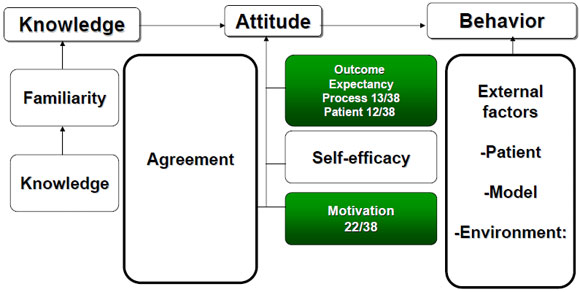
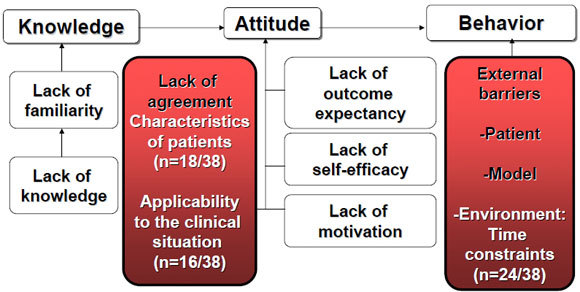
As Legare clearly points out,  however, the KAP process is far from straightforward (see also Legare and Zhang, 2013). 

[Click Below for Illustrative Images of the KAP Process: 
1. France Legare's Graphic Presentation of Facilitators in the KAP Process   
2. France Legare's Graphic Presentation of Barriers to the KAP Process. Text Source: France Legare]

Whatever the end-product of training -- preferably delivered by an accredited institution or organization -- some form of certification by an acknowledged authority is of vital importance to the skill 'holder'. Simply put, the certification or credential deflects pressure on the holder to prove, "a zillion times" after training, that he or she actually underwent the training that he/she verbally claims. Certificates or credentials are papers; papers which 'speak' with authority, on behalf of the holder, to such authorities as the holder may want them to speak to. 

Not only do credentials validate or authenticate, depending on the credibility or reputation of the issuer, they also universalize the holder's skills. They validate by linking back to the issuers' accounts of the process(es) by which the underlying skill(s) were acquired and by whom, where and when. They universalize in the sense that they are the 'passport' which allows passage into and between labour markets, as well as participation in such markets.  


1 See J.M.E. Moravcsik, Editor (1948) Aristotle: A Collection of Critical Essays. London: MacMillan


REFERENCES

Acock, Alan and M.L. DeFleur (1972) "A Configurational Approach to Contingent Consistency in the Attitude-Behaviour  Relationship." American Sociological Review. Vol. 37, pp. 714-726, 1972.

Akers, Ronald L., Marvin D. Krohn, Lonn Lanza-Kaduce and Marcia Radosevich. 1979. " Social Learning and Deviant Behavior: A Specific Test of a General Theory," pp. 636-655, in American Sociological Review. 1979. Vol.  44.           

Andrews, Kenneth and Denise Kandel (1979) "Attitude and Behaviour: A Specification of the Contingent Consistency Hypothesis." American Sociological Review. Vol. 44 (1979),  pp. 298-310)

Armstrong, Armstrong, Michael. 1999. A Handbook of Human Resource Management Practice. 7th Edition. London and Philadelphia: Kogan Page. 

Armstrong, Armstrong, Michael. 2012. A Handbook of Human Resource Management Practice. 12th Edition. London and Philadelphia: Kogan Page

ASIS. 1994. Emergency Planning Handbook. ASIS (American Society for Industrial Security)

Chien-Yun, Dai et al (2012) “A Study on Modification of Knowledge, Attitude and Practices on Vocational High School Electronics Courses Integrated with 
Nanotechnology Concept”
http://www.iasks.org/sites/default/files/ijtee20120401073079.pdf

Clelland, John (1973) “A Critique of KAP Studies and Some Suggestions for Their Improvement,” in Studies in FamilyPlanning. Vol 4, No. 2 (Feb, 1973): 42-47.

Cole, G.A (1995) Organizational Behaviour: Theory and Practice. London: Thomson Learning

Cole,G.A. (1997) PersonnelManagement: Theory and Practice. London: Letts Educational.

Cole, G.A. 2002. Personnel and Human Resource Management. Fifth Edition. London: ELST with Continuum

Dessler, Gary (2000) Human Resource Management. Delhi: Pearson Education Asia

Gersovitz, Mark et al (1998) “The Balance of Self-Reported Heterosexual Activity in KAP Surveys and the Aids Epidemic in Africa” Journal of the American Statistical Association. Vol 93, Issue 443, pp. 875-883   

Graham and Bennett Graham, H.T. and Roger Bennet. 1998. Human Resources Management. 9th Edition. London: Financial Times Pitman Publishing. [See pp. 301-304 for knowledge training, pp. 294-295 for attitude training, and pp. 296-299 for skill training]

Habermas, Jurgen (1972 ) Knowledge and Human Interest. Boston: Beacon Press 

Johnson (1976) "Organization and Management Training", pp. 2.1-2.17, in Robert L. Craig, Ed.  (1976) Training and Development Handbook: A Guide to Human Resource Development. New York: McGraw-Hill

Legare, France and Peng Zhang (2013) "Barriers and Facilitators -- Strategies for Identification and Measurement", section 3.4.a. in Sharon Straus, Jacqueline Tetroe and Ian Graham, Eds. Knowledge Translation in Health Care: Moving From Evidence to Practice. Hoboken, NJ: Wiley Blackwell. [Click here for online access to the slides version of the book]

Miller, Vincent A. 1996. “The History of Training”, pp. 3-18, in Robert L. Craig, Ed-in-Chief. 1996. The ASTD Training and Development Handbook. Fourth Edition. New York: McGraw-Hill.  http://www.amazon.com/The-ASTD-Training-Development-Handbook/dp/007013359X 

Moravcsik, J.M.E., Editor (1948) Aristotle: A Collection of Critical Essays. London: MacMillan

Needham, Joseph (1959) Science and Civilisation in China. Vol III. Mathematics and the Sciences of the Heavens and the Earth. Cambridge: Cambridge University Press

Parsons, Talcott (1970) "An Approach to the Sociology of Knowledge", pp. 282-306, in James E. Curtis and John W. Petras, Eds. The Sociology of Knowledge: A Reader. New York: Praeger Publishers.

Pattanayak, Biswajeet and Harish C. Verma. 1997. A Textbook on Human Resource Management. New Delhi: Wheeler Publishing. 

Shaw, Marvin E. and Jack M. Wright (1967) Scales for the
Measurement of attitudes. New York: McGraw-Hill

Straus, Sharon, Jacqueline Tetroe and Ian Graham, Eds. (2013) Knowledge Translation in Health Care: Moving from Evidence to Practice. Hoboken, NJ: Wiley Blackwell [Click here for online access to the slides version of the book]

Sudsawad, P. (2007). "Knowledge Translation: Introduction to Models, Strategies, and Measures." Austin, TX: Southwest Educational Development Laboratory, National Center for the Dissemination of Disability Research.


           USAID (2011) “The KAP Survey Model (Knowledge, Attitudes, and Practices)”. Arlington, VA: USAID [Click on View Tool to download a detailed text]
    
    Webb, Thomas L, Falko F. Sniehotta and Susan Michie (2010) “Using Theories of Behaviour Change to Inform Interventions for Addictive Behaviours”   http://onlinelibrary.wiley.com


WHO (2012) Health Education, Theoretical Concepts, Effective Strategies and Core Competencies. Cairo: WHO 

Monday, November 16, 2015

Notes on Social Differentiation and Social Change

NOTES ON SOCIAL DIFFERENTIATION AND SOCIAL CHANGE
Prof. Mauri Yambo

1. Introduction: Conceptualizing Social Differentiation:
Leading scholars have sought to understand the process of differentiation in society over time, and have come up with a variety of useful conceptions and explanations. Among these scholars, whom students are called upon to read in order to likewise understand and explain (and thus to carry the baton forward), are Herbert Spencer[1] (1897)[2], Emile Durkheim (2014)[3], Max Weber (1947: 424-429)[4], Ferdinand Toennies (2001)[5], Georg Simmel, Talcott Parsons (1964: 339-357) and Niklas Luhmann (1987, 1995)[6].  All have looked at how societies evolve over time, based on the forms of complexity that arise inside them and the dissimilarities that perforce emerge among their members, driven by the inevitable pressures and contradictions of nature and nurture. I use ‘nurture’ here as an umbrella term for the multiplicity of ways in which “society, polity, economy and culture”, and even nature, affect us all – even as we, in turn, variously affect them...

CLICK Here to Access the Full Text [This text was first uploaded on November 16, 2015, and then rested. It is only today re-posted on this blog, and thus made publicly available again, It is best accessed via a laptop or PC]


[CSO 103, CSO 501, Theory]

Saturday, November 07, 2015

Universality: A Key Standard of Scientific Research

Nine key standards, or principles, of scientific research can be gleaned from texts on research method. As I see them, these are:

1. Universality
3. Control
4. Measurability
5. Validity
6. Reliability (Pending)
7. Objectivity (Pending)
8. Ethics 
9. Representativeness.

I say something about each of the nine standards in separate posts, as shown in the links above. What I want to briefly talk about here is the universality standard. 

Universality: 

The tern universality has roots in the broader conception of a pervasive universe, of which we are all inescapably a part. More specifically, it is anchored in the related notion of universals. Thus:
"Universals are features (e.g., redness or tallness) shared by many individuals, each of which is said to instantiate or exemplify the universal...The metaphysical issue is whether or not these features exist independently of the particular things that have them:  realists hold that they do; nominalists hold that they do not; conceptualists hold that they do so only mentally"(A Dictionary of Philosophical terms, in Garth Kemerling (2011) The Philosophy Pages. available online).
Thus, moreover, "evolutionary universals", as Talcott Parsons argues, are those similitudes, those patterns of resemblance, which scholarship detects -- recognizes -- in the evolution of human society.

Armstrong (1986, 1989) understands that universals do have particulars, the very constituents or components which make universals possible in the first place. Moreover, the particulars of any one universal resemble one another. As resembling constituents of universals multiply within and across universals, what we end up with is identity, which, to repeat, is borne out of resemblance, and which in the end it morphs out of. And so, one can see, universals are made of common particulars.Thus:
"If we consider ordinary, first-order, particulars, then . . . two things, while remaining two, can resemble exactly. At least exact resemblance is possible (assuming that the Identity of Indiscernibles is not a necessary truth). In the limit, resemblance of particulars does not give identity. But now consider the resemblance of universals. As resemblance of properties [monadic universals] gets closer and closer, we arrive in the limit at identity. Two become one. This suggests that as resemblance gets closer, more and more constituents of the resembling properties are identical, until all the constituents are identical and we have identity rather than resemblance." [This quote is from Armstrung (1989) as found in Pautz (1977). The original article is yet to be accessed]  
So universality is ultimately "standardized" via the metamorphosis of its resembling parts into a more holistic identity recognized by the, or at the very least a, scientific community. The universality standard requires that any research project should be designed and planned in such a way that any competent researcher, not just the one(s) who wrote the proposal,  should be able to successfully undertake it. (Leedy, 1980: 46). In this sense, the research project has a life of its own, independent of any particular researcher, within the confines of the relevant discipline or scientific community.

Universality demands a high level of discipline and transparency in the research habits of all who do research. In a sense, too, universality makes all scientific discoveries part of a common, with standard operating procedures and the common ownership of the discoveries claimed and accumulated across geographies, disciplines and time.

READ: Universal (metaphysics)

ALSO READ: Professor JeeLou Lin "D.M. Armstrong, Universals: An Opinionated Introduction"


To partially sum it all up, let's see in this quotation how the International Council for Science (ICSU) defines the universality of Science:
"The universality of science in its broadest sense is about developing a truly global scientific community on the basis of equity and non-discrimination. It is also about ensuring that science is trusted and valued by societies across the world. As such, it incorporates issues related to the conduct of science; capacity building; science education and literacy; access to data and information and the relationship between science and society..." (see ICSU)
Furthermore, a noteworthy point -- on the importance of doubt and criticism (including self-criticism) in all claims to, or efforts to affirm, scientific discovery -- is made by Michel Paty (2001: 8) who, inspired by Descartes's Discourse on Method, argues that:
"...the idea of of universality, as well as ideas of reason and of demonstrative (and even objective) science, with which it has a constitutive link, carries with it the requirement of its own criticism...[Thus]... the only true knowledge is that knowledge that, for every thinking subject, overcomes the obstacles [posed] by doubt."

REFERENCES:
Armstrong, D.M. (1986) "In Defense of Structural Universals", Australasian Journal of Philosophy 64 (1986) pp. 85-88.

Leedy, Paul D. (1980) Practical Research: Planning and Design. Second Edition. New York:  Macmillan Publishing Co.,


Parsons, Talcott (1964) "Evolutionary Universals in Society" American Sociological Review, Vol. 29, Issue 3 (June, 1964), pp. 339-357


Paty, Michel (2001). "Universality of Science : Historical Validation of a Philosophical Idea." in Habib, S. Irfan and Raina, Dhruv. Situating the history of science : Dialogues with Joseph Needham, Oxford India Paperbacks, p. 303-324, 2001.  [see p. 7 of the pdf version given in this link]

Pautz, Adam (1977) "An Argument Against Armstrong's Analysis of the resemblance of Universals"


~~~~~~~~~~~~~~~~~~~~~~~~~~~~~~~~~~~
CSO 302

Tuesday, September 17, 2013

On the Foundations and Evolution of Research Method and Knowledge-Creation ~ CSO 302, CSO 501, CSO 589

(Or The Origins of the Methods by which we Acquire the Knowledge of what we Know)

By Mauri Yambo

[Note: What follows is an excerpt of a much longer manuscript] 

There are, throughout history, essentially four foundations – four origins –of the methods by which humans have acquired knowledge of what they know – or believe they know. Let us first mention them, and then briefly interrogate their historical connections. The four foundations are:

1.     Naturalistic/Ontological/Existential
2.     Theological (Religio-Cultural Belief Systems)
3.     Metaphysical/Philosophical/Speculative
4.     Positivist/Scientific.
Anchored on three of these foundations are what one may call the Holy Grails of scientific knowledge generation (the fourth foundation, the theological, is excluded on rationalistic grounds):
From ‘mainstream’ Philosophy:
i.                 Deductive and Inductive Reason/Methods
ii.               Dialectics
iii.             Rationalism/Reason.
From Marx: Materialistic Conception of History (or Dialectical Materialism).
From Positivist (or Social) Philosophy and Natural Science: Positivism-cum-Empiricism -- that is, the Scientific Method.
What is the basis of the four classes of origins listed above? It is, certainly for us in Sociology, the helping hand of Auguste Comte (1798-1857). There must be other routes back to the same origins, of course. Talcott Parsons (1902-1979)[1], for example, has more recently interrogated the evolutionary universals presumably characteristic of all societies, but more on this a little later. And Comte himself owed a great debt of scholastic gratitude to his precursors in the natural sciences – particularly physics.

Widely known as a/the founding father of Sociology, Comte developed a Law of Three Stages. This Law stated that all knowledge, all scientific disciplines, societies as a whole, and even the individual mind, pass through three immutable stages as they grow from infancy to maturity, namely: Theological, Metaphysical and Positivistic. Rather obliquely, the law suggests one more thing: that the three stages also track the dialectical progression of method as we know it generically to-day. But the law ignores the first of the four stages that I have listed above. This is something the more ‘evolutionist’ Parsons is in principle not guilty of, in view of his emphasis on continuities between modern humans and the ancestors of the homo-sapiens family. That evolutionary connect is sufficient for present purposes to posit the first stage which Comte did not see, but which materialist Marx was all too aware of: the naturalistic/ontological/existential stage.

We can add this, however: if dialectics be the template for the evolution of method, and for what Foucault termed “The Order of Things”, then, contrary and superior to Comte’s arrangement, ontology is the antithesis of nothingness, and theology the synthetic result. Ontology thus predates theology, and is the first foundation of knowledge and method Theology is then followed by the metaphysical stage, and the metaphysical by the positivistic. Thus, there are not three stages/foundations in the development of method, but four.

Parsons’ notion of evolutionary universals suggests that societies evolve through a fairly consistent pattern of stages marked by distinct sets of universals. The first set – which, following his own reasoning, I have rearranged in terms of dialectical priority of emergence as: kinship, technology, communication (through language) and religion – is consistent with the notion, already touched on, that ontology precedes theology. This is particularly so when we consider the likelihood of a considerable time/“cultural” lag between the last two. Doesn't Aristotle’s ontology, too, portray being qua being as precedent to spiritual life?

  1. Naturalistic/Ontological/Existential Foundations:
Naturalistic or ontological or existential foundations of research method, and of knowledge, evoke the circumstances of that earliest period of human existence when all that could be known was known, and all the data that could be gathered was gathered, only (and only directly) through the senses – because nature gave no other options, and the technology with which to extend the reach of the senses was still in the unimagined future. In view of how human nature and culture were to evolve in the millennia that followed, it was truly a paleo-empirical world -- in which the sense of sight, “the gaze”, was already sovereign (to repeat Foucault’s emphasis). As Parsons (1964: 340) has imagined, “Vision, whatever its mechanisms, seems to be a genuine prerequisite of all the higher levels of organic evolution.” However, the other senses were also crucial to evolution, and most probably helped to trigger the language gene[2]’[3].

We can extend the commentary a little more, to say this. Philosophy did not create the reality of things which ontology speaks to. It merely gave it a name with, the wisdom of empirical hindsight The ontological basis of method – and the ontological content of human knowledge – were both, in the beginning, weaved out of truly elemental, down-to-earth, presences, dispositions and ‘acts’ of disparate individuals and groups, along the following lines:
 
1.1.Observing (‘Sense Perception’)
At the start, reality – nature, people, made-up-things, stumbled-upon things, things seen, things heard, things touched, things tasted, and things smelt (before anyone could “smell a rat”) – was and could be ‘apprehended’ only because, and insofar as, it was and could be seen, heard, touched, tasted and/or smelt – with the ‘naked’ sense-organ. It could be ‘apprehended’ because it could be observed – naturalistically. But such ‘apprehending’ was without doubt little more than intuitive, instinctive and sub-conscious in the beginning. Yet that was a vital start. It took a substantial while for the apprehension to evolve a narrative structure (that is, form and content), and for the narrative to become, in the language and the thought-process in which it was couched, coherent. [Marx and Engels (2000: 3) couch this ontological imperative of the human condition in terms of "The first premises of all history" and the "first fact"]

So what we now call ‘naturalistic observation’ is clearly the front-runner and pathfinder among the observational methods which humans have used throughout the ages to gain knowledge. It has evolved variants such as astronomy, participant observation (or ethnography), surveillance, monitoring (including CCTV monitoring), surveying and “intelligence”.

1.2.Doing
Observing could go, and typically went, hand-in-hand with doing. One could observe the doing – on the go. And one could likewise do what one observed in another’s or others’ doings. Those tentative, prehistoric acts were the precursors of practices and habits and experimentation – as well as the ancestors of the habits, customs, cultures, professions and disciplines – that have made the motley world what it has become. Doings are the building-blocks of culture and social structure. Ontologies, doings and happenings are thus the starting points of all our narratives, all our hermeneutic postures, and all history.

1.3.Experiencing (Feeling)
Experience is, at root, existential. We experience states of being and emotional states , happenings and doings, which we or others come to narrate in whatever way for immediate purposes, and sometimes for deep posterity – which will thus know us but which we will really never know. Feeling happy, sick, angry, fearful/afraid, safe, good – these are emotions and conditions we are driven to take stock of, observing clumsily or with varying degrees of clarity, depth, understanding, and even eloquence. Experiencing pain, grief, defeat, victory – and breakthrough – is all ingrained in the human condition, which we try to make sense of and articulate lessons from.


1.4.Telling
Telling is a re-enactment or codification in narrative form of that which we or others have observed, done and/or experienced. It is thus the summation, of sorts, of all of ontology’s four manifestations, including itself, and of all that ontology means and makes possible. Often, we interrogate in order to narrate, and do tell (and thus affirm) by way of an interrogation. A good telling is a “closing of the loop”, and a hard thing to do. Fast-forward and you realize that, in a sense, ethnomethodology is a wonderful kind of telling. So is thick description. So is mythology and poetry and drama and the novel. History is a telling, in its dialectical as well as chronological renditions and traditions. The epic and all the sagas of the world are a telling. Music and painting are a telling, and so is sculpture. Monuments are a telling, too. And thus all stories are by definition already told. 
2. ‘Theological’ Foundations

When was the theological stage predominate? From the moment in antiquity that the memes of the maker (of things out of ontological things) and the creator (of Being out of Nothingness, if I may rephrase Marcuse) entered and sufficiently seized the human mind, all the way up to the Age of Reason (the Enlightenment Age) in the 16th to 18th Centuries. This brief answer adds to the overall weight of evidence which, as earlier indicated, shows that Comte’s Law of Three Stages did not capture the sequence of stages of interest as discretely (or correctly) as it so emphatically suggested. In other words, his three ‘stages’ displayed, and continue to display, considerable and even overwhelming temporal overlaps – and sequence distortions. ‘Theology’, or more correctly religion, did emerge prior to philosophy, but has had a long history of co-presence, and a rich symbiotic relationship, with philosophy. It has not ceased to be, even in the positivistic stage. So it is safer to see the stages as more-or-less localized periods of dominance, even though the term dominance can itself be disputed on certain persuasive grounds.

The crucial point here is this: During a very long period of human existence, the template or prism through which humans observed, interpreted and explained their experiences in the world was theological. That is to say, God (and the gods) were the ultimate causality – the necessary and sufficient source of all happenings (as well as all causes and all effects), and the anchor of all explanations and all unquestionable beliefs.  The dominant world-view was dogmatic. Over time, however, contrarian narratives and reason emerged, fuelled by the desire for a more persuasive truth – a desire born in part at least by accumulating contradiction between ontology or experience and the body of knowledge that one was called upon to believe unquestioningly.


3.Philosophical/Metaphysical Foundations
This stage overlapped in at least two phases with the Theological Stage. The first phase represents the age of the great Greek philosophers and their successors – from around 470 BC to 322 BC – which found itself implanted in a still overwhelmingly religious, Delphi-leaning,  epoch . Thus:
n  Socrates: 470-399 BC
n  Plato: 428/6-348/7 BC
n  Aristotle: 384-322 BC.

The second phase – the Age of Reason or The Enlightenment – ran from the 16th Century to the 18th. This was the age of Rousseau, Voltaire, Hegel and their contemporaries. It was the age of the French Revolution. Religion might have already begun to cede ground, in a very palpable way, to Reason, but could not be shaken off.

Leedy (1980: 41), who is by no means a giant in the field, makes the memorable observation that:
“In all of mankind’s long history, we have devised only two ways to seek the unknowable [I prefer to say, “the unknown”]. One of these is by means of deductive logic, the other is by means of inductive reasoning, or what is familiarly called the scientific method.” [Here is an excerpt of the 1974 edition of Leedy's book]

Only two ways! All of humankind! That is the kind of remark which, if taken at face value or uncritically, appears like a great revelation. But the truth is that the two ways that Leedy has in mind are only the classical philosopher’s; and we will see momentarily that the Deduction-Induction twins just may have a distant relative – that is, Abduction – representing a third way.

Rottenberg (1994: 207)[4] credits Aristotle with being “the first” to give “formal expression” through his treatises (some 2,500 years ago) to the process by which humans reason – that is, the “reasoning process.” Aristotle, she notes , suggested that there were two types of reasoning – inductive and deductive. We use these two types of reasoning as the alternative ways to discover Truth. In other words, we use them to observe the world, select impressions, make inferences and generalize (see Rottenberg, 1994: 207). But Aristotle was aware that neither of these two approaches was error-free. At certain stages in the “reasoning process,” we are prone to error.

Deductive (Aristotelian) Logic:  

Here are some definitions to clarify the deductive method:

Deduction = “The principle [procedure] of reasoning from general principles to particular instances” (Theodorson and Theodorson, p. 104). [In deductive reasoning, “specific hypotheses or predictions are derived from broader theoretical principles” T & T, ibid). [This happens a lot, as is to be expected, in literature review; especially the review of theoretical literature]

Deductive Reasoning = Reasoning by deducing, or inference from general to particular; a priori reasoning (see Oxford Dictionary, 1964). [A priori = self-evident, unfettered by the rule of empirical proof]

Deductive Learning: “commences with the rule or principle (theory) which is subsequently applied by the learner” (Cole, 1997: 266); or “where the individual works forward from some hypothesis or other, tests it in practice and obtains results – new experiences” (Cole, 1995: 143).

Deductive Argument = “A deductive argument proceeds from a general statement that the writer assumes to be true to a conclusion that is more specific” (Rottenberg, 1994: 219). [Rottenberg (1994: 212) believes, moreover, that unlike induction which “attempts to arrive at the truth, deduction guarantees sound relationships between statements...called premises.”]

Deduction (Ghosh, 1985: 47) = “the process of drawing generalisation, through a process of reasoning on the basis of certain assumptions which are self-evident or based on observation. In deduction, we deduce generalisations from universal to particular...The main task of deductive logic is to clarify the nature of [the] relation between premises and conclusions in valid arguments.”

The deductive approach is said to have been dominant up to the time of Renaissance. Leedy (1980: 41), for example, notes that “Up to the time of the Renaissance, insight into most problems was sought by means of deductive logic...It relied upon logical reasoning and began with a major premise. This was a statement, similar to an axiom, which seemed to be a self-evident and universally truth: Man is mortal; God is good; the earth is flat.” But the danger is that this major premise may be a “pre-conceived idea” or “preconceived conclusion” (Leedy, 1980: 42) – a ‘dogmatic’ statement – which does not turn out to be true (or grounded) in fact, in which case the conclusions arrived at will be invalid (see Leedy, 1980: 41).

In its simplest form, a deductive argument [a syllogism] has three parts: A major premise, a minor premise and a conclusion. Where each premise is true, then “the conclusion must be true. Unlike the conclusions from induction, which are only probable, the conclusions from deduction are certain” (Rottenberg, 1994: 212). [SYLLOGISM = “a formula of argument consisting of three propositions”: the major premise, the minor premise and the conclusion (see Rottenberg, 1994:213, quoting a dictionary)]

Remember: such a deductive conclusion is deemed to be “certain.” It is considered to be “valid” – that is, to derive from a valid “reasoning process” or a valid form of argument. It is “logically consistent because it follows necessarily from the premises. No other conclusion is possible” (Rottenberg, 1994: 212). However, a form of argument may be valid but the “argument itself” may not satisfy [and will not be indisputable] “if the premises are not true” (Rottenberg, 1994: 212). Thus, “The deductive argument is only as strong as its premises” (Rottenberg, 1994: 213).

Ghosh (1985) had earlier made a similar argument, as follows: The logical validity (“implication”) of an argument “does not depend upon the material [i.e. factual] truth of the premises. The premises may be materially false, but yet the reasoning may be correct” (Ghosh, 1985: 47). [For example (adapted from Ghosh (1985: 48): Democracies have no kings or queens. Britain is a democracy. Therefore, Britain has no king or queen]. However, the truthfulness/validity of a conclusion depends on the “material truth of the premises.”

Inductive Reasoning:

Here, once again, are useful definitions:

Induction = “a process of reasoning whereby we arrive at universal generalisations from particular facts. Induction gives rise to empirical generalisations, and is opposite to deduction. Induction involves a passage from observed to unobserved. Induction involves two processes – observation and generalisation” (Ghosh, 1985: 48).

Induction = “the form of reasoning in which we come to conclusions about the whole on the basis of observations of particular instances” (Rottenberg, 1994: 208). Rottenberg (1994: 211) adds that “An inductive argument proceeds by examining particulars and arriving at a generalization that represents a probable truth.” Moreover, in inductive reasoning, “the reliability of your conclusion depends on the quantity and quality of your observations (Rottenberg, 1994: 208).

Induction = “the process of reasoning from individual instances to general principles” (Theodorson and Theodorson, Dictionary of Sociology, p.199). That is to say, induction means generalization from specific facts; from individual occurrences to general cases. Thus, the experimental method is inductive, since general conclusions derive from individual observations (p. 199). Indeed, T & T observe that “Most sociological studies are” inductive in orientation (p. 200). [But remember that sociological methodology insists that, for such generalizations to hold (to be valid), the sample of individual cases to which empirical attention is paid during both data collection and analysis must be representative (that is, as a totality, a microcosm) of the ‘general cases’ (that is, the population or ‘parameters’ to which the sample refers). One seeks to ensure this at the sampling stage]

Inductive Learning:“the process in which the learner experiences an event or stimulus and draws a conclusion from it, for example some rule or guiding principle” (Cole, 1997: 266); or “where the individual experiences an event, attempts to puzzle it out, and then draws conclusions about it, perhaps in terms of a guiding rule or principle” (Cole, 1995: 142-3).


Abductive Reasoning/Method:

In his Collected Papers, Charles Peirce (1934/1935: 106), who coined the term, defines abduction as "the process of forming an explanatory hypothesis" and adds, importantly, that "every single item of scientific theory which stands established today has been due to abduction." Much has since been written about abduction, which is nowadays commonly characterized as "inference to the best explanation."

For three useful readings on abduction, and its wide application-potential as well as nearness to induction, click on these links:
1. Douven, Igor, "Abduction", The Stanford Encyclopedia of Philosophy (Spring 2011 Edition)
2. Thagard. Paul and Cameron Shelley (1997) "Abductive Reasoning: Logic, visual thinking and coherence"
3. Anonymous Author Wikipedia, A characterization of abduction that I find to be close to Anonymous Author's is to be found in the 'preliminary version' of Hector J. Levesque's article titled "A Knowledge-level account of abduction".

Douven’s (2011) definition of abduction is hard to pin down in a quick quote, but the illustrations in his “General Idea” do clarify the abductive process for those just coming upon the concept. 

Thagard and Shelley (1997), in their densely-argued and well-referenced article, define abductive reasoning as "reasoning in which explanatory hypotheses are formed and evaluated." At the heart of abductive reasoning, they argue, "is the goal of assembling a set of hypotheses (causes) that provide good explanations of the data (effects)." Viewing abductive reasoning that way, they see its applicability in many "important kinds of intellectual tasks, including medical diagnosis, fault diagnosis, scientific discovery, legal reasoning, and natural language understanding." 

According to an Anonymous Author in the Wikipedia link above, abduction is “a form of logical inference that goes from observation to a hypothesis that accounts for the reliable data (observation) and seeks to explain relevant evidence.” On the other hand, abductive reasoning is seen to have the quality of a logical fallacy – the fallacy of attributing an effect (which may be there for all to see) to one’s preferred cause, which not everyone may accept as true, or which may be countervailed by more robust explanations for the “effect” observed by all. Thus, abduction:

“allows inferring a as an explanation of b. Because of this inference, abduction allows the precondition a to be abduced from the consequence b. Deductive reasoning and abductive reasoning thus differ in the direction in which a rule like ‘a entails b’ is used for inference. As such, abduction is formally equivalent to the logical fallacy of affirming the consequent (or Post hoc ergo propter hoc) because of multiple possible explanations for b” (Anonymous Author, Wikipedia)

According to Business Dictionary, abduction is “The type of reasoning whereby one seeks to explain relevant evidence by beginning with some commonly well known facts that are already accepted and then working towards an explanation.” 

In sum, abductive reasoning is the kind of logic which tends to yield a backward-looking conclusion (about the cause of an effect) that is – more often than not, perhaps – not necessarily true or valid [Instead of backward-looking, Shanahan (I have just noted) uses the term "backwards projection (explanation)"]. But abduction often makes valid inferences as well, just as weather forecasting aka predictive deduction does. In weather forecasting, next fortnight’s actual weather may be predicted (explained?) – a prediction/ explanation which turns out to be more or less accurate – on the basis of a juxtaposition of elements of the looming (“over the horizon”) weather on past patterns or trends recorded in a ‘big’ database (which is typically not accessible or explained to the general public), and inferring (or finding) a match[5]. Q: When you predict the weather, are you engaged in explanation or simply deduction?

There is evidently both good and bad abduction, as Charles Sanders Peirce suggested. Good abduction is uncertainty-reducing, for sure. Bad abduction may be the source of much anguish, as we have consistently seen in the Kenyan and US political arenas in both 2012 and 2013. The challenge is how to consistently avoid bad abduction in lay and scientific conversations.


4.Positivistic Foundations of Method:

The Positivistic era had its roots in the Copernican Revolution of the 16th century, deep inside the metaphysical stage, which in principle preceded it. Like the Copernican Revolution itself, Positivism took some 2 to 3 centuries to take hold; that is, up to the early 19th century.

Before the 19th century, the process by which humans discovered knowledge/truth was, generally, dominated by religious and cultural dogma – and by DEDUCTIVE reasoning. The dogma tended to invalidate the DEDUCTION, but not so, conceivably, among the Bushmen (Kung) of the Kalahari. In the 19th century, positivism emerged as a key aspect of social philosophy and social theory (Giddens, 1976)[6].

Let us return briefly to what we were saying about inductive reason, in order to underscore in this section its connections with positivism and science.

Inductive Reasoning “begins, not with a preconceived conclusion – a major premise – but
with an observation” (Leedy, 1980: 42). He (1980: 42) adds that “Renaissance man began
seeking truth by looking steadfastly at the world around him. He started asking questions of
Nature. And Nature responded in the form of observable fact.”

In other words, as Leedy (1980: 42) suggests, the intellectual appeal of inductive reasoning during the Renaissance period was fuelled by “an interest in humanism” and by a pragmatic or empiricist orientation toward “this world and ... its phenomena” – both of which were characteristic of that period. Thus:
:
“Renaissance man soon found that when facts are assembled and studied dispassionately, they frequently suggest hitherto undiscovered truth. Thus, was the scientific method born; and the words mean literally ‘the method that searches after knowledge’ (scienta = L. knowledge, from scire, L. to know)” (Leedy, 1980: 42)

This scientific method (and methodology) underwent considerable development in the 16th century as a result of the work of a number of scholars/thinkers, including: Leonardo, Copernicus, Galileo, Vesalius and Vittorino da Feltre (Leedy, 1980: 42).

Back to positivism:

By positivism Giddens understands:

1.         The view that all knowledge derives from, or pertains to, a reality which we can apprehend or confirm [ontologically] only through the senses [of touch, sight, hearing, smell and taste].
2.         The view that the methods and logic of science, as exemplified by "classical physics", are equally applicable to the study of human society (Giddens, 1976: 130).

Giddens further notes that:
"In the writings of Comte [1798-1857] and Marx [1818-1883] alike, the science of social life was to complete the freeing of the human spirit from religious dogmas and the customary, unexamined beliefs men had about themselves" (Giddens, 1976: 130).

Thus, Western science differs from most types of religious and magical practices [or even lay epistemologies] in the following three ways, among others [But one may pose a 'counter-question': Is Western science a homogeneous worldview characteristic of the entire West? If so, what are its key characteristics? If not, in what specific ways do given non-western cosmologies differ from leading or specific versions or traditions of Western science?]:
1.         Science treats observed phenomena in 'nature' as the manifestations ('outcome') of impersonal forces -- not the "personalized gods, spirits or demons" characteristic of "most" non-western religious and magical systems (Giddens, 1976: 139).
2.         Science institutionalizes the process by which theory is formulated and scientific observations conducted; and, moreover, makes a "public display" of the whole process. That is to say, scientific work is, ideally, legitimated through "free debate and critical testing" (Giddens, 1976: 139). This legitimating characteristic of science (at the core of which is critical, public scrutiny) is lacking in most religious doctrines, argues Giddens (1976: 139).
3.         Science does not involve, as religion and magic often do, “...forms of activity that are alien to western science: including worship in regularized ceremonial, propitiation and sacrifice” (Giddens, 1976: 139)[7].

But Giddens recounts how, following the erosion (in the early 20th century) of faith in scientific knowledge “as exemplar of all knowledge,” there emerged two contesting philosophical camps[8] in the 1920s and 1930s: [1] the logical positivists, who championed the cause of natural science (“scientific rationalism,” scientific knowledge); and [2] the phenomenological and linguistic philosophers who saw natural science's “claims to knowledge [as] secondary to, and dependent upon, ontological premises of the natural attitude” (Giddens' words, emphasis MY's) [Natural attitude = "authority of common sense", ibid].  Anthropologists were at the forefront of this change, touting the merits of the natural attitude. A natural attitude toward knowledge, it was argued, was the most important way to uncover the truth.

It can be argued, then, that the tilt (or re-tilt) toward the natural attitude, which is the bedrock of Qualitative Research Methodology, was the result of a SWOT analysis of the scientific attitude (or “scientific rationalism”) – with its quantitative orientation.

Around the same time as this theoretical debate was going on, moreover, the practice of qualitative research was in vogue in the United States (see, for example, W.I. Thomas and Florian Znaniecki The Polish Peasant in America and Europe). [For a vey recent (2008) example of qualitative analysis, see Malcolm Gladwell’s account (in Outliers) of an Italian community in early 20th century Pennsylvania, USA: It is an account of how the community’s health profile was documented (see “The Roseto Mystery”, pp. 3.12). 

So, one Rationality or Many Rationalities?
[The ‘rationality of science’ (or the ‘scientific attitude’) versus the ‘rationality of
commonsense’ (or the ‘natural attitude’)]

The ‘Rationality of Science’ (or of the ‘Scientific Attitude’): One Rationality
This is the perspective adopted in Weber's study of rational action, which suggests that there is but one standard of rationality. It uses specific means-ends criteria – such as the operational definition of concepts, the representativeness of cases/samples, universality and generalizability of claims – to explain social phenomena. And it explains motivated action using the observer's criteria, and, contrary to the lay actor’s approach to observed reality, entails “the suspension of the belief that things are as they appear” (Giddens, 1976: 35).

The ‘Rationality of Commonsense’ (the ‘Natural Attitude’): Many Rationalities
According to Garfinkel, and Giddens, there are many common-sense rationalities which pertain to the daily rhythm of lay life – as opposed to the demands of social science (Giddens, 1976: 35-36). Reality is socially constructed, as Berger and Luckman suggested.

The concept and practice of ethnomethodology are undergirded by the view that, to paraphrase Giddens (1976: 36), the way that people organize and live their everyday lives is identical to the way that they understand and explain their life experiences; that is, identical to the procedures that they use to explain to themselves and even to others what they see and experience.

Consequently, the differences between Sociology and Natural Science can be highlighted as follows, as suggested by Giddens (1976: 146):
1.         Sociology uses the inductive conclusion with more tact, greater laterality of vision and thinking, as well as the acknowledgment of precursors, unlike natural science which relies entirely on narrowly defined reason
2.         Unlike natural science, Sociology “stands in a subject-subject relation to its ‘field of study,’not a subject-object relation”
3.         Sociology, adopting ethnomethodology’s stance, strives to understand and interpret a world that is already “pre-interpreted… by active subjects … [whose pre-interpretations feature materially in the] …the actual constitution or production of that world”]
4.         Social theory construction, like the general apprehension of social reality “involves a double hermeneutic”[9] – which is not seen in other disciplines (Giddens, 1976: 146).
5.         Sociological generalizations are by definition more nuanced and at great variance with the laws of natural science.


[4] Annette T. Rottenberg (1994) Elements of Argument: A Text and Reader. Fourth Edition. Boston: Bedford Books of St. Martin’s Press.
[5] This sounds like a tautology!
[6] Anthony Giddens. 1976. New Rules of Sociological Method: A Positive Critique of Interpretative Sociologies. London: Hutchinson.
[7] For a detailed discussion of the differences between science and religion/magic see Horton, Robert and Ruth Finnegan. 1973. Modes of Thought. London: Faber.
[8] The two camps have been likewise labeled by Giddens as: The Rationality of Science v. the Rationality of Common Sense
[9] Double Hermeneutic = Double Interpretation. In Double Interpretation, the Observer interprets the words/behavior/actions of the Observed/Respondent, who likewise interprets the Observer’s “seduction” [MY] – and so on.